By Godfrey Onyilo Onmoke
When a Government Offers Temporary Relief for a Crisis It Helped Deepen
There is something profoundly disturbing about a government announcing a 30-day measure to cushion Nigerians against rising petrol prices while millions of its citizens are struggling to afford food, transportation, electricity, housing, health care and the basic necessities of life. The announcement may be presented as an act of compassion, economic prudence or responsible leadership. Yet, to the Nigerian who has watched the purchasing power of his income deteriorate over the past three years, the more pressing question is this: How did survival become so expensive in a country endowed with enormous natural resources, fertile agricultural land, a vast human population and substantial oil wealth?
On 9 October 2026, the Federal Government announced that the Nigerian National Petroleum Company Limited would forgo its petrol retail profit margin for 30 days, selling petrol at cost in an effort to cushion consumers against the effects of rising international oil prices. Other measures were also announced, including plans for a strategic fuel reserve and possible tax relief for low-income earners under the 2027 Finance Bill. The government maintained that these interventions would provide relief without restoring a blanket fuel subsidy.
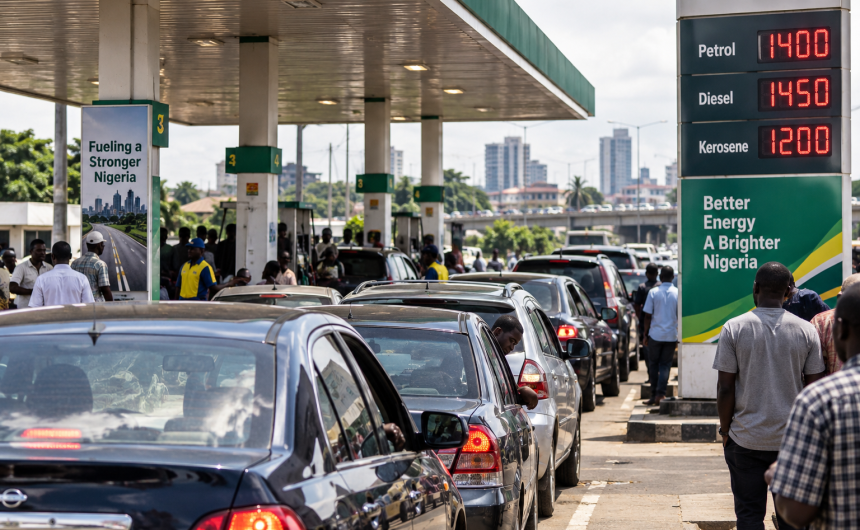
The announcement followed renewed increases in petrol prices, which had reached approximately ₦1,400 per litre in Lagos and Abuja in September, with even higher prices reported in parts of northern Nigeria. The resulting pressure on transport, food distribution and household budgets has revived public anger over the consequences of the subsidy removal announced by President Bola Ahmed Tinubu in May 2023.
Let us acknowledge the immediate value of the latest intervention. If a public corporation sacrifices its retail margin to make petrol cheaper, households and commercial transport operators may benefit. Every naira saved by a struggling family can make a difference.
However, a 30-day intervention is not an economic recovery programme. It is a temporary response to an enduring problem.
A worker whose salary can no longer sustain his family cannot build a dependable household budget around a relief measure that expires in a month. A trader whose transportation costs have doubled cannot confidently reduce the prices of her goods simply because petrol may temporarily become cheaper. A farmer who must purchase diesel, fertiliser and other agricultural inputs needs predictable production costs, not periodic government gestures.
The central issue, therefore, is not whether the latest intervention is welcome. It is whether the government understands the depth of the crisis confronting Nigerians and whether its policies offer a credible path towards restoring their economic dignity.
The 2027 elections will provide an opportunity for citizens to assess that question.
Nigeria’s Long History of Fuel Subsidy Controversies
To understand the present crisis, we must examine Nigeria’s political and economic history. The current predicament did not begin in 2023, nor can every economic difficulty in the country be attributed exclusively to the present administration. Nigeria’s fuel subsidy controversy has evolved through successive governments, each confronting the same structural weaknesses while offering different explanations and remedies.
For decades, successive administrations maintained some form of intervention in domestic petrol pricing. The policy was intended to protect consumers from the full cost of imported petroleum products and international price fluctuations. In a country where millions depend on public transport and where road transportation dominates the movement of goods, affordable petrol acquired enormous social and political significance.
However, the arrangement developed serious weaknesses.
Nigeria became heavily dependent on imported refined petroleum products despite possessing substantial crude oil reserves. Domestic refineries operated below their potential for extended periods, while governments struggled with the financial burden of maintaining controlled prices. Questions about subsidy calculations, petroleum importation, smuggling, corruption and the distribution of benefits became persistent features of the national debate.
In 1986, the Babangida administration introduced the Structural Adjustment Programme, which brought market-oriented reforms, currency devaluation and changes in public expenditure. Subsequent governments also adjusted petroleum prices as part of efforts to reduce fiscal pressures.
In January 2012, President Goodluck Jonathan’s administration attempted to remove the petrol subsidy. The decision triggered nationwide protests, strikes and the Occupy Nigeria movement. Nigerians objected to the sudden increase in the price of an essential commodity at a time when wages, public services and employment opportunities were already inadequate.
The government eventually reduced the magnitude of the proposed increase following negotiations with organised labour and other stakeholders.
That episode demonstrated an enduring principle of Nigerian political economy: an economic policy cannot be judged solely by its theoretical efficiency. Its social consequences, timing, implementation and distribution of costs also determine whether citizens consider it legitimate.
The Buhari administration subsequently pursued petroleum-sector reforms and passed the Petroleum Industry Act in 2021. In 2020, petrol pricing was also liberalised in practice as the government moved away from maintaining a fixed nationwide retail price, although the broader subsidy question remained contentious.
By the time President Tinubu assumed office on 29 May 2023, the subsidy arrangement had become a major fiscal and governance issue. The announcement that the subsidy was gone was followed by a sharp increase in petrol prices and a substantial adjustment in the foreign-exchange market.
The World Bank reported in December 2023 that the reforms had raised retail petrol prices by an average of 163%, while the naira had depreciated significantly in the official market. The institution acknowledged the fiscal rationale for the reforms but emphasised the need for complementary measures to protect vulnerable households.
The lesson from this history is clear. Nigeria’s subsidy system had serious structural defects, but eliminating those defects required more than announcing the end of the subsidy. It required a credible transition towards an economy in which citizens could absorb higher energy costs without being pushed into deeper deprivation.
That transition remains the subject of intense national debate.
The Recklessness of Policy Without Adequate Social Protection
The phrase “subsidy is gone” became one of the defining political declarations of the Tinubu presidency. It communicated a determination to abandon a costly arrangement and was interpreted by investors as evidence that the government was prepared to confront longstanding fiscal problems.
But the political boldness of a declaration should never be confused with the social wisdom of its implementation.
The problem was not simply that petrol prices increased. It was that the increase interacted with other weaknesses in the Nigerian economy, including currency depreciation, inadequate public transportation, high food costs, unreliable electricity, weak purchasing power and limited social protection.
For the average Nigerian household, petrol is not an isolated consumer product. It is an input into the cost of almost everything.
When petrol becomes more expensive, commercial drivers increase fares. Transporters charge more to move food from farms to markets. Traders pass some of their additional costs to consumers. Manufacturers face higher expenses when they rely on diesel-powered generators. Small businesses struggle to maintain their profit margins, while households reduce spending on education, healthcare and other necessities.
The effect spreads through the economy.
A family that previously spent ₦100,000 monthly on essential items may discover that the same amount can no longer provide the same quantity of goods and services. The family has not necessarily become less hardworking. Its income has simply lost purchasing power.
This is where the government’s economic argument meets the reality of household survival.
A policy can improve some fiscal indicators while simultaneously making life more difficult for millions of people. Responsible economic management requires acknowledging both outcomes and developing policies that bridge the gap between macroeconomic adjustment and human welfare.
The World Bank’s analysis of the immediate consequences of subsidy removal warned that, without adequate compensation, higher petrol prices could push millions more Nigerians into poverty. Its estimates highlighted the importance of timely and well-targeted social protection.
The implication is uncomfortable but unavoidable: the government could anticipate that petrol price increases would affect transportation, food distribution and household purchasing power. Those consequences were not entirely unforeseeable.
The relevant question is whether the accompanying protective measures were sufficiently prompt, extensive, transparent and effective.
Cash transfers announced on paper do not feed a family unless the intended beneficiaries receive them. Increased allocations to state governments do not automatically reduce transport fares or food prices. Higher public revenue does not guarantee better living conditions unless the money is converted into visible public benefits.
Economic reform without effective social protection risks becoming an exercise in transferring the burden of adjustment from the state to citizens who possess the least capacity to bear it.
That is the moral and political weakness at the heart of Nigeria’s present economic debate.
The Cruel Mathematics of Household Poverty
Poverty is often discussed through percentages, economic indicators and official reports. But its most devastating consequences are experienced in the daily decisions of ordinary Nigerians.
A civil servant must choose between buying sufficient food and paying for transportation to work. A retired worker discovers that the pension or retirement benefits he expected to support him cannot comfortably meet prevailing prices. A small business owner spends an increasing proportion of revenue on electricity and transportation, leaving less money for expansion or family needs.
Parents begin to postpone medical examinations. University students struggle with accommodation and feeding costs. Young graduates remain unemployed or accept poorly paid jobs that cannot support independent living. Families increasingly rely on relatives, informal borrowing and personal sacrifice to meet basic obligations.
These are not abstract economic outcomes. They represent the erosion of the foundations upon which stable households and productive communities depend.
The World Bank’s country assessment estimated that more than 60% of Nigerians lived below the national poverty line in 2025. It also estimated that approximately 50.8%, or 123 million people, were living in extreme poverty under its cited poverty measure. The report noted that food inflation disproportionately affects poorer households because they spend a large share of their income on food.
These figures demand serious reflection.
Nigeria is an oil-producing country whose citizens should reasonably expect its natural resources to contribute to national prosperity. Yet the ordinary citizen often experiences oil wealth indirectly through government announcements rather than through dependable public services, affordable transportation, quality healthcare, secure employment and rising real income.
The contradiction becomes more painful when citizens observe the contrast between the sacrifices demanded of them and the apparent insulation of sections of the political class from the hardships being imposed on the wider population.
When public officials preach austerity to citizens while the public continues to question the cost of government, the management of public resources and the quality of service delivery, confidence in the fairness of economic reform inevitably weakens.
Citizens do not necessarily expect every public official to experience identical living conditions. They do, however, expect a government that asks them to sacrifice to demonstrate restraint, accountability and measurable results.
The Nigerian economic crisis is therefore also a crisis of trust.
The Paradox of an Oil-Rich Nation That Cannot Guarantee Affordable Energy
One of the most embarrassing contradictions in Nigeria’s economic history is the prolonged inability to translate crude oil wealth into a dependable domestic petroleum supply system that protects consumers from severe disruption.
The emergence of large-scale domestic refining capacity has raised hopes that Nigeria can reduce its dependence on imported refined products. Yet domestic refining does not automatically guarantee cheap petrol.
The price of petrol remains influenced by the cost of crude oil, exchange rates, refining and distribution expenses, financing costs, logistics and commercial pricing arrangements. Where crude oil is priced internationally or purchased at exchange-rate-sensitive prices, domestic refining alone cannot eliminate exposure to global market fluctuations.
This helps explain why petrol prices can rise even when a major refinery is operating domestically.
Reuters reported in September 2026 that rising international oil prices had renewed pressure on Nigerian fuel prices, despite the Dangote refinery operating at substantial capacity. The report highlighted the vulnerability of Nigerian consumers to international energy-market movements.
Nevertheless, this explanation cannot absolve the government of responsibility for addressing Nigeria’s structural vulnerabilities.
A country that has depended heavily on crude oil exports for decades should have developed stronger energy-security mechanisms, reliable refineries, efficient distribution networks, effective regulatory institutions and transparent petroleum-market arrangements.
The absence of these protections leaves the country vulnerable to external shocks and forces households to absorb costs that a better-prepared economy might mitigate.
The government’s newly announced strategic fuel reserve could contribute to greater stability if it is properly designed and managed. Its effectiveness, however, will depend on clear rules for releasing reserves, transparent procurement, adequate storage, independent oversight and protection against diversion or manipulation.
A reserve that exists only in policy documents will not protect consumers. A reserve managed without accountability could create new opportunities for waste.
The same scrutiny should apply to the 30-day retail-margin concession. Nigerians deserve to know how much relief it provides, which stations participate, how prices are calculated, whether the benefit reaches consumers across the country and what happens when the 30 days expire.
Temporary relief must be measurable, transparent and accessible. Otherwise, it risks becoming another government announcement whose political value exceeds its economic effect.
The Government’s Strongest Defence: Were the Reforms Necessary?
A serious critique must confront the strongest arguments made by those who support the Tinubu administration’s policies.
The government and many economists have argued that maintaining the old subsidy arrangement was fiscally unsustainable. They have pointed to the opportunity cost of subsidising petrol, the possibility of diversion and smuggling, the unequal distribution of benefits and the danger of financing recurrent expenditure through an increasingly strained public balance sheet.
These arguments deserve consideration.
A poorly administered subsidy can consume public resources that might otherwise finance schools, hospitals, roads, electricity infrastructure and social protection. Where wealthier households consume more fuel, they may receive a larger absolute benefit from a universal petrol subsidy than poorer households. A subsidy that is vulnerable to diversion may also fail to deliver its intended value to citizens.
The government’s decision to reform the arrangement therefore cannot be dismissed simply because the transition has been painful.
However, recognising the weaknesses of the old policy does not establish that every aspect of the replacement policy was properly designed or implemented.
This distinction is essential.
A government may be correct to identify a fiscal problem and still be criticised for the speed of implementation, inadequate preparation, weak compensation mechanisms or failure to protect vulnerable citizens.
The argument that the previous system was unsustainable does not answer the question of whether the resulting burden has been distributed fairly.
Nor does the argument that reforms may produce long-term benefits automatically justify every short-term hardship. Long-term benefits must be demonstrated through credible improvements in employment, real incomes, infrastructure, productivity and access to essential services.
In July 2026, Nigeria’s finance minister acknowledged that the financial gains from subsidy removal and foreign-exchange reforms had been largely offset by higher debt-servicing costs and increased government spending. That admission reinforces the need for transparent accounting of the gains and costs of reform.
If the country has accepted substantial social costs in exchange for improved public finances, citizens are entitled to ask what lasting improvements those sacrifices have purchased.
The answer cannot consist indefinitely of promises that the benefits will arrive in the future.
The burden of proof now rests on the government to show that its policies are improving the lives of Nigerians.
The Missing Link: Where Are the Tangible Benefits of Higher Government Revenues?
One of the most important developments since the subsidy removal is the increase in government revenues.
The World Bank reported in October 2026 that gross federation revenues increased by 69% in real terms between 2023 and 2025, reflecting factors that included exchange-rate reforms, subsidy removal and stronger revenue administration. It also reported that economic growth had strengthened during the first half of 2026. Nevertheless, elevated inflation continued to weigh on household purchasing power.
These findings introduce an important qualification into the national debate.
It would be inaccurate to suggest that every macroeconomic indicator has deteriorated since 2023. Some indicators have improved, and the reforms have generated fiscal and external-sector benefits.
But economic growth and increased government revenue are not synonymous with improved household welfare.
An economy may expand while many of its citizens struggle to afford essential goods. Government revenue may rise while public expenditure remains inefficient. Foreign-exchange conditions may improve while domestic businesses continue to face high financing costs, unreliable electricity and weak consumer demand.
The decisive issue is how additional public resources are used.
Have more Nigerians obtained productive employment? Have public hospitals become more accessible and dependable? Have roads and public transportation improved? Have schools become more affordable? Have farmers gained access to cheaper inputs and more reliable routes to market? Have retired workers received their legitimate entitlements promptly? Have public institutions become more transparent and accountable?
These questions should form the basis of any serious assessment of the administration’s economic record.
The Federal Government does not operate in isolation. State and local governments also receive public funds and bear substantial responsibility for service delivery. The performance of each tier should therefore be examined separately rather than assigning every failure to the presidency.
However, the Federal Government remains responsible for national economic coordination, energy policy, monetary and fiscal direction, and the creation of conditions that allow businesses and households to prosper.
It cannot claim credit for increased revenue while treating the distribution of its benefits as someone else’s responsibility.
The real test of economic reform is not how much additional money government collects. It is how effectively public institutions convert those resources into improved living conditions.
Why the 30-Day Petrol Relief May Become a Political Liability
The latest announcement could provide temporary relief, but it also creates a political dilemma for the administration.
By acknowledging that households need protection from rising petrol prices, the government recognises that the market price of fuel can impose serious hardship on citizens.
The concession also invites questions about why the government has not developed a more comprehensive and predictable mechanism for cushioning vulnerable households against energy-price shocks.
The administration’s argument is that the intervention is temporary, that the current increase is associated with global market conditions and that restoring a blanket subsidy would recreate the problems of the past.
That position is economically intelligible. It does not, however, resolve the social question.
If the relief is too small to change household spending, Nigerians may regard it as a public-relations exercise. If it is substantial enough to reduce transportation and distribution costs, citizens will ask why comparable protections cannot be sustained through more systematic measures.
If the government promises that petrol prices will stabilise after 30 days but the international market remains unfavourable, it risks creating expectations it cannot fulfil.
If prices rise again when the concession expires, the administration could face a fresh wave of criticism.
This is the political danger of temporary relief in a country experiencing prolonged economic hardship: it raises immediate expectations without necessarily resolving the conditions that created the crisis.
The government would be wiser to publish a clear account of the concession, explain how its benefits will be measured and establish a credible plan for protecting vulnerable households after the 30-day period.
Without such a plan, the intervention could become a symbol of the gap between government announcements and the everyday realities of citizens.
The Opposition’s Opportunity: Criticism Is Easy, Credible Alternatives Are Harder
The opposition parties have a legitimate opportunity to challenge the administration’s economic record. They can point to the deterioration in household purchasing power, the burden of high transportation costs, the difficulties facing small businesses and the continuing problem of widespread poverty.
They can also question whether the benefits of reform have reached ordinary Nigerians quickly enough.
However, opposition parties should not assume that public anger automatically translates into electoral victory.
Nigerians have heard competing economic promises for decades. They have witnessed governments announce ambitious poverty-reduction programmes, agricultural initiatives, employment schemes, industrialisation strategies and reforms that were subsequently weakened by poor implementation.
The public is therefore entitled to demand more than criticism of the present administration.
Any opposition party seeking power in 2027 should explain how its economic programme will work in practice.
Will it restore a universal petrol subsidy? If so, how will the government finance it without creating unsustainable fiscal pressures, encouraging diversion or crowding out essential public investment?
Will it retain market-based petrol pricing while introducing targeted assistance? If so, how will beneficiaries be identified, how will payments be funded and how will the system prevent political manipulation?
Will it pursue a hybrid arrangement involving strategic reserves, transparent price-smoothing mechanisms, domestic refining and targeted transport support? If so, what safeguards will prevent the arrangement from becoming another opaque subsidy?
These are legitimate questions that every serious presidential candidate should answer.
A responsible opposition must also explain its approach to exchange-rate stability, electricity, agricultural productivity, public debt, taxation, industrial policy, employment generation and social protection.
It should provide realistic fiscal estimates rather than announce benefits without identifying their funding sources.
Promises of cheap petrol, cheap food, higher salaries, lower taxes, expanded public employment and increased infrastructure spending may be politically attractive. But if the same government cannot explain how it will reconcile those commitments with available revenue, its programme risks becoming another exercise in electoral wishful thinking.
The opposition’s greatest opportunity is to offer Nigerians a credible alternative based on evidence, financial realism, transparent implementation and a demonstrable commitment to social welfare.
The question is not simply whether the present government has disappointed Nigerians. It is whether the opposition can convince them that it possesses the competence and integrity to do better.
What a People-Centred Economic Alternative Should Look Like
A credible alternative to the present economic direction need not depend on restoring the entire pre-2023 subsidy structure. Nor should it assume that deregulation, on its own, will automatically create prosperity.
Nigeria requires a practical combination of fiscal responsibility, social protection, productive investment and institutional accountability.
First, the next administration should establish a transparent system for monitoring petroleum-price shocks and their effects on low-income households. Assistance should be designed around measurable needs, with clear eligibility rules, independent audits and public reporting.
Second, government should prioritise affordable mass transportation. Reliable buses, urban rail where economically viable, improved intercity transport and more efficient public transport networks can reduce the amount households spend travelling to work, school, hospitals and markets. Transportation policy should be treated as an essential part of poverty reduction.
Third, agricultural production and food distribution require urgent attention. Farmers need better access to inputs, irrigation, storage, extension services, rural roads and security. Nigeria also needs to reduce the avoidable costs associated with transporting and storing food. Temporary food-price controls, if poorly designed, could discourage production or create shortages; measures that improve supply and competition are generally more sustainable.
Fourth, electricity reform must translate into dependable and affordable power for households and businesses. Small manufacturers, artisans, food processors, cold-storage operators and traders cannot become more productive when they must absorb unpredictable electricity costs.
Fifth, public expenditure must be subjected to stricter scrutiny. The country needs transparent reporting on the revenue gained from petroleum reforms, the allocation of those funds, debt-service obligations and the measurable benefits delivered to citizens. Wasteful expenditure and poorly justified public projects should be challenged regardless of the political party responsible.
Sixth, taxation should be predictable, fair and designed to avoid imposing excessive burdens on low-income earners and struggling small businesses. The government’s proposed consideration of additional tax relief for low-income earners under the 2027 Finance Bill is a potentially relevant step, but its actual impact will depend on the details, coverage and implementation of the measure.
Seventh, economic policy must give greater attention to employment and productivity. Nigeria needs an environment in which businesses can expand, young people can acquire relevant skills, agricultural enterprises can grow and manufacturing firms can compete without being overwhelmed by energy, transport and financing costs.
Finally, social protection must be treated as an essential component of economic policy rather than a temporary concession introduced whenever hardship becomes politically dangerous.
A market-oriented economy can still protect vulnerable citizens. Fiscal discipline and social responsibility are not mutually exclusive.
The real challenge is to design institutions that combine both.
The 2027 Elections: A Referendum on Economic Credibility
Nigeria’s 2027 elections will take place against the background of competing interpretations of the Tinubu administration’s economic record.
Supporters of the government will point to fiscal reforms, increased public revenues, improvements in some macroeconomic indicators and the argument that difficult adjustments were necessary to address longstanding weaknesses.
Critics will emphasise the cost of living, the loss of purchasing power, high transport expenses, unemployment, poverty and the time it has taken for the promised benefits of reform to reach ordinary households.
Both sides will present evidence to support their positions.
The electorate will ultimately decide which interpretation is more convincing.
For many voters, the decision may be influenced less by abstract economic statistics than by direct experience. Can they afford food? Can they travel to work? Can their businesses survive? Can they pay school fees? Can they obtain medical treatment? Can they save anything after meeting essential expenses?
These are the questions through which political promises acquire meaning.
Nevertheless, economic hardship does not automatically determine election results. Voting behaviour is also influenced by political alliances, party organisation, candidate credibility, regional considerations, ethnicity, religion, security, campaign resources and the perceived competence of alternative candidates.
Opposition parties could therefore fail to capitalise on widespread dissatisfaction if they appear divided, unprepared or incapable of presenting a coherent national programme.
Likewise, the governing party could retain substantial support if it demonstrates credible improvements in living conditions before the election, strengthens its social protection measures and persuades voters that the worst consequences of adjustment are receding.
The electoral outcome will depend partly on whether citizens experience measurable improvement between now and election day.
A temporary reduction in petrol costs may help the government at the margins. It is unlikely, by itself, to overcome years of accumulated frustration if food, transportation, electricity and housing remain unaffordable.
Conversely, a sustained improvement in real incomes, employment, food prices and public services could alter the political calculation.
The critical period is therefore the interval between the latest relief announcement and the 2027 election.
The administration must demonstrate that its economic programme is producing tangible benefits. The opposition must demonstrate that its alternative is realistic and capable of implementation.
The electorate should demand evidence from both.
Three Possible Political Outcomes
The economic situation creates at least three plausible electoral scenarios.
First, the governing party could retain power if economic conditions improve sufficiently.
If inflation continues to moderate, household incomes begin to recover, employment opportunities expand and public services improve, the administration could argue that the difficult adjustments are beginning to deliver results.
In that scenario, voters who initially opposed the reforms might become more willing to accept the government’s explanation that the immediate pain was part of a longer transition.
However, improvement in headline economic indicators would need to be accompanied by changes that ordinary households can recognise.
Second, the opposition could benefit from a strong protest vote.
If the cost of living remains severe, the 30-day intervention expires without a sustainable mechanism for reducing the impact of petrol-price shocks, and households continue to experience declining purchasing power, economic dissatisfaction could become a major electoral liability for the government.
Opposition parties could turn that dissatisfaction into political momentum by presenting a credible programme for employment, affordable transport, food security, electricity, social protection and accountable government.
The effectiveness of that strategy would depend on the unity, credibility and organisational strength of the opposition.
Third, the electorate could remain dissatisfied with both the government and the opposition.
This possibility deserves particular attention.
Nigerians may reject the governing party’s economic explanations while remaining unconvinced by opposition promises. In that situation, voter frustration could manifest itself in low enthusiasm, distrust of political institutions, demands for new political leadership or a more fragmented electoral contest.
The existence of widespread hardship does not guarantee that voters will automatically embrace any party presenting itself as an alternative.
The lesson for all political actors is that Nigerians need credible leadership, not simply a different collection of campaign slogans.
These scenarios are possibilities, not predictions. Their likelihood will depend on economic developments, political alliances, candidate selection, election administration and the experience of citizens in the months ahead.
The Danger of Treating Voters as People Who Can Be Pacified
One of the greatest mistakes any government can make is to assume that citizens will indefinitely tolerate hardship if it is explained in sufficiently sophisticated economic language.
People can understand the argument that a country must sometimes make difficult adjustments. They can also recognise that previous administrations contributed to present economic problems.
What they find difficult to accept is a situation in which sacrifice becomes permanent while accountability remains elusive.
A government that asks citizens to endure higher prices must demonstrate restraint in public spending, honesty in its explanations and seriousness in its efforts to protect the vulnerable.
It must also acknowledge that policy decisions have human consequences.
When a retired worker cannot comfortably meet basic expenses, the issue is not simply whether a reform has improved government revenue. It is whether the state has created an economic environment in which a lifetime of service can still provide a measure of dignity.
When a young graduate cannot find productive employment, the issue is not simply the rate of gross domestic product growth. It is whether the economy is generating opportunities for the next generation.
When a small manufacturer cannot afford reliable electricity, the issue is not simply the success of an exchange-rate adjustment. It is whether the country’s productive capacity is expanding.
These are the realities that give economic policy its moral significance.
The 2027 elections should not be reduced to a contest between those who defend every government decision and those who condemn every reform. Such a contest would be too narrow for the challenges Nigeria faces.
The more important question is whether the country can move beyond the familiar cycle of political declarations, painful adjustments, temporary relief and renewed hardship.
A Word to President Tinubu and the Governing Party
Mr President, history will not assess your administration solely by the boldness of its announcements or the approval it receives from investors. It will also examine whether the lives of ordinary Nigerians improved during your tenure.
The removal of the petrol subsidy was presented as a necessary step towards fiscal stability. Your administration must now show that the resources released by that decision have contributed to better public services, productive employment, improved infrastructure and stronger social protection.
The government should publish clear information about the financial gains from the reform, the costs of servicing public debt, the expenditure of additional revenues and the programmes intended to cushion vulnerable households.
It should explain how the 30-day petrol intervention will be implemented, what savings consumers can reasonably expect and what mechanisms will protect households when the concession ends.
Above all, the government should resist the temptation to treat criticism as evidence that citizens do not understand economic reform.
A hungry citizen does not become unreasonable because he asks why the price of food has risen beyond his income. A struggling trader does not become an enemy of reform because she questions the cost of transporting her goods. A retired worker does not become economically illiterate because he asks whether the government has considered the realities of living on a fixed income.
These citizens are asking questions that responsible leadership must answer.
The time has come to move beyond explanations of why the old system was unsustainable and demonstrate why the new system will be better for ordinary Nigerians.
A Word to the Opposition Parties
To the opposition parties, the suffering of Nigerians should not become a convenient instrument for electoral mobilisation without a corresponding commitment to serious policy development.
It is easy to condemn the removal of a subsidy. It is harder to design an alternative that protects vulnerable citizens without creating another unsustainable fiscal burden.
It is easy to promise cheaper petrol. It is harder to explain how the country will finance that promise, prevent diversion, maintain supply and protect other essential public services.
It is easy to criticise unemployment. It is harder to create the conditions for productive private investment, reliable electricity, industrial expansion and sustainable job creation.
The opposition must resist the temptation to promise everything to everyone.
Nigerians deserve a detailed, costed and transparent economic programme. They deserve to know which policies would be implemented immediately, which would require several years and which would depend on improved revenue or institutional reform.
They deserve clear commitments on public accountability, the management of petroleum revenues, social protection, agricultural development, transportation, electricity and employment.
They also deserve credible candidates whose conduct demonstrates an understanding of public service.
The opposition’s responsibility is not simply to expose the failures of the governing party. It is to prove that it can govern more effectively.
Conclusion
Nigeria Needs More Than Thirty Days of Compassion
The latest 30-day petrol relief measure captures the central contradiction in Nigeria’s current economic situation.
The government has chosen to preserve the broad framework of market-based petrol pricing while temporarily sacrificing a retail margin to reduce the burden on consumers during a period of rising international prices.
That decision may offer useful short-term assistance. It does not resolve the underlying problems of weak household purchasing power, expensive transportation, food insecurity, inadequate social protection and the limited capacity of many Nigerians to withstand economic shocks.
The historical lesson is that fuel policy cannot be separated from the wider political economy of Nigeria. Successive governments have struggled to reconcile fiscal sustainability with the social importance of affordable energy. The present administration inherited serious structural problems, but it must also accept responsibility for the consequences of its own policy choices.
The opposition, in turn, must demonstrate that it has learnt from the failures of previous administrations and possesses a credible alternative.
Neither side should assume that Nigerians will be persuaded by slogans alone.
The 2027 elections will offer citizens an opportunity to evaluate the government’s economic record, scrutinise the alternatives and decide which political leadership deserves their confidence.
That decision should be informed by evidence rather than anger alone, but anger itself should not be dismissed when it arises from prolonged hardship and a perceived absence of fairness.
Nigeria is too richly endowed, too populous and too full of human potential to accept an economic future in which millions of citizens remain permanently preoccupied with survival.
A nation cannot build lasting prosperity by asking its people to endure sacrifice indefinitely while postponing the delivery of its promised benefits.
The government must demonstrate that reform can produce a better life. The opposition must demonstrate that it can achieve that objective more effectively. The electorate must insist that both sides account for their promises.
Thirty days of relief may reduce the immediate pressure on some households. It cannot substitute for a credible economic settlement between the Nigerian state and its citizens.
The defining question of 2027 will not simply be whether Nigerians can afford petrol. It will be whether they believe that the political system still offers them a realistic path towards dignity, security and prosperity.
And if the political class fails to answer that question convincingly, the consequences will extend far beyond the price displayed at a petrol station.