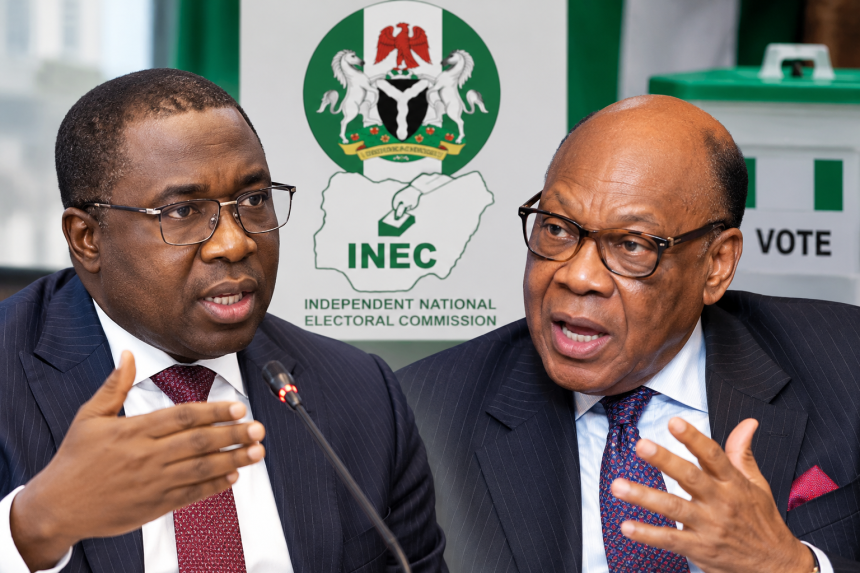
- Former NBA president cites freedom of expression as INEC insists only authorised Returning Officers can announce official results
The Chairman of the Independent National Electoral Commission (INEC), Prof. Joash Amupitan, and former President of the Nigerian Bar Association (NBA), Olisa Agbakoba, have expressed opposing views on whether individuals and private organisations can announce election results ahead of the 2027 general elections.
While Agbakoba argues that Nigerians have a right to discuss and communicate electoral information under the Constitution, INEC maintains that only duly appointed Returning Officers have the authority to make official declarations of election results.
The disagreement came to the fore at the 10th annual lecture of the Guild of Corporate Online Publishers (GOCOP), held on Thursday at the Radisson Blu Hotel in Lagos.
Agbakoba, in his opening remarks, challenged the commission’s position, arguing that citizens who participate in elections should not be prevented from sharing information gathered during the voting and collation process.
He cited Section 39 of the 1999 Constitution, as amended, which guarantees freedom of expression and the press, contending that the right extends to receiving and disseminating electoral information.
Describing Nigerians as shareholders in the electoral process, the former NBA president questioned why citizens should be restricted from expressing their views on election outcomes.
“I’m going to use a metaphor to describe the forthcoming 2027 Presidential Election. We all gathered here and all those that have been registered by INEC and indeed every Nigerian. They count themselves as a shareholder of a company,” he said.
Agbakoba acknowledged that Section 60 of the Electoral Act 2026 gives designated electoral officials the authority to declare results but questioned whether that provision should prevent citizens from sharing their own observations and assessments.
He argued that information gathered from voters leaving polling units could form the basis of public opinion or independent assessments of likely election outcomes.
However, he acknowledged that the matter raised a legal question requiring further examination.
Agbakoba also maintained that allowing citizens and independent observers to share information could strengthen public confidence in INEC, particularly amid concerns about transparency in the electoral process.
“With greatest respect to INEC, we all rightly or wrongly feel that with past experience, why shouldn’t I be able to say something about the election,” he said.
He added that public participation in discussing election outcomes could reinforce the principles of transparency, trust and shared responsibility.
INEC insists on official procedure
Responding to Agbakoba’s position, Amupitan reaffirmed INEC’s stance that only Returning Officers appointed for the relevant elections are authorised to declare official results.
The INEC chairman was represented at the event by the Lagos Resident Electoral Commissioner, Prof. Abayomi Salami, who reiterated the commission’s position on the matter.
According to the commission, allowing individuals or groups to announce results outside the prescribed electoral procedure could create confusion and trigger avoidable crises.
“No individual or group of people, no matter how respected, are to declare results. That will be a recipe for crisis,” Amupitan said.
He cited past electoral controversies, including the disputed declaration involving the Adamawa State governorship election, to illustrate the potential consequences of unauthorised announcements.
Amupitan explained that even Resident Electoral Commissioners were not empowered to make official returns where the responsibility belonged to the designated Returning Officer.
He, however, distinguished between expressing an opinion or making a prediction about an election outcome and formally declaring the result.
“I can offer opinion. Any group, any organisation can offer opinion. But that cannot represent declaration,” he said.
The commission maintained that Nigerians, political groups and other organisations could express views about likely winners, provided such opinions were not presented as official results.
The disagreement highlights a significant question ahead of the 2027 general elections: how to balance citizens’ constitutional rights to freedom of expression and access to information with the need for an orderly, credible and legally recognised process for declaring election results.
As preparations for the elections continue, clarity on the distinction between independent reporting, public commentary and official result declaration will remain important to public understanding and confidence in the electoral process.