By: Wale Alonge
One of our greatest misfortunes as a country was the 1973 Middle East oil embargo, during which an unearned windfall created the illusion—or perhaps delusion—in our collective mind that Nigeria was rich. We have lived in that bubble ever since, despite the reality that ours is a poor, debt-ridden, low-productivity country whose basic infrastructure—electricity, pipe-borne water, transportation, and healthcare—often looks more like that of the 18th century. The majority of our people still lack access to the basic infrastructure and services that much of the rest of the world takes for granted.
We are a country that has lived beyond its means for decades. Across the globe, no economic data is more politically radioactive than fuel price. Fuel price steers consumer in face each time he or she drives into a petrol station. It does not involve any complicated macroeconomic jargon and its impact on price affordability from transport to food is almost immediate. Just like the outcome of US midterm election is likely to be driven by fuel cost and affordability concern, the Nigerian 2027 election may face the same pattern. President Tinubu reelection bid is likely to hinge on fuel prices and cost of affordability by the electorate.
There is no question that the cost of fuel is excruciatingly painful for Nigerians. It is making most basic necessities beyond the reach of the populace. However. to properly contextualize our economic predicament, our analysis must go beyond fuel pricing, which is often influenced by global disruptions beyond our control.
Keeping fuel prices artificially low through unsustainable subsidies financed by debt would be irresponsible to future generations, who would ultimately bear the burden of our multigenerational debt burden and our economic mismanagement and governmental irresponsibility.
We must dig deeper into the structural problems of our economy: low wages, low productivity, the high cost of government, obscene profligacy, and crippling corruption that is literally sucking the life out of the country and worsening the misery index of our people.
President Tinubu has taken steps to address some of Nigeria’s longstanding macroeconomic and structural distortions. He has also significantly increased infrastructure investment. But the government still has a great deal of work to do to address the crushing economic pain that the reform agenda has imposed on the middle class and the multidimensionally poor—many of whom have yet to benefit from improvements in macroeconomic indicators.
Increased foreign direct investment, improved ratings by multilateral institutions, and higher GDP figures mean little to a family that cannot put food on the table, whose children attend dilapidated schools, or that lacks access to healthcare and other basic necessities. Overreliance on positive macroeconomic data without adequately addressing what is happening at the microeconomic and household levels is a danger that could become particularly consequential as the president seeks a second term.
Yet, we often compare Nigeria’s fuel situation with that of the Gulf states. That comparison is like comparing Jupiter with Mars.
The Oil-Reserve Reality
Here are the facts about proven oil reserves per capita when Nigeria is compared with the Gulf states.
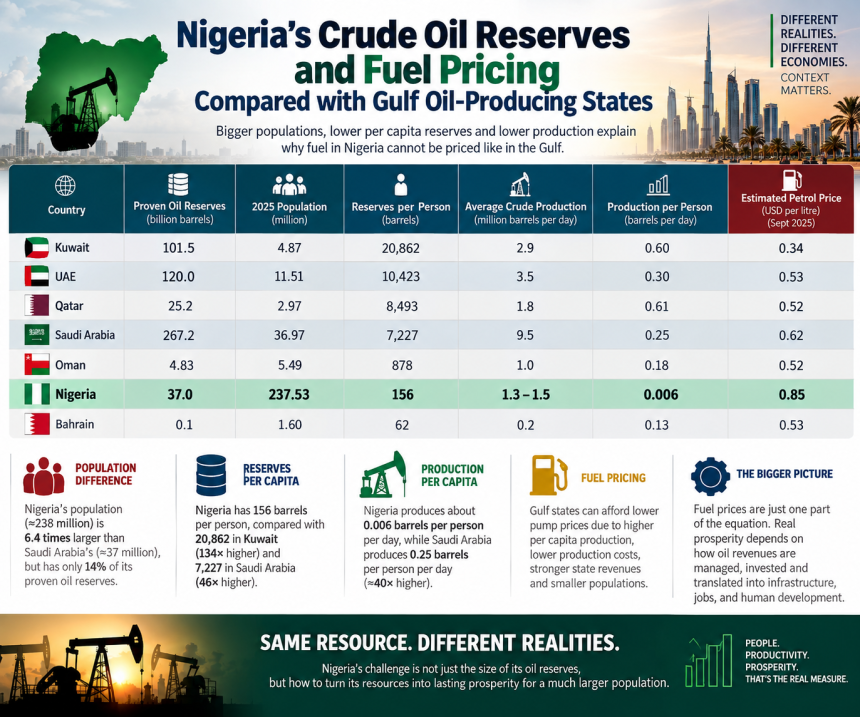
AI-generated data based on proven crude-oil reserves at year-end 2025, using OPEC data and 2025 population estimates from the World Bank, are striking. OPEC reports Nigeria’s proven crude-oil reserves at approximately 37.0 billion barrels, while the Gulf states range from about 0.1 billion barrels in Bahrain to 267.2 billion barrels in Saudi Arabia.
Country Proven Reserves 2025 Population Reserves per Person Compared with Nigeria
🇰🇼 Kuwait 101.5 bn bbl 4.87m 20,862 bbl 134×
🇦🇪 UAE 120.0 bn bbl 11.51m 10,423 bbl 67×
🇶🇦 Qatar 25.2 bn bbl 2.97m 8,493 bbl 54×
🇸🇦 Saudi Arabia 267.2 bn bbl 36.97m 7,227 bbl 46×
🇴🇲 Oman 4.83 bn bbl 5.49m 878 bbl 5.6×
🇳🇬 Nigeria 37.0 bn bbl 237.53m 156 bbl 1×
🇧🇭 Bahrain 0.1 bn bbl 1.60m 62 bbl 0.4×
The population figures are based on World Bank estimates: approximately 237.5 million for Nigeria, compared with 37.0 million for Saudi Arabia, 11.5 million for the UAE, 4.87 million for Kuwait, 2.97 million for Qatar, 5.49 million for Oman, and 1.60 million for Bahrain.
The Striking Point
Nigeria actually has more total proven oil reserves than Qatar and Oman. Its approximately 37 billion barrels represent a substantial reserve base. But Nigeria also has roughly 238 million people sharing that resource.
That distinction is critical.
For every Nigerian, there are approximately 156 barrels of proven crude-oil reserves.
By comparison:
* Kuwait: approximately 20,862 barrels per person—134 times Nigeria’s level
* UAE: approximately 10,423—67 times Nigeria’s level
* Qatar: approximately 8,493—54 times Nigeria’s level
* Saudi Arabia: approximately 7,227—46 times Nigeria’s level
* Oman: approximately 878—5.6 times Nigeria’s level
Why This Matters Economically
This helps explain an important difference between Nigeria’s oil wealth and the Gulf model.
Nigeria’s problem is not simply that it has “too little oil.” It has roughly 37 billion barrels of proven reserves. The fundamental difference is the population-to-resource ratio.
Nigeria has approximately 6.4 times Saudi Arabia’s population but only about 14 percent of Saudi Arabia’s proven oil reserves. Conversely, Saudi Arabia has roughly 46 times Nigeria’s proven oil reserves per person.
There is another dimension to the analysis: production dilution.
While Nigeria holds approximately 37 billion barrels in proven reserves, its daily crude-oil production generally ranges between 1.3 and 1.5 million barrels per day. Spread across a population of roughly 238 million, that amounts to only about 0.006 barrels per person per day.
The Gulf Contrast
Saudi Arabia, by comparison, produces roughly 9–10 million barrels per day for a population of about 37 million—approximately 0.25 barrels per person per day.
On this measure, Saudi Arabia produces roughly 40 times more crude oil per person per day than Nigeria, even before accounting for differences in production costs, refining margins, government revenue, or non-oil sources of income.
This is why simply comparing the pump price of fuel in Nigeria with fuel prices in the Gulf states can be deeply misleading. The price at the pump is only one component of a much larger economic equation.
There is an additional and important qualification: reserves per capita is a measure of resource endowment, not a measure of national wealth or citizens’ actual income. The economic benefits of petroleum depend on production levels, production costs, investment, refining capacity, government revenue, population structure, institutions, taxation, and—most importantly—how petroleum income is managed and invested.
The real question, therefore, is not simply “Why is Nigerian fuel not as cheap as it is in the Gulf?”
The more fundamental question is: What economic model can transform Nigeria’s finite petroleum resources into sustainable prosperity for a population that is many times larger than those of most oil-rich Gulf states? How can we address the endemic and intractable malaise of poor electricity generation and distribution, of abysmally poor productivity, of a low wage consumer economy with poor manufacturing base.
Nigerians are hurting badly. Elections are not won by simply regurgitating positive macroeconomic data but ny how the electorates feel in their pocket book.
Adewale Alonge, PhD, Founder & President, Africa Diaspora Partnership for Empowerment and Development. www.adped.org