Petrol Price Increased To N630.63 In October -NBS

Petrol Price Increased To N630.63 In October -NBS

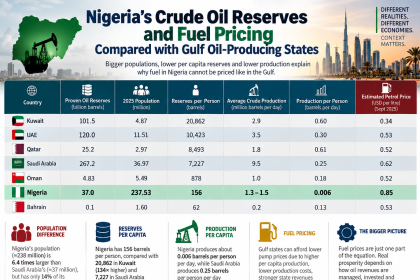
The National Bureau of Statistics (NBS), has said that the average retail price of a litre of petrol increased from N195.29 in October 2022 to N630.63 in October 2023. It made the declaration in its Petrol Price Watch for October 2023 released in Abuja on Wednesday. It stated that the October 2023 price of N630.63 represented a 222.92 per cent increase over the price of N195.29 recorded in October 2022. “Comparing the average price value with the previous month of September 2023, the average retail price increased by 0.71 per cent from N626.21. “On state profiles analysis, Zamfara paid the highest average retail price of N659.38 per litre, followed by Gombe and Borno at N658.33 and N657.27, respectively. “Conversely, Lagos, Oyo, and Delta paid the lowest average retail price at N590.95, N592.19 and N599.38 respectively,’’ it stated. Analysis by zones showed that the North-East Zone recorded the highest average retail price in October 2023 at N644.16, while the South-West recorded the lowest price at N616.81 per litre. The NBS also stated in its Diesel Price Watch Report for October 2023 that the average retail price was N1004.98 per litre. It said that the October 2023 price of N801.09 per litre amounted to a 25.45 per cent increase over the N801.09 per litre paid in October 2022. “On a month-on-month basis, the price increased by 12.82 per cent from the N890.80 per litre recorded in September 2023,’’ it added. On state profile analysis, the report said the highest average price of diesel in October 2023 was recorded in Plateau at N1150.00 per litre, followed by Nasarawa at N1138.00 and Benue at N1091.67. On the other hand, the lowest price was recorded in Rivers State at N824.44 per litre followed by Borno at N827.27 and Kebbi State at N845.00 per litre. In addition, the analysis by zones showed that the North-Central had the highest price of N1090.69 per litre, while North- East recorded the lowest price at N947.32 per litre. 

Nigeria’s Underperforming In Oil, Gas Sector Due To Insecurity – Lokpobiri

Nigeria’s Underperforming In Oil, Gas Sector Due To Insecurity – Lokpobiri

Minister of State for Petroleum Resources (Oil), Mr Heineken Lokpobiri, has said that the challenge of insecurity in the Niger Delta was responsible for the underperformance of the petroleum sector. The Minister, who said this in a meeting with the Abuja Chapter of the Energy Correspondent Association Friday in Abuja, added that it was also affecting Nigeria’s oil production output.   While noting that the issue was making it difficult for the country to meet its OPEC production quota, Lokpobiri said the government was working to address the drawback. He was hopeful that by the end of 2023, the country would increase its oil production to about 2 million barrels per day. Due to massive crude oil theft and pipeline vandalisation, Nigeria’s oil production presently hovers between 1.3-1.4 million barrels per day. “My sole agenda is to increase production. Once we increase production we will get more revenue for the country. You know Nigeria is still more dependent on oil. “Though the non-oil sector is also supporting the economy, a substantial part of our forex comes from oil. “The reason why we are underperforming is because of insecurity and we are gradually tackling those problems. “So, my ambition is to see how I can lead the sector to increase production so that we can get more revenue to deal with the fund and strategic rationale projects in the country. “I get the reports from relevant authorities. Today, we are doing about 1.4 million barrels of crude. So, we are steadily increasing but our target is to see how we can get to two million barrels,” he said. Lokpobiri urged the industry players to join hands together to find a permanent solution to the issue. He said the federal government was discussing with International Oil Companies and local producers to find a lasting solution to the insecurity challenge. He said the engagement was already yielding positive results. “We have identified where the problem is, and where we are getting the shortfall and we are already engaging them within the next few weeks, we will be able to give you how far we have gone in that direction. In an earlier remark, President of the association, Mr Victor Nnodim, assured the minister of the association’s readiness to partner with him as he sought to fulfill his agenda of ramping up crude oil production and delivering a better petroleum industry for the country. “We will support you to achieve your mandate,” he said.