

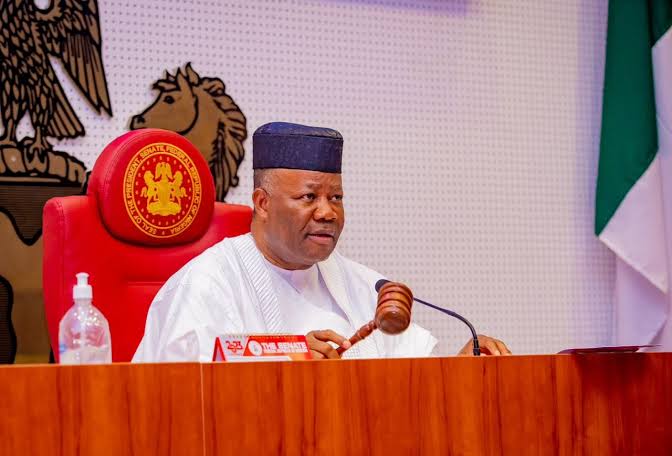
The declaration followed a motion moved by the Senate Chief Whip, Senator Tahir Monguno, during plenary on October 15, 2026. The move appeared to be an early political endorsement of continuity in the Senate leadership as politicians begin positioning themselves ahead of the 2027 general elections.
Monguno expressed confidence that many serving senators would return to the National Assembly after the elections, arguing that the leadership positions should not be treated as open contests.
His position was supported by Senator Cyril Fasuyi, who represents Ekiti North and backed the call for continuity in the leadership of the upper chamber.
Akpabio subsequently subjected the motion to a voice vote, with senators responding in the affirmative. No audible opposition was recorded when he called for dissenting voices.
“I think that settles it,” the Senate President said after the vote.
The declaration represents a political statement of support for the current leadership and an attempt by its backers to establish an early consensus ahead of the constitution of the next National Assembly. It also places the question of continuity in the Senate leadership within the broader political calculations surrounding the 2027 elections.
However, the resolution does not automatically secure Akpabio’s return as Senate President. The 11th National Assembly will emerge from the general elections, and its presiding officers will be determined by the elected members in accordance with the relevant constitutional and parliamentary procedures.
The declaration of “no vacancy” should therefore be understood as an expression of political support rather than a binding guarantee of re-election. The eventual outcome will depend on the composition of the next Senate, negotiations among lawmakers and the decisions taken when the new Assembly convenes.
Akpabio, who represents Akwa Ibom North-West Senatorial District, assumed office as Senate President in June 2023 following the inauguration of the 10th National Assembly. His leadership has since operated within a political environment shaped by legislative bargaining, relations between the executive and legislature, and competing interests among political parties and individual lawmakers.
The early endorsement could strengthen his position among supporters seeking continuity, although it remains to be seen whether the apparent consensus will hold after the 2027 elections, when the political balance of the Senate becomes clearer.
The development occurred during a plenary session that also featured controversy over Akpabio’s remarks during deliberations on a bill seeking to decriminalise attempted suicide.
The Senate President had rejected allegations that his comments portrayed Muslims negatively, insisting that a viral video clip of the proceedings had been taken out of context.
Akpabio maintained that he had neither intended to malign Islam nor stigmatise any religious group. He also warned that the circulation of misleading excerpts from legislative debates could aggravate religious and political tensions.
He argued that neither Islam nor Christianity should be associated with terrorism, stressing that individuals who engage in suicide bombings for political or financial motives should not be regarded as representatives of any religion.
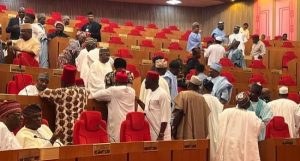
Senate conferring with Each Other
The controversy arose during consideration of a bill sponsored by Senator Asuquo Ekpenyong, which seeks to establish a legal framework for suicide prevention, decriminalise attempted suicide and provide rehabilitation for survivors.
The proposed legislation seeks to shift the response to attempted suicide from criminal punishment towards prevention, treatment and rehabilitation, placing greater emphasis on support for people who survive suicide attempts.
Although the leadership motion and the controversy over the bill unfolded during the same plenary session, the two developments concern distinct issues. The motion addressed the political leadership of the next National Assembly, while the dispute over Akpabio’s remarks centred on the interpretation of his comments during legislative deliberations.
The Senate’s declaration has nevertheless brought the question of leadership succession into sharper focus well ahead of the 2027 elections, even as the final composition of the next Assembly and the choice of its presiding officers remain unresolved.