

BY Dahiru Ali
Improved earnings and higher oil production point to progress under the current management. The real test, however, is whether these gains translate into lasting efficiency, stronger investment and greater value for Nigeria.
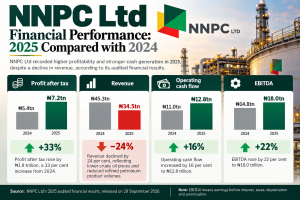
The Nigerian National Petroleum Company Limited (NNPC Ltd) has reported a profit after tax of ₦7.2 trillion for the 2025 financial year, representing a 33 per cent increase from the ₦5.4 trillion recorded in 2024. It also declared a dividend of ₦5.8 trillion, while crude oil and condensate production reached its highest level in five years.
The results offer a basis for assessing the progress made by the management team led by Group Chief Executive Officer Bashir Bayo Ojulari in repositioning the national oil company as a commercially driven enterprise. They also raise a broader question about the direction of Nigeria’s petroleum industry at a time when the Petroleum Industry Act (PIA) is reshaping its institutional framework, Dangote Refinery is changing the domestic fuel market and international energy developments are creating fresh opportunities and uncertainties.
The financial results are encouraging, but their significance extends beyond the headline profit. NNPC must demonstrate that it can sustain the improvement, operate its assets more efficiently, attract investment on credible commercial terms and compete in a market where its historical position no longer guarantees success. That is the more demanding test of the management’s repositioning agenda.
Stronger financial performance: what lies behind it?
Stronger financial performance: what lies behind it?NNPC’s audited results show that profit after tax rose by ₦1.8 trillion in 2025, even as revenue declined by 24 per cent to ₦34.5 trillion. Earnings before interest, taxes, depreciation and amortisation increased by 22 per cent to ₦18 trillion, while operating cash flow grew by 16 per cent to ₦12.8 trillion. Return on equity also improved from 14 per cent to 16 per cent. The combination of lower revenue and higher profit is one of the most revealing features of the results. It suggests that the company was able to protect and improve its earnings despite pressure on sales. NNPC attributed the revenue decline principally to lower crude oil prices and reduced volumes of refined petroleum products following market deregulation in 2024.
The improvement in profitability is consistent with stronger operational and financial discipline. Indeed, reports on the results indicate that management attributed the increase in profit partly to cost reductions and efforts to recover outstanding payments from customers. These developments deserve attention because the commercial strength of an oil company is not determined by revenue alone. A business that controls its costs, collects payments promptly and generates more cash from its operations can improve its financial position even when sales revenue comes under pressure.
However, it would be premature to attribute the entire improvement to management efficiency without examining the detailed audited accounts. Changes in crude oil prices, exchange rates, financing costs and other income or expenditure items can also influence profitability. The relative contribution of each factor must be established before drawing firm conclusions about the sources of the increase. The rise in operating cash flow is particularly important. Cash generated from operations helps a company maintain its assets, meet its obligations and finance new projects. It also provides a more practical indication of financial capacity than profit alone, although cash flow must still be assessed alongside debt, outstanding liabilities and investment commitments.
For NNPC, the important question is whether the stronger financial performance reflects improvements that can be sustained over several years. If management has succeeded in reducing waste, improving collections and tightening expenditure, those changes should continue to support earnings even when international oil prices are less favourable. The 2025 results provide grounds for examining that possibility. The detailed financial statements, however, remain essential to determining how much progress has been made and how durable it is likely to be.
The Petroleum Industry Act and the unfinished business of transformation
The Petroleum Industry Act (PIA) 2021 provides the institutional framework for understanding NNPC’s repositioning. It restructured the governance of Nigeria’s petroleum industry, established new regulatory arrangements and created the basis for NNPC to operate as a commercially oriented company under a different legal and governance structure. The transition from the former Nigerian National Petroleum Corporation to NNPC Ltd in July 2022 was intended to move the enterprise away from the older model of a state-controlled corporation towards a business expected to operate with greater commercial discipline.
That change was significant, but the conversion of a public corporation into a limited liability company could never, by itself, resolve the problems accumulated over decades. A new corporate structure does not automatically improve the reliability of oil production, make refineries profitable, eliminate financial inefficiencies or guarantee that investment decisions will generate adequate returns. Those outcomes require sustained management attention, stronger internal controls, competent execution and transparent reporting.

Against that background, NNPC’s improved earnings and production in 2025 are relevant indicators. They suggest that the company has strengthened some aspects of its financial and operational performance. The reported acquisition of 500 compressed natural gas-powered trucks, progress on major gas infrastructure and the adoption of a Technical Equity Partnership Model for refinery reform also indicate efforts to reconsider how its assets and operations should be managed.
Yet the significance of these initiatives will ultimately depend on their results. The acquisition of trucks, for example, is valuable to the extent that the vehicles improve distribution efficiency, reduce operating costs or generate additional revenue. Similarly, refinery partnerships will need to produce reliable operations and commercially defensible returns rather than simply provide a new administrative arrangement for managing old assets.
The PIA also makes governance and accountability central to the new commercial framework. NNPC must therefore demonstrate that its investment decisions are based on clear business considerations and that its financial reporting allows shareholders and the public to understand how value is being created. Its national responsibilities make this particularly important. As a major participant in the petroleum industry, NNPC has commercial interests as well as responsibilities connected with Nigeria’s energy security. Where public obligations affect its business decisions, their costs and financing arrangements should be sufficiently transparent to permit a fair assessment of its commercial performance.
The real test of the PIA is consequently not whether NNPC has adopted a new corporate identity, but whether it can operate more efficiently, allocate capital more carefully and attract investment while remaining accountable for the value it generates.
Dangote Refinery changes the rules of the downstream market
The emergence of Dangote Refinery is one of the most important developments confronting NNPC’s repositioning effort. For many years, Nigeria depended heavily on imported refined petroleum products despite being a major crude oil producer. The country’s state-owned refineries struggled to provide consistent commercial output, leaving the domestic market exposed to international supply conditions, foreign exchange pressures and the cost of importing finished products. Dangote Refinery has altered that landscape by introducing large-scale private refining capacity into the domestic market. Its 700,000-barrel-per-day design capacity also gives it the potential to serve customers beyond Nigeria, making the facility a significant participant in regional and international fuel trade.
The refinery’s commercial performance illustrates the opportunities available to an operator able to process crude oil at scale and respond to changing market demand. Reuters reported in September 2026 that Dangote Refinery recorded a net profit of $1.82 billion in the first half of the year, reversing a loss in the corresponding period of 2025. The report linked the improved result to strong demand for refined products amid disruptions to supplies from the Middle East. For NNPC, this development carries both competitive and strategic implications.
The competitive challenge is straightforward. NNPC can no longer rely on its historic position in the petroleum market as a substitute for operational efficiency. It must demonstrate that its own assets can compete on cost, reliability and commercial returns. The future of its state-owned refineries is therefore an important test of whether the management’s reform programme can move beyond improved financial reporting to resolve long-standing operational difficulties.
The company’s adoption of a Technical Equity Partnership Model for refinery reform suggests that management recognises the need to reconsider the existing approach. However, the model’s effectiveness will depend on the terms of the partnerships, the capital committed, the responsibilities of the parties and the ability of the refineries to operate reliably. NNPC needs to provide greater clarity about the intended commercial arrangements and the milestones by which progress will be measured. It should also demonstrate that the expected benefits justify the investment required, particularly when private refining capacity is expanding.
There is little economic value in maintaining an asset simply because it has historically belonged to the state. The decision to rehabilitate, partner, restructure or otherwise reposition a refinery should depend on its commercial prospects, strategic importance and the cost of achieving reliable operations.
At the same time, Dangote Refinery should not be seen only as a threat. It creates opportunities for a more integrated petroleum industry in which NNPC supplies crude oil, private operators process it, and both sides participate in commercially beneficial arrangements involving storage, transportation, gas and product distribution. The relationship is already evident in crude supply. Reuters reported in September that Dangote Refinery had secured at least 16 million barrels of Nigerian crude for October 2026, including supplies arranged through NNPC. <Cite refs={[“turn937580news46”]}/>
This demonstrates that the two enterprises can occupy different positions in the same value chain. NNPC can remain a major crude producer and supplier while a private refinery processes significant volumes for domestic consumption and export. The important consideration is that such arrangements should be transparent, commercially sound and consistent with the interests of the relevant parties. Neither the national oil company nor private refiners should depend on opaque or preferential arrangements that undermine competition.
For Nigeria, the broader objective should be to establish a petroleum market in which domestic refining reduces unnecessary dependence on imported products, crude producers receive commercially viable returns and consumers benefit from dependable supply. The expansion of refining capacity is an important step, but it does not guarantee lower petrol prices, which remain influenced by crude costs, exchange rates, processing expenses, distribution and market conditions.
Global energy volatility offers opportunities, not guarantees
International energy-market developments provide another test of NNPC’s strategy. Geopolitical tensions, supply disruptions and changes in trade flows can create opportunities for oil producers and refiners that are able to maintain reliable supplies. They can also increase costs, disrupt logistics and expose businesses and consumers to sudden price movements. Nigeria’s position is particularly complex. The country produces crude oil but has historically relied heavily on imported refined products. Expanding domestic refining can reduce exposure to some disruptions in international product supply, but it cannot insulate the economy from changes in crude oil prices or exchange rates.

For NNPC, higher crude oil production can increase the volume of oil available for sale and improve its earnings potential when prices are favourable. The company’s reported average production of 1.77 million barrels per day in 2025 is therefore significant. Sustaining that performance, however, will require continued investment, security in producing areas, reliable infrastructure and careful control of operating costs. The company’s natural gas business offers another avenue for growth. Gas can support electricity generation, industrial production and export earnings, provided that the necessary infrastructure is available to connect production with customers. NNPC’s reported gas output of 7.2 billion standard cubic feet per day, together with progress on the Ajaokuta-Kaduna-Kano pipeline and the ANOH Gas Processing Plant, provides a basis for expanding that business.
But the value of these projects will depend on completion, reliable operation and the capacity to translate additional production into sales and revenue. Infrastructure expenditure is not an end in itself; it must support a clear economic purpose and generate benefits commensurate with its cost. Global market volatility also carries risks that should not be overlooked. Oil prices can fall as supply conditions change, refining margins can narrow and demand can weaken. An investment that appears attractive during a period of exceptional prices may deliver disappointing returns when the market normalises.
NNPC’s strategy should therefore be built around resilience rather than the assumption that favourable conditions will persist. The company needs to improve operational efficiency, diversify its revenue sources and ensure that major projects remain commercially viable under different market scenarios. Its plan to mobilise $60 billion in upstream, midstream and downstream investment by 2030 is ambitious. Achieving it will require credible projects, predictable contractual arrangements, effective governance and confidence that capital can generate competitive returns.
Management must also distinguish between investment ambitions and capital that has actually been secured. The identification of projects worth billions of dollars does not mean the required financing has been obtained or that the projects will necessarily be completed on schedule. Investors will want evidence of commercial viability, sound risk management and a clear route to returns.
Production targets require investment and delivery
NNPC has set a target of producing two million barrels of crude oil per day by 2027 and three million barrels per day by 2030. It also aims to increase natural gas output to 12 billion standard cubic feet per day by 2030. These targets indicate the scale of the company’s ambition, but achieving them will depend on factors that require sustained attention. Production growth requires investment in existing fields, the development of new projects, reliable infrastructure, effective maintenance and improved security across producing areas.
It also requires disciplined management of capital. Higher output is not necessarily more profitable if the cost of achieving it rises disproportionately. The relevant measure is not only how much oil and gas NNPC produces, but how efficiently it converts its resources and investment into sustainable earnings. The proposed $60 billion investment programme will therefore be an important measure of management’s ability to translate ambition into delivery. Progress should be assessed through the projects that secure financing, the capital actually deployed, the infrastructure completed and the additional production or revenue generated.
NNPC must also determine how much of the programme can be financed from internally generated funds and how much will require external investors and partners. Its improved operating cash flow is encouraging, but the scale of the proposed investment means that capital allocation will remain a major management challenge. Regular reporting on project milestones, investment commitments and expected returns would help shareholders and the public determine whether the company is making measurable progress. Such disclosure would also reinforce the commercial discipline that the PIA was intended to encourage.
The dividend question: balancing shareholder returns with future growth
The declaration of a ₦5.8 trillion dividend, up 35 per cent from the previous year, is another notable feature of the 2025 results. Dividends are an important way for a company to return value to its shareholders. For a national oil company, however, the decision must also be considered against the need to maintain assets, expand production, develop gas infrastructure and finance projects that can generate future income. The question is not whether NNPC should pay dividends, but whether the amount distributed is consistent with the company’s long-term financial requirements.
A proper assessment would require a closer examination of its available cash, debt obligations, capital expenditure plans and other financial commitments. Without that information, it would be premature to conclude that the declared dividend is either excessive or optimal. Management should be able to explain how it balances shareholder returns with reinvestment in the business. Such an explanation would provide a clearer picture of its capital-allocation priorities and help demonstrate whether the company is building long-term value rather than concentrating primarily on immediate financial results.
The issue is particularly important given NNPC’s investment ambitions. A company seeking to expand production, improve infrastructure and reform its refineries must ensure that its financing decisions support those objectives without creating avoidable pressure on its balance sheet.
What the next phase of management must deliver
The 2025 results provide a useful starting point for assessing the current management’s repositioning agenda. The next phase requires evidence that the improvements can be sustained and translated into lasting commercial value. First, NNPC should provide clear information about the sources of its earnings, its operating costs, its outstanding receivables and its financial obligations. This would make it easier to distinguish recurring operational improvements from changes arising from market conditions or other factors. Second, the company should set out measurable milestones for refinery reform. Investors and the public need to understand the proposed partnership arrangements, the investment required, the timetable for implementation and the commercial outcomes expected.
Third, management should demonstrate that increased oil and gas production is supported by sustained investment and that major gas infrastructure projects are progressing towards completion and commercial operation. Fourth, NNPC should explain how its dividend policy fits with its financing requirements and investment programme. A clear account of the relationship between shareholder returns, retained earnings and capital expenditure would strengthen confidence in its commercial decision-making. Finally, the company must demonstrate that it can compete in a market where private refining capacity is expanding and global energy conditions remain unpredictable. This will require more than higher production targets. It will demand reliable operations, efficient asset management, sound investment decisions and the capacity to adapt when market conditions change.
These are not tasks that can reasonably be completed in a single financial year. They are the measures by which progress should be assessed over time.
The real measure of NNPC’s transformation
NNPC’s 2025 results show stronger reported profitability, improved operating cash flow and higher oil and gas production. These are meaningful developments in its effort to operate under the commercial framework established by the Petroleum Industry Act.
The figures nevertheless need to be viewed in the context of a changing petroleum industry. Dangote Refinery has introduced a major new force into the domestic and regional fuel market, while global energy volatility has created opportunities alongside significant risks. NNPC must respond by improving efficiency, strengthening its investment discipline and ensuring that its assets can compete on commercial terms.
For Ojulari and his management team, the challenge is to convert improved financial performance into a durable business model. That means sustaining production, completing infrastructure projects, resolving the future of the state-owned refineries and attracting investment on credible terms. It also means demonstrating that the company can meet its obligations, reward shareholders and reinvest sufficiently to support future growth.
The ₦7.2 trillion profit is an important measure of NNPC’s performance in 2025, but it is not, on its own, proof that the transformation is complete. The more consequential test will be whether the company can sustain its earnings, make better use of its assets and deliver consistent returns across changing market conditions.
Ultimately, NNPC’s repositioning will be judged by the strength of the enterprise it builds: one that operates efficiently, accounts transparently for its decisions, competes credibly in the petroleum market and delivers enduring value to Nigeria.
The profit is significant. Turning it into lasting commercial strength is the work that remains.