

Wale Alonge
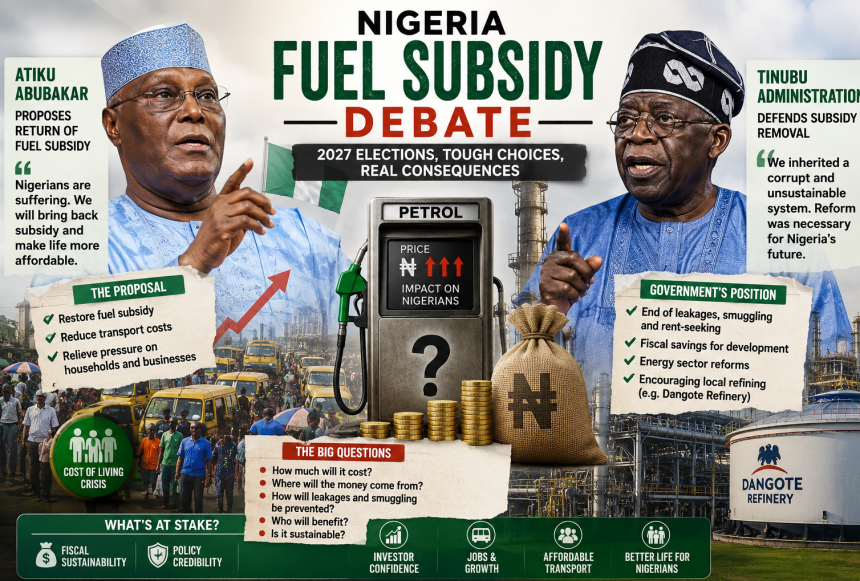
A strong opposition and competition for voters based on divergent policy prescriptions are fundamental to the sustenance of democratic governance. Around the world, fuel-price inflation ranks among the most politically sensitive issues on which the fortunes of political leaders can rise or fall. It would therefore be political malpractice for the Nigerian opposition, including Alhaji Atiku, not to make fuel subsidy a campaign issue. It is, consequently, a positive development that, after many months of focusing on personal attacks, the 2027 presidential campaign has finally shifted toward a substantive policy debate about fuel-subsidy removal and possible alternatives.
Let me state from the outset that the pain Nigerians are experiencing is real. Petrol is expensive. Transportation costs have gone through the roof. While food inflation is falling, prices are still unaffordable for many vulnerable Nigerians, and the purchasing power of the average Nigerian has been severely eroded. Anyone who pretends otherwise is either disconnected from reality or being politically dishonest.
While President Tinubu’s reform agenda has intensified the cost-of-living crisis, particularly at the painful point of the J-curve associated with major economic reforms, it is not the sole source or foundation of Nigeria’s economic distress. That foundation was laid and solidified by decades of macroeconomic mismanagement, political timidity and inept leadership.
It is not controversial to say that President Tinubu inherited an economy tilting toward the edge of a precipice. It is also important to acknowledge that President Tinubu’s APC was in power for the eight years preceding his administration. He and his party therefore cannot completely absolve themselves of responsibility, especially since the President himself claimed credit for helping to install his predecessor in his now-legendary “Emilokan” speech.
It is therefore entirely appropriate for the opposition to subject the President’s fuel-subsidy policy to rigorous performance analysis. However, it would amount to cheap politics to do so without placing the policy within the context of decades of successive governments applying temporary bandages to the deep structural and economic metastasis created by an unsustainable and corrupt subsidy regime.
For decades, Nigeria operated a fuel-subsidy system presented to citizens as a social program designed to make petrol affordable for the masses. In reality, it became one of the most abused and opaque components of Nigeria’s political economy. Trillions of naira disappeared into a system that encouraged rent-seeking, questionable subsidy claims, smuggling, import dependence and enormous opportunities for politically connected middlemen.
In effect, Nigeria was subsidizing petrol consumption across the West African axis. At the height of the subsidy era, Nigeria’s reported daily fuel consumption averaged between 67.5 million and 69.5 million litres. That figure fell sharply to approximately 47.5 million litres immediately after subsidy removal and has since stabilized at roughly 49.8 million to 51.8 million litres per day. Such a dramatic decline cannot reasonably be attributed solely to price-induced consumer behaviour. It strongly suggests that the previous figures contained substantial leakages, diversion and cross-border smuggling.
The irony of Nigeria’s corrupt subsidy programme was that the country is an oil producer that had invested billions of dollars decades earlier to construct national refineries. It also spent billions more in recent years attempting to rehabilitate those same refineries after years of criminal neglect and mismanagement. Yet despite these enormous expenditures, Nigeria continued to spend scarce public resources subsidizing imported petrol while the refineries and productive infrastructure that could have made the country genuinely energy-independent deteriorated.
The entire subsidy arrangement increasingly resembled a well-orchestrated enterprise for plundering the nation’s commonwealth.
The principal beneficiaries were certainly not the poorest Nigerians, many of whom did not own cars and whose direct fuel consumption was minimal. The biggest beneficiaries were those involved in the importation chain, the smuggling networks that moved cheap Nigerian petrol across the borders, and the politically connected interests that profited immensely from the rents created by the subsidy regime.
This is the history that the opposition, including former Vice President Atiku Abubakar—who was not just Nigeria’s number-two citizen from 1999 to 2007 but also played a central role in the privatization of public enterprises—would prefer Nigerians to overlook. They would also like us to forget the stories of empty oil vessels allegedly berthing at Nigerian ports to collect subsidy payments. Those stories sounded more like plots from one of the Hadley Chase crime novels many of us read in the 1970s. Except that they were not fiction.
Tinubu’s Fuel Subsidy Conundrum
This was the backdrop to President Tinubu’s decision to scrap the fuel subsidy. No rational person who genuinely cares about Nigeria would oppose the removal of an obscenely corrupt and unsustainable scheme. The legitimate debate should instead focus on the manner in which the President announced and implemented the policy—abruptly and without adequate preparation for the consequences.
When President Tinubu took the oath of office in May 2023, he faced three difficult choices regarding the subsidy regime. He could have followed the example of previous presidents by explaining how destructive the policy was to the economy, succumbing to populist pressure, doing nothing and keeping the subsidy in place. He could have established a broad commission to examine the advantages and disadvantages of subsidy removal while building the social-protection infrastructure needed to cushion the impact. Or he could take the most decisive option: remove the subsidy immediately.
He chose the third option and scrapped the policy with little transition.
To understand why the President may have chosen such a precipitous approach, one only has to recall the experience of the Jonathan administration, when the mother of the then Minister of Finance, Dr. Ngozi Okonjo-Iweala, was kidnapped amid opposition to her proposed reforms, including efforts to remove the fuel subsidy. Had President Tinubu delayed implementation, the subsidy mafia might have had more time to mobilize against the policy, as it had done under previous administrations.
The emergence of the Dangote Refinery has also changed the structure of Nigeria’s petroleum market. With the refinery producing refined products for domestic consumption and export, and with market forces beginning to influence petrol prices, the country has witnessed developments that were difficult to imagine under the old regime. The reform process has also ended the perennial queues at petrol stations, when Nigerians slept in their cars overnight simply to obtain fuel. In fact until President Trump decided to attack Iran six months ago and in the process disrupted the global oil supply chain, sending oil price through the roof across the globe, the market force of supply and demand was already pushing petrol price lower towards equilibrium. In fact many independent petrol stations were closing down and consolidating due to inability to compete thus reducing inefficiencies.
These gains should not be dismissed merely because the reform has imposed severe short-term hardship. At the same time, the government must recognize that the existence of these gains does not excuse its failure to provide adequate relief for vulnerable citizens.
The fundamental question Alhaji Atiku owes Nigerians an answer to is this: What has fundamentally changed in Nigeria’s economy in the last few months to make a subsidy that was unsustainable yesterday suddenly sustainable tomorrow? What precipitated his sudden proposal to restore fuel subsidy almost four years after Nigerian have almost weathered the pain point in J curve and about to start reaping the benefit of their sacrifice. Where is the justification and rationale for such a seismic policy reversal?
Has smuggling disappeared? Have the opportunities for rent-seeking vanished? Has Nigeria suddenly developed the fiscal capacity to spend trillions of naira every year keeping petrol artificially cheap? Have the country’s enormous infrastructure, education, healthcare and security deficits been resolved? Most importantly, how does Alhaji Atiku plan to finance his constantly evolving proposal to restore the subsidy?
If the answer to these questions is no, then what exactly are we bringing back?
And if the argument is that Atiku is not proposing a return to the old, corrupt subsidy regime but rather a more targeted and transparent mechanism to make petrol affordable for Nigerians, then the burden is even clearer. How much would such a programme cost? Who exactly would benefit? How would it be funded? What safeguards would prevent the leakages, diversion, smuggling and rent-seeking that plagued the old system?
The burden is not on Nigerians to prove that they deserve affordable petrol. The burden is on Atiku to demonstrate that his proposed subsidy mechanism can achieve that objective without recreating the fiscal leakages, smuggling incentives and rent-seeking opportunities of the old regime.
We should also be honest about the economics. Government does not have an inexhaustible purse. Every naira committed to subsidizing petrol is a naira that cannot be deployed elsewhere. At a time when Nigeria needs massive investment in infrastructure, electricity, transportation, security, education and healthcare, returning to a blanket petrol-subsidy regime would carry a substantial opportunity cost.
There is no free lunch in macroeconomics. If the government does not raise the money through taxation, it must borrow it. If it does not borrow, it must cut expenditure elsewhere. If it does neither, the pressure will eventually appear through inflation, currency instability or another fiscal crisis. There is no magic in subsidy economics.
A government cannot permanently make Nigerians richer by making one product artificially cheaper. This is why the fuel-subsidy debate cannot be reduced to whether Nigerians prefer paying less at the pump. Of course they do. The real question is whether Nigeria is building an economy capable of making its citizens prosperous without perpetually manipulating the price of petrol.
There is also a larger issue that should concern every Nigerian, regardless of political affiliation:
Policy credibility.
Nigeria has begun sending a message to international investors and development institutions that it is prepared to confront some of the structural distortions that have held the economy back for decades. Subsidy reform and foreign-exchange reform are painful, controversial and imperfect, but they form part of a broader attempt to place the economy on a more sustainable footing. The positive impact of the president’s painful economic reform policy are already visible in increase inflow of foreign investment, especially diaspora remittances, positive credit rating and economic outlook by major indices, positive projection and actual GDP growth. Yes, the government has a lot of work to do translate these positive macroeconomic data, which means absolutely nothing to the long suffering masses, into affordable cost of living for them. That is a worthy policy debate the opposition should be taking the president and his team to task on as they seek to unseat them from Aso Rock. That is a legitimate campaign debate to have not a cheap and highly destructive populist policy prescription.
If every difficult reform becomes politically reversible as an election approaches, what message are we sending to the rest of the world? An investor contemplating a ten- or twenty-year investment in Nigeria is not looking only at today’s petrol price. The investor is asking whether the policies on which the investment decision is based will still exist five or ten years from now.
That is why Atiku’s proposal has implications beyond the price Nigerians pay at filling stations. It could reinforce the unfortunate perception that Nigerian economic policy is hostage to electoral politics—that difficult reforms can be abandoned whenever they become unpopular. That is a dangerous message for a country desperately seeking long-term investment.
There is, of course, an understandable political calculation behind the proposal. The opposition’s plan to unite around a single candidate to challenge the incumbent President has fallen apart, leaving a fractured opposition struggling to break through the news cycle. At the same time, the efforts by the former Vice President to unearth damaging information about President Tinubu in Chicago and through the United States courts appear, as in 2023, not to have produced the expected political returns.
Skeptics may therefore wonder whether the timing of Atiku’s constantly changing subsidy-restoration proposal represents an attempt to throw a premature Hail Mary—or to throw the kitchen sink at the wall and hope something sticks. If that was the intention, the strategy has worked remarkably well. The proposal has taken on a life of its own, dominated political commentary and attracted the attention of policy analysts, social-media commentators and the wider public.
However, the fact that Atiku and members of his team appear to be speaking from different talking points, while repeatedly revising the proposal, suggests that it may not have been fully developed before its release. A serious economic policy should not require constant clarification before the public can understand what is being proposed.
A politician has an easy choice: tell the people the difficult truth and risk their anger, or tell them what they desperately want to hear. Atiku appears to have chosen the latter. But presidential leadership should be about more than identifying public anger and converting it into an electoral slogan.
It should involve explaining the difficult choices a country must make and having the courage to defend those choices. If Atiku believes the Tinubu administration has mishandled subsidy removal, let him explain what he would do differently. Let him explain how he would cushion the poor, reduce transportation costs, strengthen social protection, improve electricity supply and accelerate domestic refining.
Most importantly, let him tell the electorate where and how he plans to source the funds required to finance the crippling cost of fuel subsidy, rather than adding to the already unbearable debt burden that Nigeria is passing on to future generations.
That would constitute a serious alternative. Simply promising to restore the subsidy is much easier. It is also much less convincing.
Nigeria has travelled this road before. We know where it leads. What Nigerians need is not permanently cheap petrol. They need an economy in which wages, businesses, productivity and purchasing power grow faster than the cost of living.
That is a much harder political promise. But it is the promise Nigeria actually needs.
- Adewale Alonge, PhD, Founder & President, Africa Diaspora Partnership for Empowerment and Development. www.adped.org