By Dahiru Ali
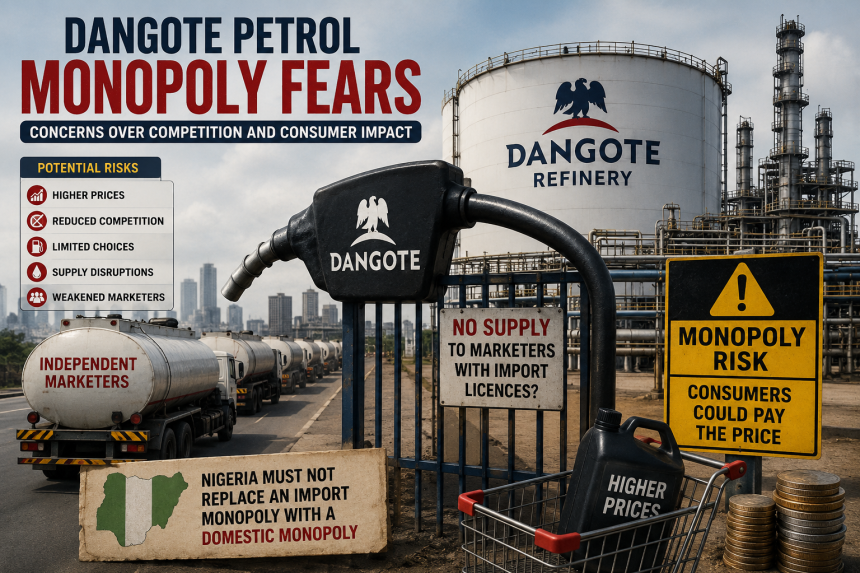
Fresh reports that Dangote Petroleum Refinery may restrict the sale of Premium Motor Spirit (PMS), popularly known as petrol, to major marketers holding valid import licences have raised concerns over competition and the future structure of Nigeria’s downstream petroleum market.
Industry sources reportedly indicated that major marketers, including Matrix Energy and A.A. Rano, could be affected by the alleged restriction.
If confirmed, the development could have significant implications for competition, supply and pricing in a market where Dangote Refinery has rapidly become a major source of locally refined petrol.
The concern is not about the refinery’s emergence as a major domestic supplier. Its contribution to reducing Nigeria’s dependence on imported petroleum products and strengthening domestic refining capacity is significant.
The bigger question is whether the expansion of local refining could inadvertently create a new concentration of market power.
Can Nigeria move away from dependence on imported petrol without replacing it with dependence on a single dominant domestic supplier?
That question deserves serious regulatory attention.
A downstream market in which one refinery supplies a substantial share of available petrol while potentially determining which marketers can access its products could leave independent operators with reduced bargaining power.
The implications could become more serious if marketers with valid import licences are effectively discouraged from importing products when market conditions require additional supply.
Competition remains particularly important in Nigeria’s petrol market because changes in supply can quickly affect prices and availability. Where alternative sources of supply are weakened, consumers may ultimately bear the cost through higher prices, reduced choices or greater vulnerability to supply disruptions.
This is why the reported development should not be treated merely as a commercial disagreement between a refinery and petroleum marketers.
It raises a broader policy question about how Nigeria intends to balance the promotion of domestic refining with the need to preserve a competitive downstream market.
The Nigerian Midstream and Downstream Petroleum Regulatory Authority (NMDPRA), Federal Competition and Consumer Protection Commission (FCCPC), Nigerian National Petroleum Company Limited (NNPC Ltd.) and other relevant agencies should closely examine the situation and establish the facts.
If the reported restrictions are confirmed, regulators should determine whether they could substantially lessen competition, create unfair barriers for legitimate operators or undermine the ability of other market participants to compete.
Regulatory scrutiny should not be interpreted as opposition to Dangote Refinery or private investment. On the contrary, Nigeria needs strong domestic refining capacity and more private-sector investment in the petroleum value chain.
But investment and competition must advance together.
Nigeria needs Dangote Refinery. It also needs independent marketers, importers, depot operators and other legitimate participants capable of competing on fair terms.
The objective should be clear: Nigeria must not replace an import-dependent petrol market with a domestic monopoly.
A competitive downstream sector, rather than dependence on any single supplier, offers the strongest protection for consumers and the long-term stability of Nigeria’s petroleum market.