


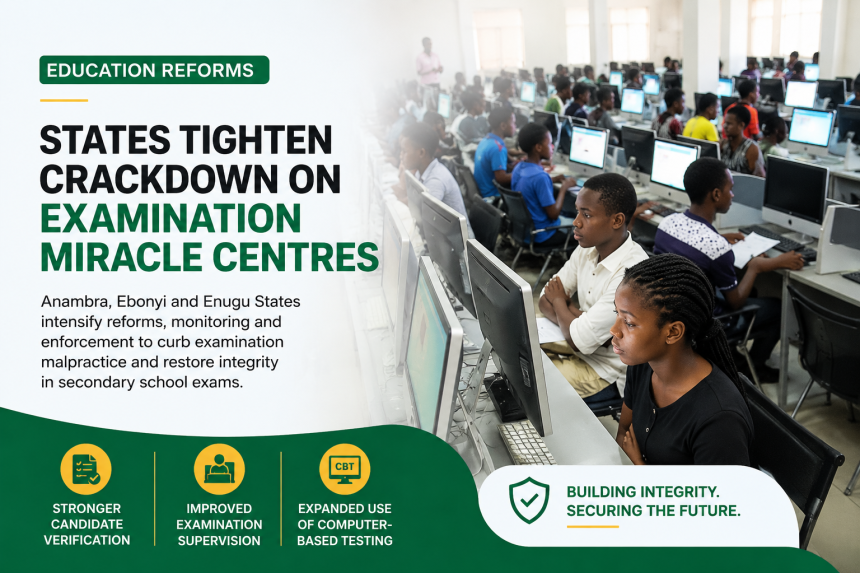
Education stakeholders in Anambra, Ebonyi and Enugu states say reforms targeting examination malpractice are beginning to weaken the activities of so-called “miracle centres”, while strengthening accountability across the secondary school system.
The stakeholders, who spoke separately in a survey conducted by the News Agency of Nigeria (NAN), said tighter candidate verification, school monitoring, stronger examination supervision and proposed wider use of Computer-Based Tests (CBT) were among measures that could reduce malpractice in the West African Senior School Certificate Examination (WASSCE) and National Examinations Council (NECO) examinations.
They described examination malpractice as a longstanding threat to the credibility of Nigeria’s education system, with parents, students, teachers and school administrators identified among those who can either enable or help prevent the practice.
Enugu strengthens candidate verification
In Enugu, the Executive Chairman of the Enugu State Post Primary Schools Management Board (PPSMB), Rev. Fr. Hilary Mgbodile, said the state had incorporated the fight against examination malpractice into its wider education reform programme.
A major intervention, he said, was stopping students from moving from their registered schools to established miracle centres to sit external examinations.
Under the system, class lists are captured at the SS2 level and subsequently verified so that students sit their external examinations in the schools where they completed SS2. The measure is intended to prevent lesson centres and other establishments associated with malpractice from recruiting candidates from other schools.
Mgbodile also said Enugu had introduced external examination monitors to strengthen supervision and reduce opportunities for inducement of invigilators and monitors. The state provides basic necessities for monitors, including food and water, as part of efforts to reduce the likelihood of compromising their responsibilities.
An external examination screening committee also scrutinises candidates before registration, while schools are required to obtain approved candidate lists from the Ministry of Education and the screening committee before registering candidates for external examinations.
Anambra prioritises monitoring and accountability
In Anambra, the Commissioner for Education, Dr Ekene Ogugua, said the government was using monitoring and administrative accountability to prevent schools from becoming centres for examination malpractice.
Ogugua said he had engaged principals and operators of public and private secondary schools on the importance of discipline and adherence to examination standards. He also undertook unscheduled visits to schools during the recently concluded NECO examinations to assess compliance with established guidelines.
He said school managers were expected to take responsibility for discipline and examination integrity in their institutions, warning that administrators who failed to align with the government’s education reform agenda could face removal.
The commissioner said the Ministry of Education would continue unscheduled monitoring during internal and external examinations to strengthen accountability and protect the credibility of the state’s education system.
The Chairperson of the All Nigeria Confederation of Principals of Secondary Schools (ANCOPSS), Anambra Chapter, Mrs Hope Ezeani, said principals supported the government’s efforts to improve the education system and eliminate examination malpractice.
The Executive Secretary of the Anambra State Post-Primary Schools Service Commission, Mr Benedine Anagor, also said there had been no reported case of miracle centres or withheld WAEC and NECO results in public schools in the state. He stressed the responsibility of school administrators to ensure compliance with examination guidelines.
Stakeholders seek stronger enforcement
Teachers in Anambra said eliminating miracle centres would require more than examination-period enforcement.
Mrs Prisca Chimezie, a mathematics teacher, said the centres provide candidates with an unfair advantage by facilitating access to examination assistance and fraudulent results. She attributed part of the problem to pressure from parents and students who prioritise high grades over actual learning.
Other teachers called for continuous school monitoring, stronger supervision of teachers and invigilators, appropriate sanctions for those involved in malpractice and expanded guidance and counselling programmes.
Mr Simon Onyekachi, an ANCOPSS chairman in Nsukka Local Government Area, identified examination-question leakage as another factor supporting miracle centres. He called for tighter protection of WAEC and NECO examination materials and prosecution of officials found culpable.
He also recommended the withdrawal of licences from schools involved in examination malpractice as a deterrent.
Push for wider use of CBT
Several stakeholders advocated the expansion of CBT beyond existing examinations.
A school administrator, Mr Ben Edeh, said the use of CBT in examinations such as the Joint Admissions and Matriculation Board (JAMB) examination had reduced opportunities for malpractice compared with traditional examination formats.
He argued that extending CBT to WASSCE, NECO and other major examinations could make it harder for candidates to receive external assistance and would place greater emphasis on individual preparation and knowledge.
A former education supervisor in Nsukka, Mrs Ann Ugwu, similarly urged WAEC and NECO to accelerate the transition to CBT for senior secondary school final examinations.
However, the Secretary of the Ebonyi State Universal Basic Education Board, Dr Livinus Ezeuwa, cautioned that technology alone would not solve the problem. He said CBT would need to be supported by broader enforcement measures and collective action involving government, parents, teachers, school administrators and students.
Parents, schools share responsibility
Stakeholders also linked examination malpractice to inadequate preparation, weak reading culture and pressure from families.
Teachers said some parents, worried about poor academic performance, sometimes encourage children to seek examination centres where they believe they can obtain higher grades through malpractice. They warned that this undermines genuine learning and can discourage students who invest time and effort in their studies.
Mrs Ukamaka Okoro also raised concerns about inadequate teaching and learning materials in some schools, as well as alleged involvement of some teachers and the use of artificial intelligence in facilitating malpractice. She nonetheless supported CBT as one measure that could help minimise the problem.
In Ebonyi, the Area Inspector of Education for Ikwo Local Government Area, Mr Sunday Nweke, attributed malpractice partly to poor reading habits and a weak value system. He called for greater respect for knowledge and stronger collaboration among government, schools, teachers, parents and students.
The stakeholders agreed that the sustainability of the reforms would depend on consistent enforcement rather than short-term interventions during examination periods.
For the states, the policy challenge extends beyond preventing candidates from cheating. It is also about restoring confidence in school-based assessment, ensuring that certificates reflect actual learning and strengthening the capacity of schools to produce graduates with knowledge and skills that can withstand scrutiny beyond the examination hall.