Nigeria’s North Central region must move decisively from an economy built around the production and export of raw agricultural and mineral resources to one driven by manufacturing, processing and value addition, prominent regional leaders have said.
The call reflects a growing recognition that the region’s substantial natural-resource endowments have not translated into commensurate industrial capacity, employment or locally retained wealth.
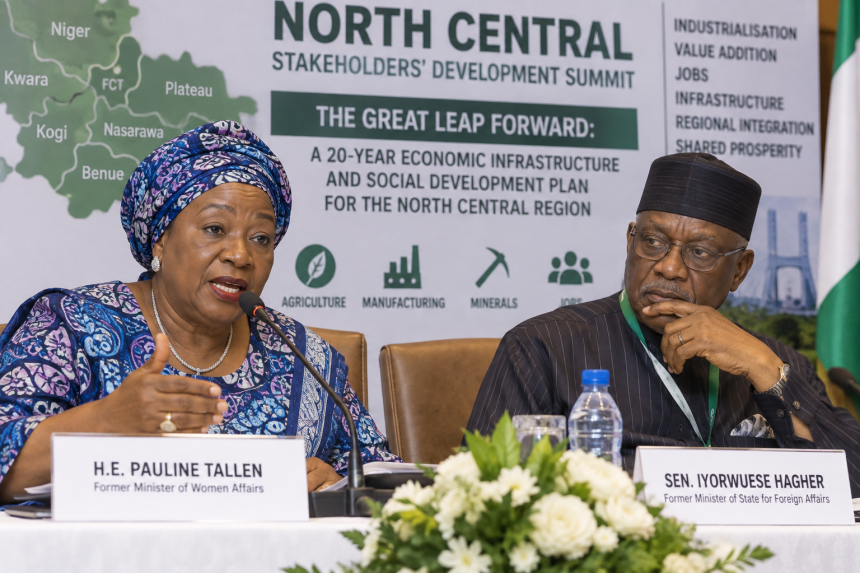
Former Minister of Women Affairs, Pauline Tallen, and former Minister of State for Foreign Affairs, Sen. Iyorwuese Hagher, made the case for a coordinated industrial transformation of the region at a Stakeholders’ Development Summit in Abuja on Monday.
The summit, themed “The Great Leap Forward: A 20-Year Economic Infrastructure and Social Development Plan for the North Central Region,” brought renewed attention to the economic possibilities presented by the region’s strategic location and its agricultural and mineral resources.
The North Central comprises Benue, Kogi, Kwara, Nasarawa, Niger and Plateau states, as well as the Federal Capital Territory.
For Tallen, the region already possesses many of the basic ingredients required to support a major manufacturing economy. Its agricultural production, mineral deposits and central position within Nigeria’s transport and commercial networks, she argued, provide a foundation for industrial expansion.
The missing element, she said, is a sufficiently coordinated political and economic strategy among the states.
“What we only lack is the cohesion, the unity, the patriotism, the love to work together,” Tallen said.
Her argument goes to the heart of the region’s development challenge. Individual states may pursue agricultural, mining, infrastructure or investment initiatives, but fragmented interventions can limit their collective economic impact.
A regional industrial strategy, by contrast, could allow states to develop complementary industries, share infrastructure and logistics networks, attract larger investments and create integrated supply chains stretching from farms and mines to factories and markets.
Tallen therefore urged governors, federal ministers and other stakeholders to work closely with the North Central Development Commission (NCDC), established by the Federal Government to address development challenges in the region.
She said the commission should be positioned as an engine for industrial and infrastructure development, with particular attention to factory establishment, mineral processing and other productive investments.
The effectiveness of the NCDC, however, would depend on the extent to which state and federal authorities align their policies and programmes with its development objectives.
Tallen said the commission could not deliver meaningful transformation without the cooperation of governors and federal officials whose policies directly affect land, infrastructure, investment, taxation, security and economic activity.
The region’s mineral wealth, she added, should no longer be viewed simply as a source of commodities for external markets.
“We are sitting on gold, diamonds, and lithium. What we need to do is unite and implement,” she said.
That emphasis on implementation is significant for a region that has considerable resource potential but still faces gaps in industrial infrastructure, processing capacity and investment.
Turning mineral deposits into a source of broad-based development requires more than extraction. It requires processing facilities, reliable power, transport infrastructure, skilled labour, financing and an investment environment capable of supporting enterprises through the entire production chain.
The same principle applies to agriculture, which remains central to the economies of several North Central states.
Hagher was particularly critical of a production model in which farmers supply commodities while the higher-value stages of processing, packaging, storage and distribution occur elsewhere.
“We produce, others process; we harvest, others warehouse. A food basket can still really be a poverty basket, and that must end now,” he said.
His argument highlights a structural weakness in Nigeria’s agricultural economy: high production does not automatically generate high incomes when producers have limited access to processing and organised markets.
The development of agro-processing clusters could allow the North Central to capture a greater share of the value generated by its agricultural output.
Benue’s agricultural production, for instance, could support larger-scale food processing and packaging industries, while states such as Niger, Nasarawa, Kogi and Kwara could develop processing and manufacturing activities around their own agricultural and mineral resources.
Hagher called for the establishment of agro-processing factories, cold-chain facilities and specialised industrial parks across several North Central states.
Such infrastructure could address multiple constraints simultaneously. Cold-chain systems can reduce losses in perishable agricultural products; processing plants can extend the shelf life and increase the value of commodities; while industrial parks can provide businesses with shared infrastructure and a more predictable operating environment.
The economic implications extend beyond agriculture.
A functioning industrial ecosystem can create demand for transport, warehousing, financial services, engineering, construction, technology, packaging and professional services. It can also expand the tax base of states as formal businesses and employment opportunities increase.
But the industrialisation agenda will face a fundamental obstacle if insecurity continues to disrupt rural production.
Hagher therefore placed security at the centre of the region’s economic development strategy, arguing that farmers cannot sustain production and investors cannot build reliable supply chains in areas where communities remain unsafe.
“A dead farmer cannot produce yam; an abandoned village pays no tax. Peace is infrastructure, and justice is development,” he said.
The statement underscores an increasingly important dimension of economic policy: security is not merely a social or political concern. It is also an economic input.
Where farmers abandon their land, agricultural supply declines. Where rural roads become unsafe, logistics costs increase. Where communities are displaced, local markets contract. And where investors perceive persistent insecurity, capital is likely to move elsewhere.
For the North Central to become an industrial corridor, therefore, investment in physical infrastructure will have to be matched by investment in security, institutions and human capital.
Hagher also warned against reducing the NCDC to another bureaucratic institution whose principal activities revolve around administration and expenditure.
“The NCDC must not become another office that spends money and produces audit reports. It must become the strategic brain of an integrated regional economy,” he said.
That vision would require the commission to play a stronger coordinating role in investment promotion, infrastructure planning, industrial policy and regional economic integration.
It would also require measurable outcomes.
The success of a regional development commission should ultimately be judged not only by the number of projects it funds, but by the economic activity those interventions generate: factories established, jobs created, businesses expanded, commodities processed locally, investment attracted, infrastructure delivered and state revenues strengthened.
The region’s young population will also be critical to that transformation.
Hagher urged young people to move beyond dependence on political patronage and become active participants in manufacturing, processing, technology and distribution.
For the North Central, this could represent an opportunity to connect traditional economic strengths with emerging technologies.
Digital platforms can improve access to markets, logistics technology can strengthen supply chains, financial technology can widen access to business finance, while technical and vocational training can help develop the workforce required by modern manufacturing.
The region’s proximity to Abuja provides another strategic advantage.
Hagher proposed that the Federal Capital Territory should become a major consumer market for goods manufactured and processed in the North Central.
The opportunity is considerable. Abuja’s large population, government institutions, businesses, hospitality industry and expanding service economy generate substantial demand for food, construction materials, household products, industrial inputs and other manufactured goods.
A stronger supply relationship between Abuja and neighbouring North Central states could reduce transportation distances for producers while creating a ready market for locally processed goods.
More importantly, it could help establish a regional economic corridor in which production, processing, logistics and consumption reinforce one another.
The broader challenge, however, is translating the emerging consensus into an implementable long-term strategy.
A 20-year development plan must go beyond broad aspirations. It will require clear industrial priorities, state-level specialisations, infrastructure sequencing, financing mechanisms, investment incentives, skills development programmes and measurable targets.
It will also require continuity beyond individual political administrations.
For a region endowed with agricultural land, strategic transport routes and significant mineral resources, the central development question is increasingly not whether resources exist, but whether the institutions and infrastructure needed to convert those resources into sustainable economic value can be built.
The message from the Abuja summit is therefore straightforward: the North Central cannot achieve its full economic potential by remaining primarily a supplier of raw materials.
Its next phase of development will depend on how effectively it can build factories around farms and mines, connect producers to markets, secure its production corridors and coordinate the economic strengths of its constituent states.
If that transition is achieved, the North Central could move from being described primarily in terms of what it produces to being recognised for what it manufactures, processes, exports and creates.