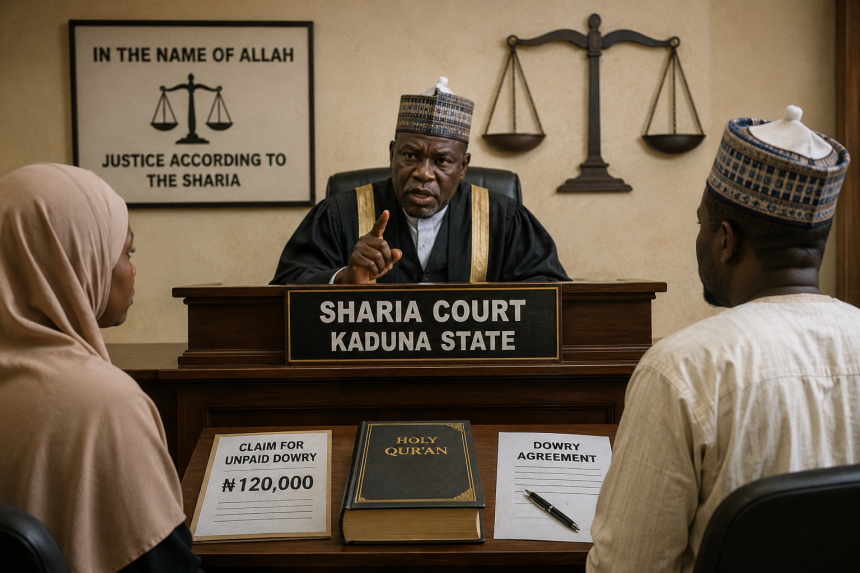
A housewife, Ummulkhairi Lawal, has approached a Sharia Court in Magajin Gari, Kaduna, seeking an order compelling her former husband, Isa Haruna, to pay the ₦120,000 dowry agreed upon at the time of their marriage.
Lawal told the court on Thursday that the amount remained unpaid despite the dissolution of their marriage.
According to her, Haruna divorced her on March 27 and was expected to settle the outstanding dowry following the divorce.
“He divorced me on March 27 and is to offset the dowry. I beg the court to order him to pay me,” Lawal told the court.
She therefore urged the court to intervene and ensure that the agreed amount was paid to her.
Responding to the claim, Haruna did not dispute the obligation but appealed for more time to raise the money.
“I am a commercial tricyclist. I am pleading with the court to give me four months to look for the money to pay her,” he told the court.
Haruna’s plea was, however, not granted in full.
Delivering his ruling, the judge, Malam Yakubu Abdullahi, stressed the importance of prompt payment of dowry under Islamic law.
The judge explained that a woman’s dowry was an entitlement that should not be unnecessarily withheld, noting that delayed payment could cause inconvenience to the woman.
“In Islam, the dowry of a woman is supposed to be paid without delay, for fairness and in order not to inconvenience her,” Abdullahi said.
The court subsequently ordered Haruna to pay Lawal the agreed sum of ₦120,000.
Rather than granting the four-month period requested by Haruna, the judge gave him until October 5 to settle the outstanding dowry.
The ruling brings the dispute over the unpaid marital entitlement before the court to a specific deadline, requiring Haruna to make the payment within the period stipulated by the Sharia Court.