


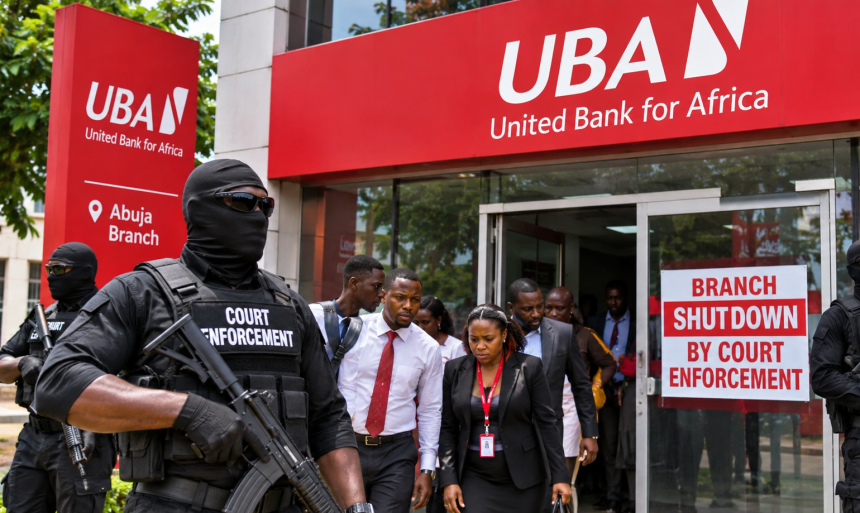
Masked security operatives eject customers, staff from Abuja branches; operation expected to continue as judgment creditors intensify pressure on bank
ABUJA — As a new working week begins, staff of United Bank for Africa (UBA) Plc in Abuja face uncertainty over their return to work amid fears of another encounter with masked, gun-wielding security operatives reportedly enforcing a court order over a ₦7.448 billion judgment debt involving the Benue State Government.
Banking operations at several UBA branches in the Federal Capital Territory have been disrupted since Friday, October 23, 2026, when armed operatives reportedly stormed the bank’s premises, ordered customers and employees out of the banking halls and halted operations.
The development marks a significant escalation in the protracted legal battle involving Mauritz Walton Limited, Bizplus Consulting Services Limited and the Benue State Government, with UBA caught in the enforcement process as the garnishee bank.
The judgment creditors are seeking to recover ₦7,448,113,025.42 awarded by the FCT High Court in a judgment delivered by Justice Bello Kawu on November 17, 2025.
In a subsequent ruling delivered on December 4, 2025, the court made its earlier Garnishee Order Nisi absolute against UBA, directing the bank to pay the judgment sum within 24 hours of service of the order.
The court established that the Benue State Government maintained a FAAC/Treasury Single Account with UBA, which had a balance of approximately ₦2.09 billion when the initial garnishee order was served. It further noted that subsequent FAAC allocations had been paid into the account and found that the funds were sufficient to satisfy the judgment debt as of December 1, 2025.
Justice Kawu rejected the argument that pending appeals by the Benue State Government could halt the garnishee proceedings, holding that an appeal against the substantive judgment did not automatically operate as a stay of the garnishee process.
Consequently, the court directed UBA, identified as the 17th garnishee, to remit the full judgment sum to the judgment creditors through their solicitors within 24 hours of service of the order.
CREDITORS SEEK TO DETER OTHER BANKS
The judgment creditors are understood to have resorted to the enforcement action not only to recover the outstanding judgment debt but also to send a strong warning to other financial institutions allegedly in the habit of frustrating or disregarding valid court orders.
The move is intended to demonstrate that banks cannot continue to hide behind procedural arguments or their corporate status when acting as garnishees in the enforcement of judicial decisions.
The Group Executive Chairman and Chief Executive Officer of Mauritz Walton Limited, Dr. Maurice Ibe, had earlier indicated that the company was prepared to pursue all available legal options to secure compliance with the court’s decision.
Ibe disclosed that the company had activated contempt proceedings against UBA’s top executives and instructed its legal team to pursue further enforcement measures, including applications for the attachment of the bank’s headquarters and other properties in Abuja.
He also disclosed that the company had briefed lawyers in the United Kingdom and the United States to explore the possibility of pursuing UBA’s assets in those jurisdictions and reporting the bank’s alleged conduct to relevant regulatory authorities.
The Mauritz Walton chairman maintained that the company had exhausted considerable time and resources pursuing the matter through the courts and would not abandon the enforcement process.
He also cited an earlier judgment involving the Ebonyi State Government, in which he alleged that UBA frustrated efforts to recover a separate judgment debt involving $30 million and ₦20 billion.
For the judgment creditors, the latest enforcement operation is therefore being presented as a broader warning against the alleged practice of financial institutions frustrating the execution of court judgments.
UNCERTAINTY AS NEW WORKING WEEK BEGINS
With the security operatives reportedly indicating that the exercise would continue, uncertainty surrounds the resumption of normal banking activities at affected UBA branches in Abuja.
The prospect of further enforcement operations raises concerns among customers and businesses that depend on the bank for daily financial transactions, while employees are left uncertain about the security and operational conditions awaiting them at their duty posts.
The situation also raises broader questions about the implications of enforcement actions against financial institutions, particularly where customers and employees who are not parties to the underlying litigation become affected.
While the judgment creditors appear determined to sustain pressure on the bank, UBA’s response to the reported enforcement operation and allegations of non-compliance was not available at the time of filing this report.
The legal dispute is increasingly becoming a test of the enforcement of judicial decisions in Nigeria, particularly the obligations of banks served with garnishee orders and the consequences of any established failure to comply.
For now, the coming days could prove decisive for UBA’s Abuja operations as the judgment creditors intensify their efforts to recover the ₦7.448 billion debt and pursue legal consequences over the alleged non-compliance with the court’s order.