


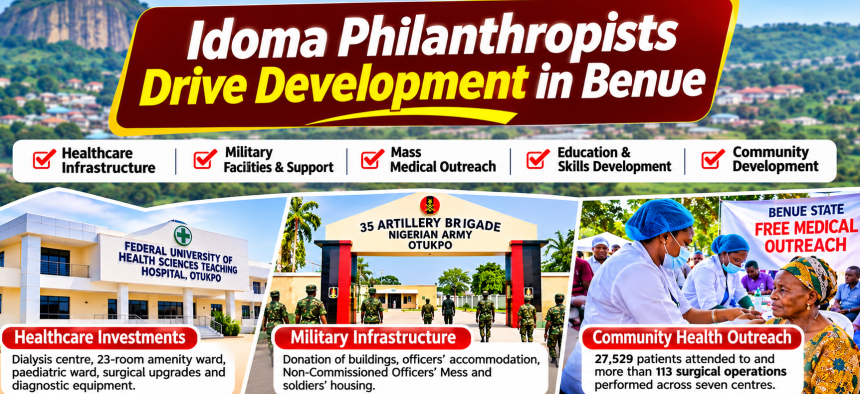
From Godwin Obla’s investments in healthcare to Harrison Adoga’s donation of a building to the Nigerian Army and Sonny Echono’s medical outreach that attended to 27,529 patients, Idoma philanthropists are redefining community development through enduring public interventions.
A new chapter appears to be unfolding in the history of philanthropy in Idomaland, Benue State, as an emerging generation of accomplished sons and daughters increasingly deploys personal resources, professional influence and private assets to build, equip and donate substantial infrastructure to public institutions.
What is particularly remarkable about the emerging trend is the departure from the conventional understanding of philanthropy as occasional financial assistance, scholarships, donations to religious institutions or support for vulnerable individuals. Increasingly, the focus is shifting towards the construction of permanent facilities, provision of critical equipment and donation of valuable properties to institutions whose responsibilities extend beyond individual beneficiaries to entire communities.
From healthcare and education to military infrastructure and security, the emerging interventions suggest a growing determination among successful Idoma professionals, military officers, entrepreneurs and public figures to translate individual accomplishments into enduring community assets.
Recent developments in Otukpo, the political and administrative centre of Benue South, offer perhaps the clearest illustration of this changing philanthropic culture.
At the centre of the unfolding story are prominent personalities, including Chief Godwin Odumu Obla, SAN; Major General Harrison Adoga (rtd); Arc. Sonny S. T. Echono, Executive Secretary of the Tertiary Education Trust Fund (TETFund); Engineer Agaba Ikwue; AVM Emmanuel Ejeh (rtd); and several other distinguished sons and daughters of the Idoma nation.
Their interventions, although directed at different institutions and sectors, share a common thread: the willingness to commit substantial personal resources to the development of public infrastructure and the welfare of their people.
Obla and the emergence of legacy philanthropy
One of the earliest and most visible expressions of this new approach is the intervention of Chief Godwin Obla, SAN, whose investments in healthcare and education have helped establish a practical template for institutional philanthropy in Idomaland.
Obla’s philanthropic journey took a particularly significant turn following the death of his wife, Judith Ogwa Obla, from complications associated with diabetes and kidney failure in 2022.
Determined to transform his personal loss into a lasting contribution to society, he established the Judith Ogwa Obla Memorial Kidney Centre at the Federal University of Health Sciences Teaching Hospital, Otukpo.
The specialised facility, reportedly valued at about N400 million, was equipped with six dialysis machines and supporting medical infrastructure, bringing an important renal care service closer to patients in Benue South and neighbouring communities.
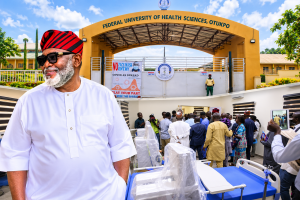
Its significance has extended beyond the immediate availability of dialysis services. According to the hospital’s management, the centre has reduced the financial and physical burden on patients who would otherwise have to travel outside Otukpo to access treatment.
Obla subsequently expanded his intervention to other areas of institutional development. Through the Godwin Obla Foundation, he initiated the construction of a 23-room modern amenity ward at the teaching hospital, designed to improve patient accommodation and comfort.
The project, which was conceived after he encountered the poor condition of existing hospital facilities, reflects a philosophy of philanthropy that goes beyond making donations to addressing identifiable institutional deficiencies.
His foundation has also supported educational development through endowments, scholarships and interventions in school infrastructure, while Obla has personally undertaken to support outstanding young Idoma professionals in their academic advancement.
His latest intervention at the teaching hospital, alongside contributions from other benefactors, has further expanded the scope of this engagement.
The projects include the completion and furnishing of the 23-room amenity ward, upgrading of the renal dialysis centre, installation of a 20KVA solar power system and construction of a connecting walkway.
Other contributors have taken responsibility for different sections of the hospital. Engineer Agaba Ikwue has undertaken the construction, equipping and furnishing of an emergency paediatric ward, while Architect Akor Adapoyi has supported the renovation and furnishing of the male surgical ward.
Major General Alechenu Mike Alechenu (rtd) has contributed to the rehabilitation of hospital walkways, while Dr Joshua Musa, SAN, donated a high-resolution digital mobile X-ray machine.
Obla has also indicated his intention to champion a proposed N1 billion medical simulation centre to strengthen medical education and clinical training at the university.
The cumulative effect is a growing partnership between private citizens and a federal healthcare institution, with individuals taking responsibility for projects that would ordinarily require substantial public investment.
A new dimension: Idoma philanthropy and military infrastructure
The arrival and operationalisation of the Nigerian Army’s 35 Artillery Brigade in Otukpo have introduced another remarkable dimension to this emerging culture of giving.
In a development that has attracted considerable attention, Major General Harrison Adoga (rtd) donated his sprawling one-storey property in Otukpo Government Reserved Area (GRA) to serve as the formation’s foundation headquarters.
At an emotional handover ceremony, Adoga described the establishment of the Brigade in Otukpo as a prayer answered, recalling the longstanding relationship between the Idoma people and the Nigerian military.
He traced that relationship to the early military careers of distinguished Idoma officers, including retired General Ebije Ikwue, a former Chief of Air Staff, and the late General Ignatius Obeya, among others.
He also recalled the sacrifices suffered by the Idoma people during the Nigerian Civil War of 1967 to 1970, placing the Brigade’s establishment within the broader historical experience of the community.
But Adoga’s gesture did not stand alone.
Other illustrious sons of Idomaland used the occasion to demonstrate their support for the new military formation through donations of residential facilities, accommodation and other resources to facilitate its take-off.
Retired Colonel Idu Enonche, of the Nigerian Defence Academy’s Third Regular Course, assured the Brigade Commander of the support of retired military personnel.
Air Vice Marshal Emmanuel Ejeh (rtd) donated his residential property in Otukpo GRA, while the Ward Head of Ewulo, Chief Akatu Ahubi, offered his palace at Upu to accommodate the Brigade Commander.
Perhaps one of the most significant commitments came from Chief Godwin Obla, SAN, who pledged to construct, furnish and deliver a Non-Commissioned Officers’ Mess to the Brigade by Easter 2027.
The proposed facility will be named after his father, who retired from the Nigerian Army as a Regimental Sergeant Major, thereby linking the donation to a family history of military service.
Engineer Agaba Ikwue, who has also been active in the hospital development projects, promised a comprehensive renovation of the Brigade Commander’s residence and the construction of a block of ten apartments for soldiers.
The Chairman of Aojoko k’Otukpo, Dr David Ekwo, welcomed the new formation and pledged the cooperation of the people of Otukpo.
General Owoicho Ejiga, son of the late first Idoma Major General, Geoffrey Ejiga, and a course mate of the new Brigade Commander, also sent a goodwill message announcing the donation of his facility in Otukpo town.
The donations collectively represent a substantial community contribution to the establishment of the Brigade’s initial administrative and residential infrastructure.
For a community that has historically produced distinguished military officers, the gesture also carries a symbolic significance: a demonstration of local ownership and support for an institution expected to contribute to security in the area.
Reacting to the generosity, Dr Wadai Mutah, Director of General Studies at the Federal University of Health Sciences, Otukpo, and an indigene of Borno State, described himself as a living witness to the hospitality of the Idoma people.
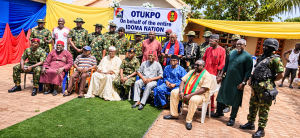
He recalled being accommodated free of charge by an Idoma individual for nine months, expressing the hope that the spirit of generosity demonstrated towards the Army would be replicated by other communities.
In his acceptance speech, the visibly elated Brigade Commander, Brigadier General J. A. Hassan, thanked Adoga and the other donors, describing the occasion as his happiest since joining the Nigerian Army.
He said the history of the 35 Artillery Brigade would remain incomplete without an account of the extraordinary support received from the people of Otukpo.
Hassan promised to document the community’s positive disposition towards the military and expressed his commitment to building a mutually beneficial military-civilian relationship.
He, however, emphasised that the Army would remain decisive in dealing with threats to peace within its areas of responsibility.
Security agencies operating in Benue South also pledged their support to the Brigade Commander.
The Och’Otukpo Odu, Chief Dr John Onuminya Eimonye, OON, welcomed the establishment of the formation and invoked God’s blessings and those of the ancestors on the benefactors and everyone contributing to peace in the land.
The development is particularly significant because it extends the new philanthropic momentum beyond the traditional sectors of healthcare and education into the critical area of security.
Echono’s medical outreach reaches 27,529 patients
While Obla, Adoga and other benefactors are committing resources to permanent institutional infrastructure, Arc. Sonny S. T. Echono has demonstrated another dimension of philanthropy through a large-scale intervention in public healthcare.
The TETFund Executive Secretary recently facilitated a five-day free mega medical outreach across Benue State, providing consultations, diagnostics, treatment, medications and surgical services to thousands of residents.
The outreach, organised under the North-Central Grassroots Mobilisation Movement for Tinubu/Shettima 2027, commenced on October 27 and ended on October 31, 2026.
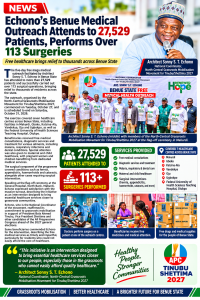
At the conclusion of the exercise, organisers reported that 27,529 patients had been attended to, while more than 113 surgical operations had been successfully performed.
The programme covered seven healthcare centres across the state, including facilities in Makurdi, Gboko, Katsina-Ala, Vandeikya, Oju and Ugbokpo, as well as the Federal University of Health Sciences Teaching Hospital, Otukpo.
Its services covered a wide range of medical needs, including malaria and respiratory infections, dental conditions, eye examinations, cataract procedures, blood pressure and blood sugar checks, maternal and child healthcare, hernia and appendicitis operations, haemorrhoid treatment and other minor surgical interventions.
Beneficiaries also received free medication, reading glasses and other medical supplies, while children benefited from deworming services and the distribution of mosquito nets.
The programme was particularly significant for rural and low-income households that often postpone medical treatment because of the cost of consultations, investigations, drugs and surgical procedures.
At the flag-off ceremony in Makurdi, Echono described the initiative as an intervention designed to bring essential healthcare services closer to grassroots communities, particularly people who could not readily afford quality medical care.
The reported outcome, with more than 27,000 patients attended to and over 113 operations performed within five days, places the outreach among the notable private-led mass healthcare interventions in the state.
Although organised through a political grassroots mobilisation platform, the medical services were presented as free to all eligible residents, without registration, consultation, medication or surgery charges.
For Idomaland, the significance of Echono’s intervention is also reflected in his connection to the community and his willingness to deploy his personal influence and organisational capacity to address a major public welfare concern across the state.
From individual generosity to collective development
What is emerging from these developments is not simply a succession of generous gestures by wealthy individuals. It is the gradual formation of a new philanthropic culture in which accomplished citizens are increasingly identifying public institutions as legitimate destinations for substantial private investment.
The distinction is important.
A donated building, a fully equipped hospital ward, a dialysis centre, a diagnostic machine, soldiers’ accommodation or a medical simulation facility constitutes an asset whose benefits can extend well beyond the immediate beneficiaries and the lifetime of its donor.
In the case of the 35 Artillery Brigade, the willingness of retired military officers and other prominent Idoma personalities to donate residential properties and commit resources to the formation’s take-off demonstrates how community goodwill can be mobilised around an institutional objective.
Similarly, the collective intervention at the Otukpo teaching hospital shows how one person’s initiative can inspire others to take responsibility for different components of a common development challenge.
There is, however, a larger question about the sustainability of this emerging model.
Public institutions receiving privately funded infrastructure must have the personnel, funding, maintenance arrangements and administrative capacity required to keep the facilities operational. Government must also continue to discharge its responsibilities rather than allow private philanthropy to become a substitute for public investment.
The Army’s relationship with host communities must equally be anchored on mutual respect, professional conduct and the protection of civilian interests.
These considerations notwithstanding, the developments offer a compelling example of how private initiative can complement government efforts and strengthen public institutions.
For Idomaland, the opportunity now is to expand the culture beyond a handful of prominent personalities and individual projects. Successful Idoma professionals, business leaders, entrepreneurs and members of the diaspora could be encouraged to adopt public schools, support university research, establish vocational centres, provide water infrastructure and invest in rural healthcare.
The emerging examples also invite a reassessment of what constitutes a meaningful legacy.
For some, it may be the establishment of a successful business or the attainment of a distinguished professional position. For others, it may be a public institution that continues to serve thousands of people long after its benefactor has departed.
The growing interventions of Obla, Adoga, Echono, Ikwue, Ejeh and their associates suggest that a number of accomplished Idomas are increasingly embracing the latter proposition.
The significance of the moment, therefore, lies not only in the number or monetary value of the donations, but in the changing philosophy behind them.
From hospitals to military facilities, the people of Idomaland are witnessing a form of philanthropy that builds, equips, accommodates and institutionalises.
If the momentum is sustained and matched with responsible public management, the new generation of benefactors may well be remembered not merely for what they gave, but for the public institutions they helped strengthen and the enduring assets they left behind.