

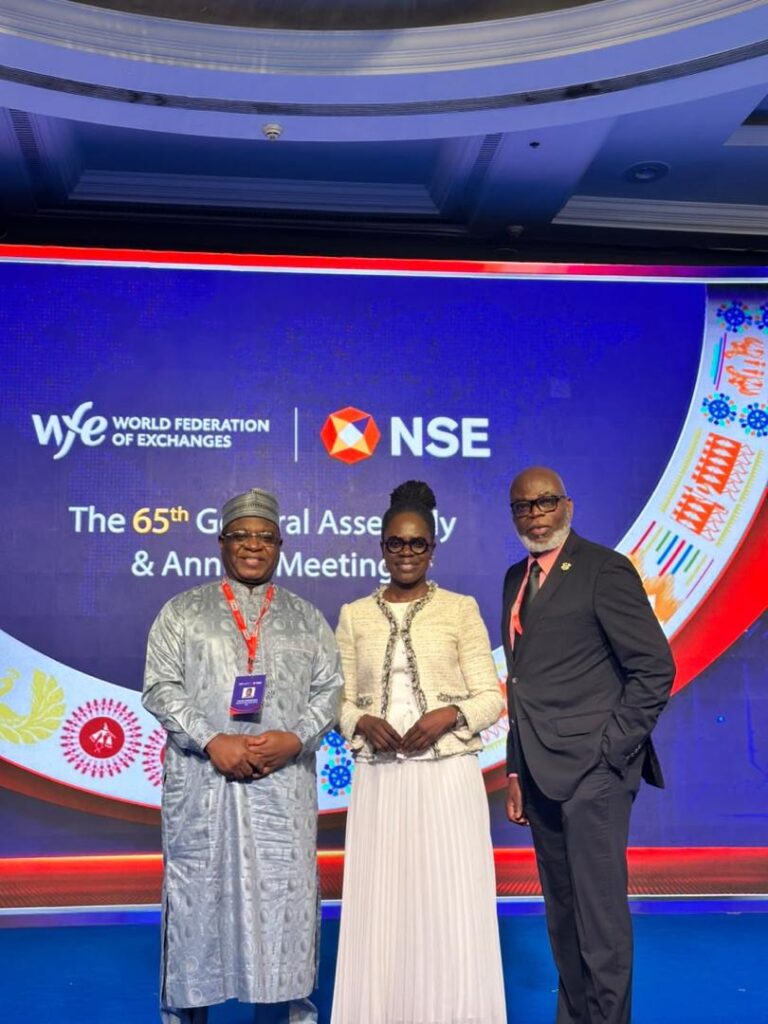
The Nigerian Exchange Group (NGX Group) is pushing for stronger integration of African capital markets, with cross-border trading identified as a key mechanism for expanding investment opportunities, improving liquidity and attracting greater participation in the continent’s stock exchanges.
The group’s chairman, Alhaji Umaru Kwairanga, said connecting African exchanges would create a larger and more liquid investment market, potentially strengthening the continent’s ability to compete with established global financial centres.

Kwairanga made the remarks at the 65th General Assembly and Annual Meeting of the World Federation of Exchanges (WFE), held in Mumbai, India, from Nov. 17 to Nov. 19.
He identified the African Exchanges Linkage Project (AELP) as an important framework for advancing the integration agenda by enabling investors and market operators to access participating exchanges through cross-border trading arrangements.
According to him, improved connectivity among African exchanges could widen investment access, strengthen market liquidity and improve the global competitiveness of the continent’s capital markets.
He said NGX was strengthening its institutional structures and processes while pursuing partnerships across Africa and other regions to expand its market reach.
The chairman also emphasised the importance of international collaboration and knowledge exchange in improving the efficiency and standards of capital market operations.
He described the WFE annual meeting as an important platform for market operators to exchange expertise, assess emerging developments and examine research shaping the global financial industry.
The meeting, hosted by the National Stock Exchange of India, also provided an opportunity for exchanges to strengthen institutional relationships and share approaches to improving investor services.
Kwairanga reaffirmed NGX Group’s commitment to the WFE’s efforts to promote sound policies, international standards and innovative services across global exchanges.
However, the broader integration ambition will depend on how effectively participating African markets address differences in trading infrastructure, regulatory frameworks, settlement systems and currency arrangements.
For Nigeria, deeper regional market connectivity could create additional channels for capital mobilisation, broaden investment opportunities and strengthen the country’s position within Africa’s financial system.