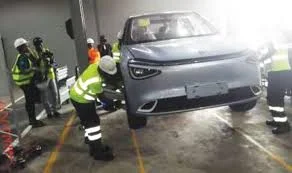
Stakeholders target African leadership in electric mobility and local manufacturing
The Federal Government has reiterated its commitment to accelerating the growth of Nigeria’s electric vehicle (EV) industry through policies that promote local content development, innovation, technology transfer and industrial expansion.
This assurance was given by the Minister of Innovation, Science and Technology, Dr. Kingsley Udeh, during the inaugural meeting of the Electric Vehicle Assemblers and Manufacturers Association of Nigeria (EVAMAN) held in Abuja.
Represented by the National Coordinator of the Strategy Implementation Task Office for Presidential Executive Order No. 5, Mr. Ibiam Oguejiofor, the minister said the government was determined to ensure that Nigerian expertise, resources and enterprises play a leading role in shaping the country’s industrial future.
According to him, Presidential Executive Order No. 5 remains one of the Federal Government’s key policy instruments for strengthening indigenous capacity and increasing local participation in science, engineering and technology-related projects.
He explained that the Ministry of Innovation, Science and Technology is working closely with relevant Ministries, Departments and Agencies (MDAs) to institutionalise local content requirements across strategic sectors, including clean transportation, renewable energy, advanced manufacturing and digital innovation.
“Our objective is clear and unwavering: Nigerian talent, Nigerian resources, Nigerian technology and Nigerian enterprises must occupy a central place in the country’s industrial future,” Oguejiofor said on behalf of the minister.
He added that the ministry would continue to support EVAMAN through policy coordination, research partnerships, innovation support programmes and strategic collaborations designed to drive industrial growth within the emerging electric mobility sector.
EVAMAN Charts New Course
Speaking at the event, EVAMAN President, Mustapha Audu, described the inauguration as a significant milestone in the association’s development, marking its transition from a caretaker administration to a democratically elected leadership structure.
Audu noted that within two years of its establishment, EVAMAN had secured legal recognition through registration with the Corporate Affairs Commission (CAC) and built productive relationships with government agencies and industry stakeholders.
He said the association had successfully expanded its membership to include electric vehicle manufacturers, assemblers, charging infrastructure providers, renewable energy specialists, researchers and investors across the electric mobility value chain.
“Nigeria has enormous potential to become a major player in Africa’s electric mobility revolution,” Audu said.
“With our large market, skilled manpower and growing technological capacity, we can position ourselves as a hub for electric vehicle manufacturing and clean transportation solutions in Africa.”
He stressed that the association would continue to advocate policies and partnerships that encourage investment and innovation in the sector.
PEBEC Highlights Economic Opportunities
The Director-General of the Presidential Enabling Business Environment Council (PEBEC), Zahrah Audu, said the Federal Government remains committed to building a modern, competitive and innovation-driven economy under President Bola Tinubu’s Renewed Hope Agenda.
She noted that electric mobility presents significant opportunities for industrialisation, environmental sustainability, renewable energy integration and youth employment.
According to her, PEBEC will continue supporting reforms aimed at improving the ease of doing business and creating an enabling environment for investments in emerging industries.
“The electric vehicle ecosystem has the potential to stimulate growth across several sectors, including manufacturing, renewable energy, logistics, infrastructure technology and skills development,” she said.
Experts Identify Industry Challenges
In a presentation at the meeting, Operations and Strategy Consultant at Leke Services, Gift Agboro, identified several obstacles slowing the growth of Nigeria’s EV ecosystem.
She listed limited access to finance, inadequate charging infrastructure, the absence of comprehensive industry standards and insufficient market data among the major challenges facing stakeholders.
Agboro called for lower lending rates, stronger policy coordination and enhanced collaboration between public and private sector players to unlock the industry’s full potential.
She also emphasised the importance of a unified industry platform through EVAMAN to address regulatory gaps, improve transparency and facilitate sustainable infrastructure development.
Oando Expands Clean Mobility Investments
Meanwhile, President of Oando Clean Energy, Ademola Ogunbanjo, represented by the company’s Senior Vice President for Technology and Innovation, Adeyemi Adebajo, highlighted ongoing investments aimed at advancing clean transportation in Nigeria.
He disclosed that the company has deployed electric buses as part of broader efforts to promote environmentally friendly transportation and boost public confidence in electric mobility solutions.
Ogunbanjo added that renewable energy sources, particularly solar power, would play a crucial role in supporting sustainable transportation systems across the country.
New Leadership Emerges
The meeting concluded with the election of a new leadership team for EVAMAN.
Mustapha Audu emerged as President, while Al Amin Ibrahim was elected Vice President. Other elected officials include Chinedu Ochinanwata as Secretary General, Ademola Ogunbanjo as Assistant Secretary General and Adeyemi Olukayode Kalejaiye as Treasurer.
Additional members of the executive committee are Maxx EV as Assistant Treasurer, Celyena Okiyi as Legal Adviser, Ikenna Ayu as Head of Public Affairs, Chinedu Ekeh as Head of Research and Innovation, and Edward Ihejirika as Government Liaison and Policy Officer.
The newly elected leadership is expected to drive collaboration among stakeholders and support the development of policies and infrastructure needed to position Nigeria as a leading electric vehicle manufacturing and innovation hub in Africa.