


By Dr. Dahiru Ali
The race for the Benue South Senatorial District seat (Zone C), in the 2027 general elections is shaping up as a significant political contest, with implications for leadership, equitable representation and the future of the district. Beyond party supremacy and personal ambition, the election raises a fundamental question: will the eventual winner emerge through the genuine expression of the people’s will, or will the familiar challenges of Nigeria’s electoral system influence the outcome?
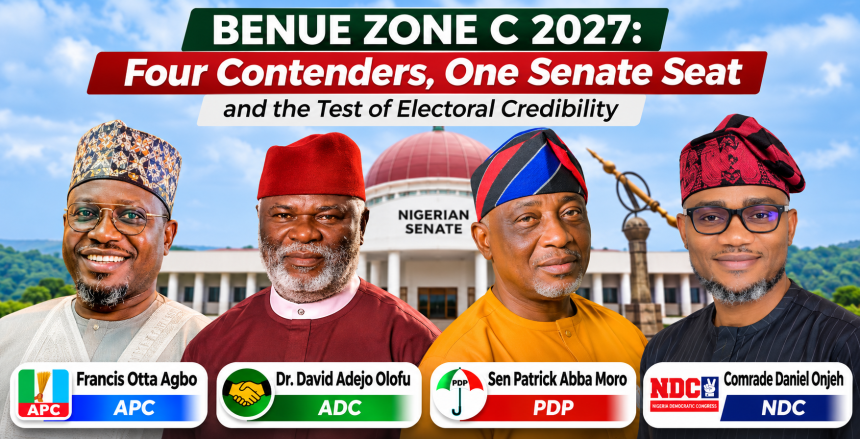
The list longer, but the frontrunners are Dr. David Adejo Olofu of the African Democratic Congress (ADC), incumbent Senator Abba Patrick Moro of the Peoples Democratic Party (PDP), former House of Representatives member Francis Ottah Agbo of the All Progressives Congress (APC), and Daniel Donald Onjeh of the Nigeria Democratic Congress (NDC). All these contestants bring different political backgrounds, networks and ambitions to the contest. Each offers a distinct proposition for Benue South, making the race a test of political experience, public acceptance, party organisation and the ability to mobilise support across the district.
Olofu is seeking to translate his experience in public finance, economic planning and governance into a development-oriented legislative mandate. Moro must defend his record after two terms in the Senate and convince voters that continuity remains in their interest. Agbo hopes to leverage his previous legislative experience and the APC’s control of the Federal Government to expand the party’s influence in a district where the PDP has maintained a strong presence. Onjeh, a familiar figure in previous senatorial contests, is seeking another opportunity through a new political platform after failing to secure the APC ticket.
Beyond their individual ambitions, the contest will engage the longstanding debate over equitable representation between the Idoma and Igede communities. The distribution of political opportunities, development projects and federal interventions across the district’s nine local government areas will remain important considerations. Whoever occupies the Senate seat will be expected to represent the collective interests of Benue South, rather than the narrow interests of a political, ethnic or geographical constituency.
But there is another dimension that makes the contest particularly consequential: the Nigerian factor. Elections in the country have, at different times, been affected by vote buying, voter intimidation, manipulation of polling-unit figures, falsification of results, compromise of electoral officials and irregularities during collation. These practices raise an uncomfortable question about whether political popularity and genuine voter support are always reflected in declared outcomes. Consequently, an assessment based solely on candidates’ credentials, party structures and grassroots mobilisation would overlook the potential influence of electoral malpractice.
The 2027 contest therefore presents two interconnected challenges: the competition among four politicians for the people’s mandate and the responsibility of electoral institutions to ensure that the mandate is respected. The central question is not simply who has the strongest political machinery or the most attractive campaign promises, but whether voters will have a free and credible opportunity to choose their representative—and whether the final result will faithfully reflect their choice.
Olofu: The Technocrat’s Bid to Redefine Representation
Of the four contenders, Dr. David Adejo Olofu appears to be positioning himself around a development-oriented political narrative that seeks to move the senatorial contest beyond the conventional politics of personalities, patronage and party affiliations.
A former Benue State Commissioner for Finance and Economic Planning, Olofu brings considerable experience in public administration, fiscal management and economic planning. His previous engagement with the Nigeria Governors’ Forum as Senior Technical Adviser on Fiscal Policy further strengthens his claim to an understanding of public finance and the institutional processes through which government resources can be translated into development.
His political proposition is essentially that Benue South requires more than a senator who occupies a seat in the National Assembly. It needs a representative capable of articulating a development vision, mobilising resources, facilitating federal interventions and establishing measurable mechanisms for accountability.
This proposition has become more pronounced with the unveiling of his twelve-point legislative agenda, anchored on People, Power, Prosperity and Progress (PPPP).
The agenda identifies education, healthcare, agriculture, enterprise development, digital skills, infrastructure, security, equitable resource allocation and institutional accountability as priorities.
More significantly, Olofu is attempting to establish a connection between his campaign promises and interventions he says he has already undertaken.
He has cited the Apa Legacy Sustainability Initiative, through which he reports supporting more than 300 students with annual scholarships; a ₦10 million intervention towards medical bills for pregnant women at St. Helen’s Specialist Hospital, Otukpo; and the Wealth and Empowerment in Benue South initiative, which provides grants to small-scale entrepreneurs and vulnerable groups.
He has also spoken of supporting constituents in acquiring shares in the Dangote Refinery as a means of encouraging asset ownership and long-term wealth creation.
His approach suggests a deliberate attempt to build a campaign around development outcomes rather than political rhetoric alone. However, the extent to which these initiatives translate into electoral support remains to be seen.
His principal challenge will be converting professional credentials and development-oriented messaging into a broad political coalition across the nine local government areas of Benue South. Technocratic experience may strengthen his argument, but elections are also determined by party structures, local alliances, political history and the ability to mobilise voters.
Olofu must therefore demonstrate that his development proposition can command support beyond his immediate political and professional networks.
Moro: Incumbency, Experience and the Burden of Another Term
For Senator Abba Patrick Moro, the 2027 election is fundamentally a test of political endurance and the strength of incumbency.
Having represented Benue South since 2015, Moro has built an established political network and accumulated legislative experience that distinguish him from the other contenders. His re-election in 2023, when he defeated Daniel Onjeh of the APC, demonstrated the continuing strength of his political machinery and the PDP’s historical influence in the district.
Before entering the Senate, Moro served as Minister of Interior under President Goodluck Jonathan. His experience in the executive arm of government, combined with his years in the National Assembly, gives him an understanding of federal institutions and legislative processes.
His supporters can reasonably argue that continuity matters, particularly in a political environment where constituents expect their representative to consolidate existing relationships, pursue outstanding projects and maintain access to federal institutions.
However, incumbency also comes with considerable responsibility. After two terms, the electorate is entitled to assess what has been achieved, which constituency projects have been completed, what legislation has advanced the interests of Benue South and how effectively the senator has addressed the district’s development challenges.
The 2027 contest will therefore require Moro to present a clear account of his legislative performance rather than rely exclusively on political experience and party loyalty.
There is also the question of political fatigue and the appetite for renewal. Some voters may prefer continuity, while others may believe that after years of representation by the same political leadership, the district should consider a different direction.
Moro’s challenge is to convince the electorate that his experience remains an asset and that another term would deliver results that build on his previous years in office.
His position within the PDP is another important consideration. The party’s organisational strength, internal cohesion and ability to mobilise its traditional supporters will influence his campaign. But the PDP cannot assume that its historical presence guarantees another victory, particularly with the emergence of alternative political platforms and candidates seeking to attract voters dissatisfied with the existing political order.
For Moro, the central argument must be that experience and continuity offer practical benefits to Benue South.
Ottah Agbo: The APC’s Opportunity to Break the PDP’s Hold
Francis Ottah Agbo enters the contest with an opportunity to combine the political advantages of the ruling party at the federal level with his own legislative experience and local political relationships.
A former member of the House of Representatives, Agbo represented Ado/Ogbadibo/Okpokwu Federal Constituency between 2019 and 2023. He also chaired the House Committee on Narcotic Drugs, giving him experience in legislative oversight and national policy discussions.
His emergence as the APC’s senatorial candidate followed the party’s primary in May 2026, in which he defeated several aspirants, including Daniel Onjeh.
The APC’s control of the Federal Government provides an opportunity to make a case for stronger alignment between the district, the presidency and federal development institutions.
Agbo could argue that representation under the ruling party would improve his capacity to facilitate federal projects, attract infrastructure investment and pursue interventions in agriculture, education, healthcare and security.
However, party affiliation alone will not secure the seat. Benue South has a long history of supporting PDP candidates, and the APC must demonstrate that it has developed a sufficiently broad and credible political structure to challenge that tradition.
Agbo also faces the task of consolidating the party after a competitive primary. The participation of several prominent aspirants means that the ability to reconcile different interests will be important.
In particular, the political implications of Onjeh’s defeat in the primary cannot be ignored. Onjeh has contested the senatorial seat repeatedly and has maintained a recognisable political profile in the district. Whether his supporters will fully transfer their loyalty to Agbo, remain politically neutral or support another candidate is an important consideration.
Agbo’s legislative background gives him a foundation on which to build his campaign. His challenge is to demonstrate that he can unite the party, expand its appeal and persuade voters that the APC offers a credible route to development.
Onjeh: Persistence, Political Visibility and the Search for a Winning Coalition
Daniel Donald Onjeh is arguably the most persistent of the four contenders in the struggle for the Benue South Senate seat.
A former president of the National Association of Nigerian Students (NANS), Onjeh has maintained a political presence in the district through successive electoral contests. He contested the senatorial seat in 2015, the 2016 rerun and the 2023 general election, establishing himself as a familiar figure in Benue South politics.
His 2023 contest against Moro was particularly significant. Although he lost, the result demonstrated that he could mobilise a substantial opposition constituency against the incumbent.
Onjeh’s political strength lies partly in his visibility, his experience in grassroots mobilisation and his sustained engagement with the district’s political issues. Unlike a newcomer, he does not have to introduce himself to the electorate or build name recognition from the beginning.
His decision to emerge under the Nigeria Democratic Congress (NDC) following his unsuccessful attempt to secure the APC ticket presents a new political calculation.
The move gives him another platform on which to pursue his senatorial ambition, but it also introduces a major challenge: the strength of the NDC’s electoral structures and its ability to compete effectively against established political organisations.
The party’s presence on the ballot provides an opportunity, but the real test will be whether it can establish polling-unit structures, recruit credible agents, mobilise voters and sustain an effective campaign across the nine local government areas.
Onjeh must also address the question of political fragmentation. His departure from the APC means he will be competing against the party’s candidate, Agbo, potentially dividing a constituency of voters who might otherwise have supported a single opposition candidate against the PDP.
His supporters may see the NDC platform as an opportunity to escape the limitations of established party structures and pursue a more independent political agenda. However, electoral success will require more than personal popularity and persistence.
Onjeh’s task is to demonstrate that his previous electoral experience has translated into a stronger political organisation and that his new platform can offer voters a credible alternative.
The Idoma–Igede Question: The Politics of Equity and Inclusion
Beyond the personalities and party affiliations of the four candidates lies an issue that could significantly influence the 2027 election: the question of equitable representation between the Idoma and Igede communities.
Benue South comprises nine local government areas: Ado, Agatu, Apa, Obi, Ogbadibo, Ohimini, Oju, Okpokwu and Otukpo. The district is predominantly inhabited by the Idoma and Igede, alongside other indigenous communities.
Although the Idoma and Igede communities share geographical, cultural and political interests, the question of access to elective political offices has remained a recurring subject of debate.
The Senate seat has historically been occupied by Idoma politicians, with David Mark serving for 20 years before Abba Moro succeeded him in 2019. Moro’s re-election in 2023 extended that pattern.
For many Igede political stakeholders, the absence of an Igede senator since the return to democratic government in 1999 raises questions about inclusion and political equity.
The agitation is not necessarily an argument against the competence or qualifications of Idoma candidates. Rather, it reflects a wider concern about whether the political arrangements within the district adequately accommodate its different constituent communities.
The 2027 election therefore presents an opportunity for political leaders to address these concerns through dialogue, consultation and a commitment to inclusive representation.
However, geographical or ethnic identity alone cannot substitute for competence, credibility and electoral acceptability. Any arrangement for political inclusion must also respect the democratic right of voters to choose their representatives.
For the candidates, the challenge is to demonstrate that their understanding of Benue South extends beyond their immediate constituencies. A senator represents the entire district, not one local government area or ethnic community.
A candidate’s ability to articulate a credible commitment to balanced development across the nine local government areas will be an important consideration for voters seeking a more inclusive model of representation.
The Electoral Arithmetic: Political Strength Versus the Nigerian Factor
The 2023 senatorial election provides an important reference point for understanding the political dynamics ahead of 2027.
Moro secured 76,459 votes, defeating Onjeh, who polled 59,938 votes. Labour Party candidate Joseph Ojobo came third with 40,194 votes.
The result demonstrated the continuing strength of Moro’s political organisation and the PDP’s presence in the district. It also showed that there was considerable support for alternative candidates, although the opposition vote was divided.
The 2027 contest introduces a different configuration. The APC has Agbo as its candidate, while Onjeh is contesting under the NDC. Olofu represents the ADC, and Moro remains the PDP candidate. This wider political configuration introduces new calculations. The division of opposition support, party alliances, internal disagreements and the ability of candidates to mobilise voters across the nine local government areas will all be relevant.
However, conventional political arithmetic does not tell the entire story of elections in Nigeria. Any serious assessment of the Benue South contest must acknowledge what is commonly described as the Nigerian factor: the influence of electoral malpractices on the process and, potentially, the outcome of elections.
Vote buying, voter inducement, intimidation, manipulation of polling-unit figures, falsification of results, compromise of electoral officials and interference with collation processes have featured in Nigeria’s electoral experience. These practices can weaken the relationship between candidates’ actual support among voters and the results eventually declared.
Vote buying, in particular, complicates the assumption that campaign popularity necessarily translates into votes. Economic hardship can make some voters vulnerable to financial inducement, allowing immediate material considerations to influence decisions that should be based on candidates’ records, programmes and capacity to represent the people.
There is also the issue of result management. The credibility of an election depends not only on what happens at polling units but also on the accurate recording, transmission and collation of results. Any discrepancies between polling-unit results and subsequently declared figures can generate disputes and undermine public confidence.
For a district with nine local government areas and numerous polling units, effective monitoring, deployment of party agents, protection of election materials and transparent collation will be important. The role of INEC, security agencies, political parties, election observers and the judiciary will therefore be central to the credibility of the exercise.
This dimension introduces an important qualification to the conventional assessment of the four candidates. A candidate may enjoy considerable grassroots support, possess an extensive political network and run an effective campaign, yet the integrity of the electoral process remains essential to ensuring that the people’s choices are accurately reflected.
Equally, allegations of malpractice must be supported by evidence. It would be inappropriate to presume that any of the four candidates intends to manipulate the process or that electoral irregularities will necessarily favour a particular party. The critical point is that political popularity and the final declared outcome are not always synonymous in an environment where electoral safeguards may be tested. Consequently, the 2027 contest must be assessed from two perspectives: the political competition among the candidates and the integrity of the electoral process through which the winner will emerge.
Beyond Personalities: What Should Benue South Expect from Its Next Senator?
While the political calculations of the four contenders are important, the more fundamental issue is what the people of Benue South expect from whoever eventually emerges victorious. The district continues to face significant development challenges. These include poor road infrastructure, inadequate healthcare facilities, unemployment, limited economic opportunities, insecurity and the need to strengthen educational institutions.
Agriculture remains a major economic activity, but farmers require better access to markets, processing facilities, affordable financing, storage infrastructure and modern agricultural support services.
The district also needs stronger federal interventions in critical infrastructure, improved access to tertiary education and more opportunities for young people to participate in the digital economy. These challenges require more than constituency empowerment programmes and occasional distributions of relief materials. They demand sustained legislative engagement, effective oversight, strategic partnerships and the ability to attract federal development projects.
The next senator must also be prepared to provide regular accounts of legislative activities, constituency interventions and the utilisation of resources secured for the district. This is where the different political propositions of the four candidates will be examined.
Olofu’s development-planning approach must demonstrate how technical experience can translate into practical legislative results. Moro must show what his years in the Senate have delivered and why another term would be justified. Agbo must establish how his previous legislative experience and membership of the ruling party can deliver meaningful advantages to Benue South. Onjeh must convince voters that his political persistence and new party platform offer a credible alternative.
Each candidate has a different political proposition, but the expectations of the electorate should remain the same: effective representation, accountability and tangible development.
The Final Test: Organisation, Acceptability, Credibility and Electoral Integrity
As the 2027 elections approach, the contest is likely to become increasingly intense. Campaign messages, party alliances, endorsements, community engagements and political negotiations will shape the political environment.
Four considerations will be particularly important.
First, political organisation. Elections are not won through media visibility alone. The ability to mobilise supporters across the nine local government areas, maintain functional ward structures and ensure effective participation on election day will matter considerably.
Second, acceptability across the district. Benue South is politically diverse, and no candidate can afford to treat any community or geographical bloc as insignificant. A broad-based campaign that addresses the concerns of Idoma, Igede and other constituent communities will be important.
Third, credibility. Voters must assess candidates on their documented records, professional experience, legislative contributions and realistic programmes rather than campaign rhetoric alone.
Fourth, electoral integrity. The credibility of INEC’s processes, the conduct of security personnel, the independence of election officials and the transparency of result collation will be critical. Political parties and candidates must also demonstrate a commitment to lawful campaigning and respect for the electorate’s choices.
These considerations are interconnected. A candidate’s political organisation may help mobilise voters, but only a credible electoral process can ensure that their votes are properly counted. Similarly, popularity and party strength cannot legitimately substitute for the actual votes cast.
The 2027 contest will therefore test not only the political strategies of the candidates but also the capacity of democratic institutions to protect the electoral mandate.
Conclusion: One Seat, Four Strategies and a District at a Crossroads
The 2027 Benue South senatorial election is shaping up as a contest between different political experiences and competing ideas about representation.
Olofu is offering a technocratic and development-oriented alternative. Moro is relying on incumbency, legislative experience and an established political network. Agbo is seeking to capitalise on the APC’s national political advantage and his previous legislative experience. Onjeh is banking on political persistence, visibility and the opportunity provided by a new party platform.
None of these political advantages guarantees electoral victory. The contest will depend on how effectively each candidate connects his political proposition to the aspirations of the electorate, builds alliances and mobilises support across the district. But the outcome will also depend on whether the electoral process protects the integrity of the votes cast.
The Idoma–Igede question will remain relevant, but it should be addressed through constructive engagement rather than ethnic confrontation. Political equity and competence are not mutually exclusive. A representative can respect the diversity of the district while pursuing policies that benefit every community.
For the voters of Benue South, the most important consideration should be the capacity of the next senator to deliver effective representation, attract development opportunities, promote accountability and give the district a stronger voice in national affairs. But there is an additional democratic responsibility: ensuring that the people’s mandate is neither bought, manipulated nor distorted. The credibility of the election must be measured not merely by the announcement of a winner but by whether the declared outcome faithfully reflects the votes cast.
In the final analysis, Benue South faces two interconnected contests in 2027: the competition among four prominent politicians for the people’s mandate and the broader struggle to ensure that the electoral process respects that mandate. Four contenders may have four different political calculations, but the people of Zone C have one overriding expectation: a credible election that produces a senator capable of turning representation into results.