Wale Alonge
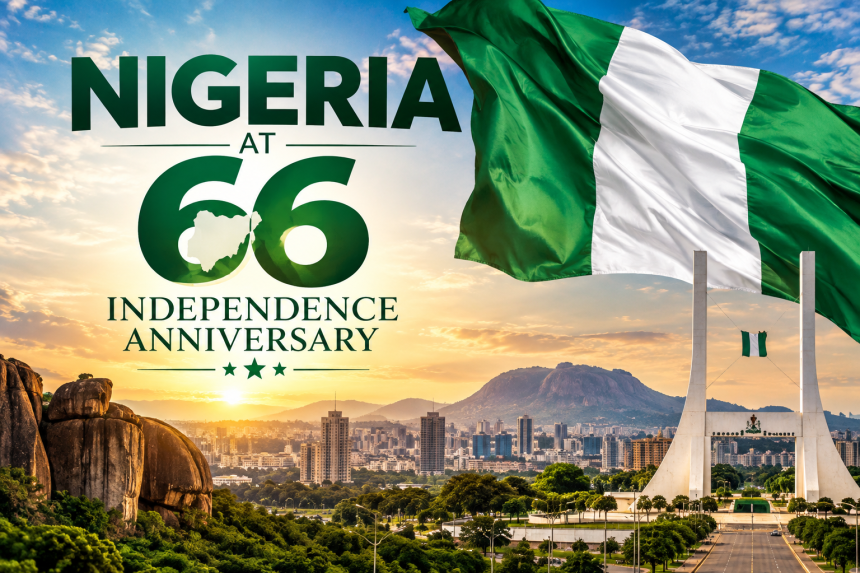
Let me begin this piece by wishing Nigeria and Nigerians a happy 66th Independence Anniversary.
In the global context of nationhood, sixty-six years is but a blip in time. However, for Nigerians who have waited sixty-six years for their nation to fulfil the dreams and hopes of its founding fathers, the experience has been one of great consternation, frustration, and disappointment. While I totally understand and share in that frustration and impatience, I remain supremely confident and optimistic that Nigeria’s better days are ahead. I firmly believe that, despite these past frustrating decades of fits and starts, of hope and disillusionment, this current moment of anguish and excruciatingly painful structural and macroeconomic reforms will eventually be looked back upon as a watershed in the emergence of a vibrant, empowered, confident, and economically prosperous Nigeria. Nigeria shall rise to take its rightful position as the leader of the African continent and the hope of the Black race. On that, I have no doubt.
However, even against that backdrop of optimism, there is no question that as Nigerians mark their country’s 66th Independence Anniversary, one undeniable consensus is that the country has failed to actualize the lofty dreams and boundless optimism that drove its founding fathers to fight for independence from British colonial exploitation.
In fact, were they to return to the country today, they would be utterly disappointed and dismayed that some of the problems they confronted at independence, such as ethnic animus, fractious politics, corruption, and the absence of a national consensus about sovereignty and nationhood, have become even more pronounced.
No generation feels this frustration more intensely than our Baby Boomer generation, many of whom were born in pre-independence Nigeria. That generation gained its political consciousness under the dynamic regional governments of the First Republic, saw their descent into political chaos and violence, and witnessed their truncation by the military. It also experienced the country at its worst as it descended into the abyss of the apocalyptic Biafra Civil War.
Nigerian Baby Boomers also saw Nigeria at the height of its greatness in the early 1970s, when, buoyed by an oil-boom windfall, the country became a wealthy, self-assured, and geopolitically important nation. It was a Nigeria so confident in its economic and diplomatic standing that it played a consequential role in the liberation of southern Africa, including the struggle against Ian Smith’s white-minority government in Rhodesia. That was the Nigeria whose leadership famously declared that the country’s problem was not money, but how to spend it. Yet, barely a decade later, the same country was forced to swallow the bitter pill of the IMF-supported Structural Adjustment Program.
Looking back at the country in its current state of economic anomie is like living in an alternate universe. When we tell our children about growing up in a Nigeria where dreams were alive and a university degree was an automatic ticket to a decent middle-class life, they sometimes think we are telling fairy tales about an imaginary country.
In tracing our steps back to socio-economic, moral, and political renewal, and exploring a pathway out of the culture of corruption and moral decadence that now pervades the country, the first step is to understand the source and genesis of this social pathology. We must examine how and when the social contract ruptured, triggering the country’s precipitous descent into its current state of despondency, which the Tinubu presidency is attempting to extricate it from through its painful structural and macroeconomic reform agenda.
Despite the politicization of the current economic struggle, which is expected in a political contest for power, one fact no objective analyst can deny is that Nigeria’s descent into economic, social, and moral decline predated the Tinubu presidency by decades.
Its genesis, in fact, can be traced back to its very beginning, when the geopolitical space named Nigeria was created via a colonial fiat by Lord Lugard in 1914. The diverse ethnicities that constitute present-day Nigeria were consigned and conscripted into a political contraption without their consent. A century later, the country is still struggling with the question of nationhood and sovereignty. That was the backdrop within which Nigeria’s fight for independence took place. It was also the same factor that undergirded the emergence of the First Republic. Hence, the First Republic and the military regimes that truncated it started on slippery ground. Its operators were not angels either. They each had their fair share of political scandals, corruption, and administrative shortcomings.
The Second Republic was also far from perfect. To begin with, the 1979 election was marred by allegations of rigging, malpractice, and violence. Who can forget the 12 2/3 judicial soap opera? President Shehu Shagari’s administration also faced severe accusations of economic mismanagement. Who could forget the iconic image of the late Alhaji Umaru Dikko in a crate, barely escaping being carted away to answer for the rice-importation scandal?
Even with these allegations of corruption and mismanagement, however, public office remained tied to an expectation of public morality. Political figures shaping that era, such as Chief Obafemi Awolowo, Dr. Nnamdi Azikiwe, and Alhaji Aminu Kano, operated within traditions that framed politics around competing visions of nation-building, ideology, and regional development. President Shehu Shagari himself was widely recognized as a modest and personally restrained leader. While corruption and patronage existed, corruption had not yet acquired the social legitimacy it would later obtain.
The violence that accompanied the 1983 elections and the allegations of corruption against the Shagari administration provided the justification for the Buhari/Idiagbon regime to seize power with a mandate to restore discipline and combat corruption. Its War Against Indiscipline (WAI) was an authoritarian effort to enforce order, punctuality, and adherence to rules in public life. Though harsh and prone to violating civil liberties, the regime’s approach reflected a fundamental assumption: corruption and indiscipline were deviations from an accepted national moral code. Politicians received prison sentences for offences that, in retrospect and when compared with what followed, appeared like petty theft.
The distinction between then and now was that corruption was treated with public disdain, unlike the present situation in which an institutionalized culture has emerged where corruption increasingly becomes a pathway to wealth, status, and political power.
The 1985 Coup: The Beginning of a Fundamental Shift
The General Ibrahim Babangida coup, which overthrew the Buhari regime on the grounds of its draconian and inflexible approach to governance, is regarded as a watershed moment in the fundamental shift of Nigeria’s political, social, economic, and institutional environment.
As I have argued earlier, corruption was neither new nor peculiar to the Babangida regime. General Babangida did not invent corruption. However, his administration fundamentally altered the political and economic environment connecting state power, administrative authority, and private wealth. Many analysts regard the 1985 coup as the watershed in the institutionalization of corruption and the gradual erosion of the moral conventions that had previously constrained public life.
The Structural Adjustment Policy of 1986 is often regarded as the dividing line in the economic trajectory of Nigeria before and after. Following the collapse of oil revenues and a severe fiscal crisis, Nigeria adopted the Structural Adjustment Program (SAP) in 1986. It included exchange-rate reform, trade and tariff changes, fiscal and monetary restraint, the removal or reduction of selected subsidies, and greater reliance on market mechanisms. It was not designed to encourage corruption. Nevertheless, its implementation within a highly centralized military system with weak legislative and judicial oversight created opportunities for it. The Second-Tier Foreign Exchange Market, for example, became a system of corruption and the monetization of access to power centres, in which the powerful and well-connected gained access to highly subsidized forex. Import licences, highly lucrative oil prospecting licences, government contracts, regulatory concessions, and later privatization opportunities also became valuable political commodities.
In an environment where economic authority was concentrated in the hands of the military government, proximity to political power increasingly became an important determinant of economic opportunity. What were supposed to be market-oriented reforms were implemented through institutions that lacked sufficient transparency, competition, and accountability. The result was an emerging political economy in which privileged access to state-controlled resources could confer advantages over genuine entrepreneurial competence, productivity, and open-market competition.
SAP, with its fallout of pauperizing millions of Nigerians, creating generations of university graduates who were thrown into the unemployment market, denied an opportunity to earn a living wage, build their retirement nest egg, or enter the middle class like previous generations, and fostering a new class of nouveau-riche crony capitalists, is often regarded as a major rupture of the social contract between the government and its citizens.
Similarly, the 1988 civil-service reforms, which were meant to improve the bureaucratic efficiency of the civil service, ended up weakening its independence and professionalism. The reforms did not by themselves create corruption or eliminate professional standards. However, by weakening bureaucratic autonomy and increasing executive control over senior administrative appointments, they made the civil service more vulnerable to politicization. They created a system built on patronage and the discretionary allocation of contracts, licences, foreign exchange, and other state-controlled opportunities. Instead of the state serving as an institution intended to facilitate national development, it was transformed into an instrument through which politically connected individuals could accumulate private wealth.
It took the Tinubu administration’s forex reform policy to correct the legacy of foreign exchange manipulation and round-tripping that was started under the Babangida regime.
In the political realm, General Babangida’s ambitious and costly political engineering experiment, constructed entirely on the American presidential model—including the creation from scratch of two political parties, the Social Democratic Party (SDP) and the National Republican Convention (NRC), which were structurally and ideologically aligned to the American Republican and Democratic Parties—also marked another watershed moment in Nigerian democracy.
The tragedy of that costly political experiment was its ultimate collapse with the annulment of the results of the June 12, 1993 presidential election won by Chief MKO Abiola. That election to this day is widely regarded as one of Nigeria’s fairest presidential elections. The annulment was not merely the cancellation of an election. It was the repudiation of the sovereign authority of the electorate. It represented a fundamental breach of the social contract between the Nigerian state and its citizens. The electorate had exercised its democratic right to choose a leader, only for the military establishment to repudiate that choice. The message was unmistakable: the sovereign authority of the people could be subordinated to the political calculations of those who controlled the instruments of state power. It ruptured Nigerian faith in the political system, which the country is still grappling with. The Nigerian electorate has almost lost faith in the political system and the sanctity of the vote. It is the reason they would rather trade their votes for money rather than fight for reform.
The emergence of General Sani Abacha in November 1993 took institutional and political rupture to another level. Following the collapse of the Interim National Government under Ernest Shonekan, Abacha consolidated military authority, dismantled much of what remained of the democratic transition, and presided over one of the most repressive periods in Nigeria’s history.
The Abacha regime represented the evolution of institutional decay into authoritarian political predation. Political opposition, civil liberties, and institutional independence were severely restricted. Arbitrary detention, intimidation, political assassination, and repression became instruments for preserving political power. The execution of Ken Saro-Wiwa and eight other Ogoni activists on November 10, 1995, was the culminating national trauma and assault on the Nigerian belief in the basic principles of justice and accountability on which social contracts are constructed.
The Abacha era institutionalized, internationalized, and elevated to another level the scourge of corruption that had eaten into the fabric of Nigerian consciousness. Even more than two decades later, Nigeria is still pursuing the recovery of the billions of dollars stolen and laundered in foreign financial institutions by Abacha and his associates.
The legacy of the Abacha years, which the country is still grappling with, is the institutionalization of a system in which political power, coercion, patronage, and private accumulation reinforced one another. The capacity to control the state became inseparable from the capacity to distribute economic opportunities, suppress opposition, and protect the interests of those within the ruling establishment.
That legacy was the backdrop to the return to democratic rule in the 1999 Fourth Republic. Its main actors and beneficiaries were the same people who had developed, adapted, and accumulated political influence and wealth under two decades of military rule and the structural changes of the Babangida and Abacha administrations. The traditional concept of public office, where authority was tied to duty, institutional continuity, and public trust, had been weakened. In its place was an entrenched political economy in which public office increasingly served as a mechanism for access, patronage, and private accumulation.
Hence, while the return to electoral democracy restored an important constitutional framework, it did not automatically reverse the institutional incentives and social values that had evolved during military rule.
Consequently, the Fourth Republic inherited more than a dysfunctional economy and weakened public institutions. It inherited a political class and a political economy whose operating assumptions had been shaped by two decades of military authoritarianism. Electoral competition increasingly became associated with the struggle to control the resources of government rather than competing visions of national development.
This helps explain the persistence of political godfatherism, transactional politics, the monetization of political participation, and the increasing social acceptance of unexplained wealth.
When public office becomes an economic asset, corruption ceases to be merely an individual moral failure and becomes a structural incentive.
The Moral Consequences of Institutional Change
Systemic corruption does not remain confined to government. It gradually alters societal values, expectations, and the definition of success. When unexplained wealth commands more respect than personal integrity, the social consequences become pervasive.
In education and employment, hard work, professional competence, and formal qualifications increasingly appear secondary to political access and connections. In public service, official duties become secondary to the financial opportunities associated with holding public office.
The question of how someone acquired their wealth becomes less important than the wealth itself. This is the most damaging consequence of the rupture of the social contract. Corruption went from being institutionalized to being normalized. What was once regarded as a taboo and a source of familial shame becomes celebrated.
Our country’s challenge has evolved from corruption to a fundamental crisis of values and institutional legitimacy.
Sadly, overcoming our systemic problem with corruption requires more than EFCC prosecuting individuals who abuse public office. It requires rebuilding our moral core, aligning our institutional frameworks with professional competence, transparency, accountability, and the public interest.
This is also why I believe the current moment of economic reform, painful as it is, must be understood within a much broader historical context. Nigeria’s challenges are not simply the consequences of the policy failures of any one administration. They are the cumulative consequences of decades of institutional erosion, distorted economic incentives, and the progressive normalization of corruption.
The Tinubu administration’s structural and macroeconomic reforms are an attempt to address some of these inherited distortions. Whether they deliver the promised economic transformation will depend not only on the soundness of the policies but also on their implementation, institutional discipline, transparency, and the equitable distribution of the resulting economic opportunities. It would also depend on the willingness of the masses to postpone immediate gratification for the promise of a better future. This is a big ask given the systemic erosion of trust between the governed and those who wield power. That is why the Tinubu reform agenda seems to be swimming against the waves. Macroeconomic stabilization and fiscal discipline are necessary, but they are not sufficient to restore a ruptured social contract. That requires rebuilding public trust, strengthening institutional independence, restoring the value of merit, and re-establishing the expectation that public authority is exercised in trust for the people.
Ultimately, Nigeria’s renewal must be both economic and moral, both institutional and societal. We must rebuild a country in which hard work is rewarded, merit is respected, public service is regarded as a responsibility rather than an opportunity for personal enrichment, and political power is understood as a trust rather than a license to accumulate wealth.
I remain optimistic that Nigeria can achieve this transformation. However, optimism must not become an excuse for historical amnesia. We must understand how we arrived at this point if we are to avoid repeating the mistakes that brought us here. The Yoruba adage says when a child trips and falls, he looks forward; when a grown-up, he looks back for the trip point. That is the purpose of this post. Its purpose is not to assign blame. We are all collectively culpable.
Nigeria’s better days are ahead, but the journey to those better days requires more than changing governments. It requires rebuilding the institutions, values, and social contract upon which a functioning nation must rest.
Happy 66th Independence Anniversary, Nigeria.
Adewale Alonge, PhD, Is the President & Founder, Africa Diaspora Partnership for Empowerment & Development ( ADPED).