EFCC to Arraign Ex-AGF Malami on Money Laundering Charges

The EFCC will arraign former AGF Abubakar Malami, his son, and an associate on 16 counts of money laundering, involving billions of naira and multiple property acquisitions across Abuja, Kano, and Kebbi.
Forgeries, taxations and the reign of Rehoboam

By UGO ONUOHA “A profligate regime should not expect Nigerians to willingly submit to a new tax regime that looks like an exercise in extortion. The administration gets its priorities wrong. At a time that virtually all federal highways have collapsed and become deathtraps, this government prioritises the construction of a N15 trillion coastal highway from Lagos to Calabar.” A little over three months into the presidency of Alhaji Bola Ahmed Tinubu, on September 5, 2023, I wrote an opinion piece titled “100 days of Rehoboam” in this space and elsewhere. Rehoboam was a king of the divided kingdom of ancient Israel. He was the son of King Solomon and the grandson of King David, both of whom were also past rulers of a united Israel. Rehoboam caused Israel to be divided through policies that inflicted pains on his people. He was reckless. He was proud. He was unfeeling. He took counsel from his scatter head fellow young men. He told the Israelites that the privations they suffered under his father should be regarded as a child’s play. And that while his predecessors chastised them with a whip, he would chastise them with a scorpion. And he verily proceeded to do so. Rehoboam and Tinubu share similarities and dissimilarities. Rehoboam was a monarch. Tinubu is not a king in spite of his pretending to be one. Rehoboam was born into royalty. Tinubu was not. Indeed Tinubu’s birth and early years are still subjects of conjectures and controversies. Rehoboam was a young man when he ascended the throne of his fathers, and so could be excused on account of youthful exuberance. Tinubu was an old man when he was installed as president of Nigeria though his true age is only known to himself and himself alone. There’s no verifiable evidence of when he was born and where. Unlike Rehoboam, Tinubu takes no counsel from anyone. He said this much himself when, without consultations and without a Cabinet, he unilaterally removed the so-called petrol subsidy. Tinubu at 100 days in office] has been like that proverbial bird that perched on a tree branch—the branch has remained unsettled and the bird can’t stop dancing to unheard sounds. Since his inauguration on May 29, 2023, exacerbated hopelessness has been the lot of Nigerians. Tinubu himself can only pretend to have peace of mind…” On September 5, 2023, I wrote this about Tinubu and Rehoboam. “[Tinubu at 100 days in office] has been like that proverbial bird that perched on a tree branch – the tree branch has remained unsettled and the bird can’t stop dancing to unheard sounds. Since his inauguration [as president] on May 29 [2023], exacerbated hopelessness has been the lot of Nigerians and Tinubu himself can only pretend to have had peace of mind. If he has had the presence and prescience of mind, he would not have been enmeshed in serial fumbling from one policy somersault to another from the removal of the so-called petrol subsidy, [devaluation of the Naira], student loan and [the] proposed payment of N8,000 per month for six months to a specified number of poor Nigerian families, and planning to lead the Economic Community of West African States [ECOWAS] to war on Niger Republic [when the military in that country seized political power]”… In Igbo Tinubu is a classical case of ‘akwu rere ere n’ikwo puru epu’ which transliteration in English language will roughly read: rotten palm fruits being pounded inside a decayed mortar. The finished product is better left to the imagination…” When Rehoboam became the king, the older advisers in the palace pleaded with him “to heed the cry of the people and lighten the heavy load of labour and taxes that Solomon had laid on them, but the younger elements who had grown up with the new king counselled otherwise. He took the counsel of his mates. The consequences of the actions of the new and rash King Rehoboam are well documented in the chronicles of the kings of Israel in the Holy Bible book of 1Kings. In Tinubu’s rash and irrational decisions [on] the first day and [subsequent] weeks of his reign, he appears to have borrowed a leaf from the wicked and unthinking King Rehoboam”. One of the undoings of Rehoboam was that he insensitively raised taxes on his people and so lost more than half of his kingdom. The northern part of Israel split away, taking its own path separate from the southern kingdom of Judah. But Nigeria is not a monarchy and bears no resemblance to the old kingdom of Israel. Does that mean that Nigeria splitting is unthinkable? With the new tax laws set to come into effect in a matter of days, Tinubu who rules like a monarch may yet be treading the path of King Rehoboam. Rehoboam raised taxes on his people at a time they were already complaining of privations and pains, Tinubu is poised to also raise taxes on Nigerians at a time the people are groaning under the weight of a multiplicity of harsh economic policies of the regime. And he appears not to be bothered. He is irritated by wise counsel that he steps on the brakes and allows Nigerians to breathe. Instead, he empowers the relevant agency of government to execute a secret contract with a so-called tax consultant in France which may lead to handing over Nigeria’s tax data to a foreign company. Tax data is a national security issue that should not be traded as a favour to a friend. Tinubu and the president of France, Emmanuel Macron, are known to be buddies. The frequent ‘working visits’ of our president since he assumed office a little over two years ago had been to Paris, France, unlike his predecessor, Muhammadu Buhari, who made London his tourism and medical destination, and the former archbishop of Canterbury his bosom friend. And a go-to man. A profligate regime should not expect Nigerians to willingly submit to a new tax regime that looks
EFCC and National Defence College Join Forces to Update Curriculum on Financial Crimes

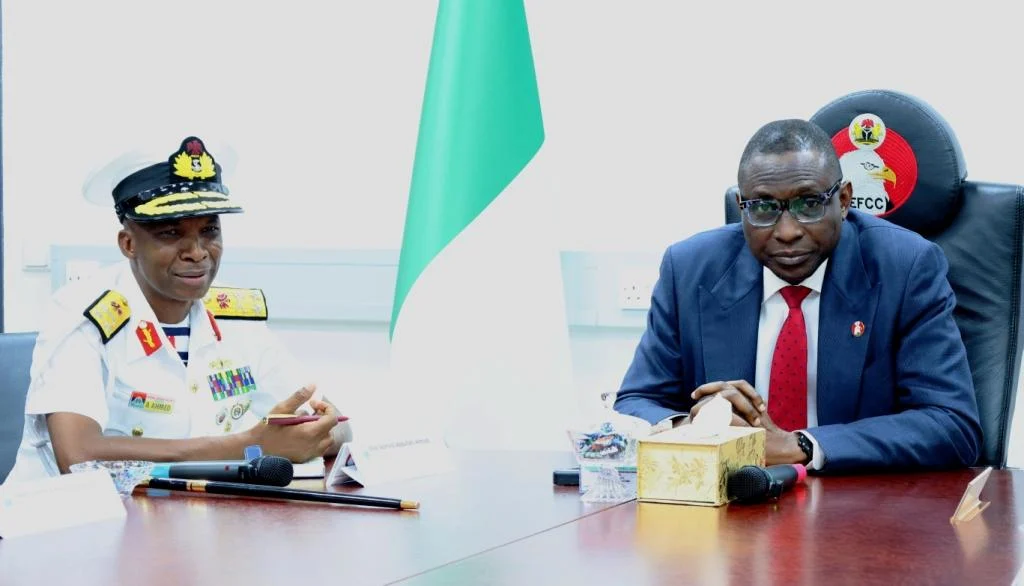
New partnership aims to equip future leaders with skills to tackle corruption, public fund mismanagement, and emerging financial threats. he Economic and Financial Crimes Commission (EFCC) and the National Defence College (NDC) have agreed to collaborate on revamping the College’s curriculum to reflect Nigeria’s evolving security and governance landscape. During a courtesy visit to EFCC Chairman Ola Olukoyede in Abuja, NDC Commandant Rear Admiral Ahmed emphasized the need for a curriculum update to better prepare participants in public fund management and strategic governance. Related Stories: Ahmed lauded EFCC’s expertise in fighting economic crimes and requested the agency’s input in designing the new course content. “We want participants to learn how to manage public funds effectively so that they are ready for leadership roles,” he said. Olukoyede welcomed the proposal, highlighting EFCC’s readiness to support the initiative and noting emerging threats such as cryptocurrency fraud, which caused global losses exceeding $2 trillion last year. “There are areas where our work overlaps, and collaboration will help strengthen Nigeria’s fight against financial crimes,” he said.
Money Laundering: EFCC to investigate Bank Executives

The Economic and Financial Crimes Commission (EFCC) has said bank executives are complicit in aiding money laundering in the country, adding that it would commence prosecution soon. Speaking at the 17th annual conference of the Chartered Institute Bankers of Nigeria, the Chairman of the EFCC, Ola Olukoyede said the commission will soon start prosecution of bank executives involved in corruption. According to him, findings revealed complicity in money laundering, illegal forex sales and trading among bank officials. While calling on the CIBN to step up its regulatory functions to guard against fraud, the EFCC boss said major financial fraud were conducted through the nation’s banking system. The commission recently urged the National Assembly (NASS) to enact a law which supports the whistle-blower policy of the government. Olukayode who made the call at the Nigerian Bar Association (NBA) conference in Lagos, noted that once the law is enacted, it will make it mandatory for law enforcement agencies to protect the whistle-blowers. The EFCC chairman also called on lawyers across the country to always observe due diligence in their practices. This, according to him, is necessary for them to know the background of their clients so as not to run foul of the Anti-Money Laundering and Counter-Terrorism Financing (AML/CTF) regulations. He said, “As lawyers, we are supposed to hold a position of trust in our professional conduct. While we try to comply with international laws and regulations, we should also do what is right for ourselves to protect the sanctity of our profession, which is very key. “Don’t try to protect suspected criminals, people who must have committed financial crimes. So, if you know who we are looking for, you must bring that person to the open and we will do our part. “Doing the right thing doesn’t necessarily come from the way of international conventions. If you do the right things, they will automatically take you out of the grey list. “It is expedient on you to, at least, know who your client is. You are expected to be paid from a legitimate source. “If you are a victim of crimes, you will understand what I am saying. As lawyers, you must not, in any way, derogate or demean your professional commitment to your clients. “Even a part of the money laundering Act that we have evaluated doesn’t stop me from enforcing the regulations of the EFCC Act and other financial laws in Nigeria.”
BREAKING: August 1 Protest: Protesters march to Presidential Villa

“We are marching to the Villa, bad governance must end”, one of the protesters angrily told DAILY POST.
How Thousands Of Dollars Are Flown Out Of Nigeria Every Hour – INTERPOL

Vandalism of the Nigerian national treasury continues unabated as the International Police Organisation (INTERPOL) has revealed that “hundreds of thousands of dollars” are being laundered out of Nigeria every hour, reaching other African countries and locations worldwide.
Why Some religious organisations are more corrupt than public offices — EFCC boss

By Doris Isreal Ijeoma Chairman of the Economic and Financial Crimes Commission, EFCC, Mr Ola Olukoyede has alleged that some religious organisations are “more corrupt” than public offices in Nigeria. Olukoyede spoke at a leadership conference organised by the Redeemed Christian Church of God, RCCG, in Lagos on Friday. The EFCC boss disclosed that his organisation recently recovered “how many millions from a religious organisation.” Olukoyede accused religious leaders of looking at the “speck in someone else eyes, but meanwhile; there is a log in yours.” He, however, urged clerics to use their platform “not only to preach but also to demonstrate” good characters to their congregation. He said: “Just this last week, I have had cause to recover how many millions from a religious organisation,” the EFCC boss said. “They appointed you a pastor, and that is when you become a big man. We don’t even know what you are doing to earn a legitimate living. You live on the ministry and the church or mosque money. You can’t even explain the source of your wealth. “Some religious organisations are more corrupt than public offices. I have evidence towards that. You look at the speck in someone else eyes, but meanwhile, there is a log in yours.” In January, Olukoyede said the EFCC uncovered a religious sect laundering money terrorists in Nigeria.
Damning Report Reveals Nigerians Paid N721 Billion in Bribes in 2023

A new report from the National Bureau of Statistics, in collaboration with the United Nations Office on Drugs and Crime, has revealed that Nigerians paid a staggering N721 billion ($1.26 billion) in cash bribes to public officials in 2023. The report, titled “Corruption in Nigeria: Patterns and Trends,” highlights the widespread nature of bribery in the country. On average, each cash bribe amounted to N8,284, up from N5,754 in 2019. Judges topped the list of bribe recipients, with an average bribe of N31,000. Customs and Immigration officials followed with N17,800, while members of the armed forces received N16,600 per bribe. Land registry officials and police officers received N11,700 and N10,400, respectively. The findings also showed that 46% of public officials admitted to offering bribes to secure their employment. This figure is 1.5 times higher than that reported in 2019. Additionally, six out of ten successful candidates in the public sector confessed to using nepotism or bribery to enhance their recruitment chances. The police were identified as the most prevalent in requesting bribes, with 9% of individuals who interacted with police officials reporting such demands. Nurses and doctors followed at 4%, teachers and lecturers at 3%, and public utility officials at 6%. Contact with Federal Road Safety Corps officials and vehicle inspection officers also resulted in bribe requests at rates of 4% and 2%, respectively. The report also noted that individuals with higher education levels were more likely to pay bribes than those with no formal education.
Plateau: Muftwang Debunks Reports Of Bribery Collection By Judges

Plateau State Governor, Caleb Mutfwang, has vehemently denied allegations suggesting judges received a $5 million bribe to annul his election victory. Elected under the Peoples Democratic Party (PDP), Governor Mutfwang labeled the claims as “baseless and defamatory.” Through his Director of Press and Public Affairs, Gyang Bere, in Jos on Friday, Mutfwang refuted the allegations, attributing them to deliberate attempts by detractors to sow discord between him and the judiciary. Expressing deep concern, Mutfwang urged thorough investigations by security agencies to apprehend those responsible for the libelous publication, emphasizing the importance of facing legal consequences to deter such misconduct. Terming the report a fabrication by individuals manipulated as pawns by the opposition party in Plateau State, Governor Mutfwang highlighted that it aims to tarnish the PDP government’s image in the state. He reaffirmed his unwavering support for the Judiciary while cautioning against disparaging justices and respected leaders, warning of severe consequences for those engaging in destructive activities.
Antigraft Campaign: EFCC Secures 1,688 Convictions In 9 Months

The Acting Chairman of the Economic and Financial Crimes Commission (EFCC), Abdulkarim Ckukkol, has said that the agency, in its war against corruption, economic and financial crimes, has secured 1,688 convictions between January and September, this year. Ckukkol disclosed this weekend at the Passing out Parade of Detective Assistant Course 4 Cadre for 331 cadets of the commission at the Nigeria Police Mobile Force Training College, Ende Hills, Akwanga. According to him, the EFCC in 20 years of existence, has made a huge difference in the affairs of the nation. “Through the efforts of the commission, odious image of Nigeria as a 419 hub, with the attendant negative effect on our economy, was erased. “The Commission’s investigation activities have led to the recovery of asset running into billions of Naira. “Last year (2022), the commission secured a total of 3,785 convictions, the highest by any law enforcement agency in Nigeria in a single year. “Between January and now, the commission recorded 1,688 convictions. The figure is bound to increase as more cases are brought to conclusion in the courts,” he said. He said that the commission, in addition to enforcement activities, would continue to pursue its prevention mandate with relentless vigor through engagement with different stakeholders in the fight against corruption, economic and financial crimes. According to him, the commission recently broke new grounds in this endeavor with the commencement of test transmission of its radio station, EFCC Radio 97.3 FM. “The initiative promises fresh vista of opportunities for public engagement as the commission strives to get the people to own the fight against corruption,” he said. He urged the cadets to bolster the efforts of the Commission to consolidate on the achievements of the past and secure its place as a premier law enforcement agency not only Nigeria but the world. He urged them to be committed to the profession they signed up for, and should know that law enforcement, especially fighting economic and financial crimes, is a crucial national service. He described it as “a career” which takes years to build but could be destroyed in a moment of careless indiscretion or poor judgment. “For you to run this race and fulfill your dream as an EFCC officer, you must at all times stay focused and uphold the values of the Commission which are Integrity, Courage, Professionalism and Collaboration. “I must also sound a note of warning that the Commission will not condone any indiscipline, as violation of the established code of conduct will be met with appropriate sanctions,” he said. The Acting Commandant of the EFCC Academy, Karu, Abuja, Mr Baba-Shani Umar, urged the new cadets to stand on the precipice of new beginnings. “I urge you to remember the principles that have been instilled in you: integrity, Courage, professionalism and Collaboration in the pursuit of excellence. “Carry these values as your compass, and they will guide you through the challenges and triumphs that lie ahead,” he said. The Commandant, Police Mobile Force Training College, Ende Hill, Nasarawa, DCP Ikioye Orutugu, urged the cadets to make use of the training they had received in eradicating corrupt practices in the country. Orutugu admonished them to use their talents as well as skills acquired to contribute their quota to the fight against economic and financial crimes. He also stressed the need for inter-agency cooperation and mutual understanding among other sister agencies as witnessed between EFCC and the Nigeria Police for the growth of the nation.