By Dahiru Ali
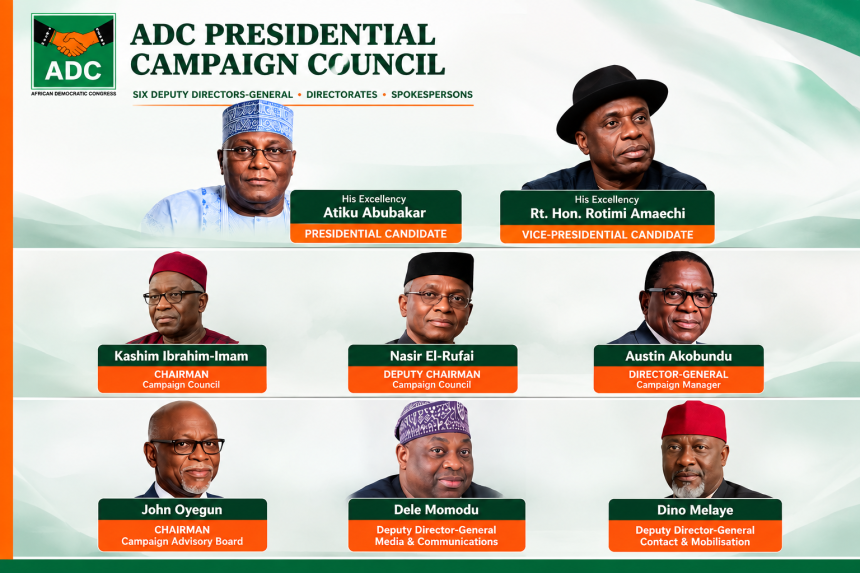
The African Democratic Congress (ADC) has unveiled the organisational structure that will drive Atiku Abubakar’s 2027 presidential campaign, putting names, responsibilities and political relationships to the coalition that has been taking shape around the former vice-president. The 69-member structure, comprising the Presidential Campaign Council and Campaign Management Committee, brings together former governors, legislators, technocrats, media figures, political organisers and personalities with roots in different political parties and traditions.
At first glance, the list reads like an inventory of political experience accumulated from across Nigeria’s recent political history. Kashim Ibrahim-Imam is chairman of the campaign council, former Kaduna State Governor Nasir El-Rufai is deputy chairman, while Senator Austin Akobundu serves as Director-General and Campaign Manager. Former APC national chairman John Oyegun heads the Campaign Advisory Board, with former Rivers State governor Rotimi Amaechi as Atiku’s running mate. Mohammed Hayatu-Deen heads the Policy Team, while Dele Momodu and Dino Melaye are assigned to media and communications and contact and mobilisation respectively.
But the significance of the structure lies less in the sheer number of prominent names than in what their placement reveals about the political strategy of the ADC coalition. It is an attempt to construct a campaign that reaches beyond Atiku’s established political base and incorporates figures who have occupied influential positions in different political formations. That makes the council both a campaign organisation and a reflection of the broader realignment taking place ahead of 2027.
El-Rufai Takes the Front Row
The appointment of Nasir El-Rufai as deputy chairman is perhaps the clearest expression of that realignment. The former Kaduna governor is not simply another senior politician added to an already crowded list. He has been placed directly beneath the council chairman, giving him one of the most senior positions in the presidential campaign.
El-Rufai’s political history makes the appointment particularly significant. His most recent major partisan identity was within the All Progressives Congress, under which he served as governor of Kaduna State from 2015 to 2023. His movement into the ADC camp, followed by his elevation to deputy chairman of Atiku’s campaign council, gives institutional expression to the political migration that has become one of the defining features of the emerging opposition coalition.
The importance of the appointment also goes beyond the symbolism of a former APC governor working for a presidential candidate whose political career has been principally associated with the Peoples Democratic Party. It gives Atiku’s campaign access to the political relationships and networks associated with El-Rufai, while giving him a formal role in shaping the organisation that will attempt to convert the broader opposition coalition into an electoral operation.
That calculation, however, comes with its own complications. El-Rufai remains a highly scrutinised political figure and is currently facing corruption-related legal proceedings. Those allegations are contested, and he has denied wrongdoing. His presence in the senior leadership of the campaign means that questions surrounding his legal circumstances are likely to remain part of the public conversation around the campaign, even when the campaign itself would prefer the focus to remain on its political programme.
The appointment therefore carries two distinct dimensions. On one level, it demonstrates the value Atiku’s campaign places on political experience and coalition-building. On another, it places one of the coalition’s most recognisable figures in a position where his own political history and current legal circumstances will inevitably become part of the campaign’s communications environment.
From APC Stronghold to ADC Camp
The presence of John Oyegun reinforces the cross-party character of the structure. Oyegun, who served as the first national chairman of the APC, has been named chairman of the Campaign Advisory Board. His inclusion places a former senior figure from the governing party’s institutional history within the advisory structure of an ADC presidential campaign.
His appointment becomes even more significant when considered alongside El-Rufai and Amaechi. Amaechi, who is now Atiku’s running mate, also has a political history that moved from the PDP into the APC before returning to the political orbit of the opposition coalition. The campaign therefore contains senior figures whose political careers have crossed party lines and, in some instances, placed them on different sides of previous electoral contests.
This is one of the defining features of the ADC project. The campaign is not being presented as a conventional party organisation in which nearly all of the senior figures have emerged from one political tradition. Instead, it is attempting to function as a coalition platform capable of absorbing politicians with different histories while giving them defined responsibilities within a common structure.
That breadth can expand the political networks available to the campaign, but it also creates an organisational challenge. People who have spent years operating in different political environments do not automatically acquire a common political language simply because they have joined the same campaign. The leadership will therefore have to turn a collection of individual political networks into an organisation capable of speaking with sufficient coherence to the electorate.
Moghalu Draws the Line
That challenge became immediately visible with the inclusion of Professor Kingsley Moghalu in the published campaign structure.
Moghalu was listed as a member of the Policy Team chaired by Mohammed Hayatu-Deen. Shortly after the structure was released, however, the former Deputy Governor of the Central Bank of Nigeria publicly stated that he had not been consulted and had not consented to the inclusion of his name. He went further to say that he was not a member of Atiku’s policy team, either officially or unofficially, and reaffirmed his non-partisan position.
The clarification is significant because Moghalu’s name carries particular weight in a policy context. A former CBN deputy governor and former presidential candidate, he is known for his work and commentary on economics, public policy and geopolitical strategy. His inclusion in a presidential campaign’s policy team would therefore naturally be interpreted as an indication that he had agreed to participate in shaping the candidate’s economic and governance agenda. Unfortunately, his denial removed that assumption.
The distinction is important. The campaign document listed Moghalu as a member, but Moghalu himself said he had neither been consulted nor consented to the listing. As of the reports published after his statement, there was no public explanation from Atiku’s campaign clarifying how his name came to appear on the list.
The immediate issue is therefore not whether Moghalu supports or opposes Atiku. He has expressly stated that he has withdrawn from partisan politics and does not belong to, or sympathise with, a Nigerian political party. The relevant fact is that his name appeared in an official campaign document and he subsequently disowned that association.
For a campaign that is projecting an image of a disciplined and professionally structured organisation, the episode raises a basic question about the process of confirming appointments before they are announced publicly. That question becomes more important where the individual involved has an established independent public profile and can publicly contradict the campaign’s account.
The Policy Team Faces Its First Test
The controversy has inevitably shifted some attention towards the Policy Team itself. Hayatu-Deen, who also contested the ADC presidential primary, has been appointed chairman, with Professor Mohammed Sagagi as deputy chairman. Other listed members include Professor Mustapha Akinkunmi and Senator Abdul Ningi. The policy structure will have to do considerably more than produce campaign slogans. The issues identified by the campaign — cost of living, unemployment, insecurity and declining purchasing power — are problems that require specific policy proposals, financing assumptions and implementation strategies. The credibility of the team will consequently be judged by the substance of what it produces rather than by the professional credentials of the individuals listed on the document.
This is particularly important in a contest in which the economy is likely to occupy a central place in public debate. Questions about inflation, taxation, public debt, energy costs, employment, investment, industrial production and the purchasing power of households cannot be answered convincingly through broad political promises. They require detailed explanations of what a proposed administration would change, how quickly it could change it and how the cost of those interventions would be managed. Moghalu’s withdrawal does not remove the campaign’s obligation to develop those answers. It simply means that the campaign must not continue to represent him as part of the team unless that position changes with his consent.
The incident also provides an early test of the campaign’s ability to distinguish between political association and professional reputation. A person may contribute to public debate about Nigeria’s economy without participating in a political campaign, and public commitment to national development does not necessarily amount to partisan support.
Beyond the Big Names
The campaign council also reveals an attempt to build a modern electoral machine rather than relying exclusively on the visibility of its political principals. Six Deputy Directors-General have been assigned to operational directorates covering administration, operations, media and communications, contact and mobilisation, diversity and support groups, and technical and systems functions. Thirty directors have specific portfolios under those directorates.
The technical and systems directorate is particularly notable because its responsibilities include election operations and management, polling-unit operations, voter intelligence, monitoring and evaluation, and a situation room. That structure reflects the increasingly data-driven character of election campaigns, in which voter mapping, polling-unit organisation, monitoring and rapid information flow have become important elements of campaign management.
The media and communications directorate is similarly divided into strategic communication, media and publicity, branding, digital and online media and content development. Dele Momodu is the Deputy Director-General, while Phrank Shaibu is responsible for strategic communication. Several spokespersons have also been appointed.
Dino Melaye’s contact and mobilisation directorate covers women mobilisation, youth mobilisation, persons with disabilities, stakeholder engagement and mandate protection. Another directorate focuses on support groups, civil society organisations, business and professional bodies, gender issues and the entertainment and creative industry.
The implication is that the campaign is trying to establish separate channels for political mobilisation, communications, policy, voter intelligence and stakeholder engagement rather than placing all of those responsibilities within a small political leadership circle.
A Coalition of Former Adversaries
The composition of the council is ultimately a reflection of the political circumstances from which the ADC has emerged. Atiku is running on a platform that has attracted figures whose political careers have developed in different parties, while the senior campaign structure includes people who have previously served in governments controlled by parties that now occupy the opposite side of the political divide.
David Mark is the ADC national chairman. Kashim Ibrahim-Imam is campaign council chairman. El-Rufai is deputy chairman. Oyegun heads the advisory board. Amaechi is the vice-presidential candidate. Tambuwal, Abdulfatah Ahmed and Emeka Ihedioha are among the senior campaign advisers, while Momodu and Melaye have been assigned major operational responsibilities.
The breadth is deliberate. It gives the campaign access to different political constituencies and professional networks and allows Atiku to present the ADC not merely as another partisan vehicle but as a coalition capable of drawing personnel from across the political spectrum. The difficulty will be maintaining coherence within that coalition. Each senior figure comes with a political history, a network of relationships and, in some cases, a personal constituency. The leadership must therefore establish clear lines of authority and ensure that policy, communications and mobilisation are coordinated rather than driven by competing political interests.
This is where the appointment of Akobundu as Director-General and Campaign Manager becomes particularly important. While the senior political figures provide visibility and political weight, the DG is responsible for converting the structure into an operational campaign. The six directorates will ultimately have to work within one chain of command if the campaign is to avoid becoming a collection of prominent individuals operating independently.
The Credibility Test Begins
The Moghalu episode has provided the first unexpected test of the campaign’s organisational credibility. A campaign can assemble an impressive list of politicians and professionals, but the authority of such a list depends on the accuracy of the relationships it claims to represent. Moghalu’s public clarification has established that, at least in his case, the published list did not represent his consent. He has maintained that he left partisan politics in 2022 and that his current public-policy engagements are non-partisan.
That does not invalidate the wider campaign structure, nor does it establish why his name appeared on it. It does, however, provide a reminder that political organisations are ultimately accountable for the accuracy of the public claims they make about their personnel. For the ADC campaign, that means that the emphasis on discipline and accountability will have to extend to the basic business of confirming appointments, defining responsibilities and communicating changes promptly.
The campaign’s own stated philosophy is that every directorate should have a duty, every director should have an assignment and every appointee should be accountable for results. That standard will apply not only to policy delivery and electoral mobilisation but also to the accuracy and credibility of the campaign’s public-facing organisation.
El-Rufai and the Politics of the Big Tent
El-Rufai’s position ultimately brings the different strands of the campaign together. His appointment demonstrates the value Atiku’s coalition places on political experience outside the traditional PDP network, while the presence of Oyegun and Amaechi reinforces the same cross-party character.
At the same time, the decision places a politically prominent and closely scrutinised figure at the centre of the campaign. His legal circumstances, political record and relationships within the opposition coalition will inevitably attract attention throughout the electoral cycle. That does not determine the political consequences of his appointment, but it does mean that the campaign will have to manage the public conversation around one of its most senior figures alongside the wider presidential message.
The council therefore represents both the strength and the complexity of the ADC’s current political project. It has brought together experience from different political formations and created a structure in which political leadership, policy development, communications, mobilisation and election technology have separate responsibilities.
Whether that breadth becomes a functional national campaign organisation will depend on what happens after the unveiling. The political personalities now have to work within a common structure, the policy team has to produce detailed and credible proposals, the communications operation has to maintain consistency, and the mobilisation structure has to translate national political momentum into organisation at the grassroots. The two-page document has supplied the names and the hierarchy. The campaign’s real test will be whether those names can operate as one political organisation. For Atiku, the ADC and the coalition assembled around the 2027 presidential bid, that is the work that begins now.