


Nigeria’s youth challenge is an existential ticking time bomb, a human capital and economic development imperative, and arguably one of the country’s most consequential national security threats. It is also a demographic and political reality that demands urgent attention.
The depth of despair facing young Nigerians was brought home to me during a chilling exchange with a young woman who visited our hotel. In an attempt to gauge the pulse of the electorate, I asked how she was doing. She is a 35-year-old single woman from an affluent family who holds a master’s degree from a private university. She lamented how much her late mother had spent on her expensive education, yet she has never held a stable job commensurate with her qualifications. Instead, she has had to take on several contract jobs with unrealistic targets, often exposing her to sexual and personal exploitation. Her attempt to start a private business selling beauty products was frustrated by high-interest loans and clients who failed to pay. She also has a younger brother with a degree in civil engineering who lives with her but remains unemployed.
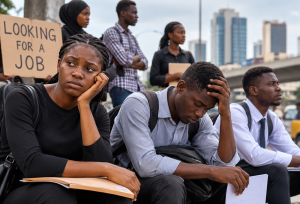
She explained that, since their mother’s passing, their safety net has been an older sister living in the United Kingdom. She said she would leave Nigeria for any other country at the drop of a hat, describing Nigeria as a “dream-killer.” The statement broke my heart, especially as I recalled the boundless optimism with which we grew up in the Nigeria of our youth.
We have failed our young people. Our generational obligation must now be to rewrite the narrative for future generations.
Then she shared something that sent chills down my spine.
“Sir, the country should be grateful for ‘Yahoo Yahoo’,” she said, referring to internet fraud. According to her, it serves as a security blanket for Nigeria’s wealthy class. Had I not noticed a sharp decline in the armed robberies that once terrorised Nigerians and kept them awake at night? Many young people who might otherwise have taken up guns, she argued, were now making a living by defrauding lonely individuals abroad.
That conversation knocked me off balance. It took me hours to recover and process the implications of her shocking assertion. Whether or not her explanation accounts for changes in criminal activity, the underlying message was disturbing: Nigeria is sitting on a powder keg of unemployed and underemployed young people, with potentially grave consequences for social stability and national security.
According to the United Nations Population Fund (UNFPA), Nigeria’s population was estimated at 237.5 million in 2025, with approximately 41 per cent below the age of 15 and 34 per cent between the ages of 10 and 24. For broad planning purposes, children and adolescents under 18 constitute roughly half the population, while those aged 18–35 account for nearly three in ten. These figures underscore the scale of the country’s human capital challenge: millions of young people require education, gainful employment and housing, even as the nation struggles with a backlog of people unable to secure their economic futures.
For many parents in a society where children have traditionally served as a safety net in old age, that safety net has been torn to tatters.
Even the relatively conservative figures reported by the National Bureau of Statistics (NBS)—including an unemployment rate of 7.5 per cent among people aged 25–34 in the first quarter of 2024, compared with 5.3 per cent nationally, and 8.4 per cent among those aged 15–24, with 14.4 per cent not in employment, education or training (NEET)—understate the broader crisis.
These measures do not fully capture the scale of insecure work, low earnings and severe underemployment.
A large youth population can generate a tremendous demographic dividend, but only when supported by quality education, productive jobs, relevant skills and viable pathways to economic independence. Without these foundations, demographic potential can become a source of frustration, insecurity and social unrest.
This demographic reality also carries enormous electoral significance. Young Nigerians constitute a formidable voting constituency. As they recognise their shared economic interests and political agency, their concerns can no longer be treated as peripheral. Any policy platform or political movement that ignores this constituency does so at its peril.
The Federal Government’s economic reform programme must therefore be complemented by a comprehensive human capital development and social protection agenda. The objective is not to reverse necessary reforms, but to protect vulnerable households, expand productive opportunities and prevent the economic transition from sacrificing an entire generation.
Four Strategic Priorities
1. Declare a National Public Education Emergency
Nigeria needs a national public education emergency and a reform programme more comprehensive than the policy response to the A Nation at Risk report issued in the United States in 1983 under President Ronald Reagan, following the work of the National Commission on Excellence in Education.
Our country is truly at risk because of decades of inadequate investment in its young people.
For many Nigerian families, private school fees constitute one of their largest household expenses—a direct consequence of the failure to provide consistently accessible, quality public primary and secondary education. Families are forced to divert scarce resources from food, healthcare and other basic needs to secure schooling for their children.
The President, in collaboration with state and local governments, should declare a National Public School Emergency and launch a comprehensive K–12 reform agenda. Priorities must include rehabilitating school infrastructure, improving teacher quality and accountability, strengthening foundational literacy and numeracy alongside digital literacy, providing instructional materials and school meals in disadvantaged communities, and expanding vocational education.
Federal matching grants should reward states for independently verified improvements in school attendance, learning outcomes, teacher performance and financial management.
2. Align Tertiary Education Financing with National Development Needs
The Nigerian Education Loan Fund (NELFUND) must be integrated into a broader national human capital strategy. Student financing should expand access to higher education while avoiding the indiscriminate accumulation of debt for programmes with weak employment prospects.
Rather than relying on an unguided, blanket loan programme, financing should be linked more closely to skills required in national priority sectors. The programme should also offer a National Job Corps service option as an alternative pathway to loan forgiveness or direct employment placement.
Funding decisions should encourage relevant skills development without unfairly restricting individual academic choices.
Furthermore, graduate repayment arrangements must reflect actual earnings, with safeguards for prolonged unemployment and financial hardship.
3. Launch a National Youth Employment and Enterprise Programme
Youth unemployment and underemployment must be treated as priority national security and economic development risks. Government strategy must move beyond counting training enrolments and one-off grants to measuring the creation of sustainable, long-term livelihoods.
A coordinated national programme should combine paid apprenticeships, first-job wage subsidies, technical and digital skills training, community employment initiatives, and transparent start-up support for viable enterprises.
Priority sectors should include agriculture and food processing, construction, light manufacturing, renewable energy, healthcare support, logistics and digital services. Federal, state and local governments should collaborate directly with private-sector employers to ensure that training is linked to industry demand.
4. Establish a National Economic Transition Safety Net
Even the most theoretically sound proposal risks falling apart without adequate funding. That is the challenge Nigeria faces, particularly under current macroeconomic constraints.
Addressing the youth crisis will require a government-wide reassessment of priorities and budgetary allocations to place young people and human capital at the centre of national development. This should include setting aside a dedicated proportion of the savings generated by fuel subsidy removal and foreign exchange unification for a National Economic Transition Safety Net and K–12 emergency matching grants.
The proposed safety net should help vulnerable households withstand the short-term costs of economic reforms while enabling young people to access education, acquire marketable skills and pursue productive employment.
There is insufficient funding in the national coffers for government alone to shoulder the burden of addressing decades of youth neglect. The same public-private-civil society co-financing model adopted in physical infrastructure development should be applied to this massive investment in human capital infrastructure.
Such an approach would mobilise resources and expertise from government, businesses, development partners, philanthropic organisations and civil society. It would also require transparent funding arrangements, measurable outcomes and independent monitoring to ensure that resources reach intended beneficiaries.
Conclusion
Nigeria’s youth crisis is simultaneously a human capital emergency, an economic development imperative, a national security priority and a defining question of democratic representation.
The policy roadmap is clear: restore public education, align tertiary education financing with economic demand, create productive pathways for young people, protect vulnerable families, support voluntary family planning and establish credible demographic data for national planning.
Nigeria does not lack demographic potential; it risks failing to harness it. The urgent task facing the country’s leadership is to convert its youth bulge from a looming security threat into the nation’s greatest economic and human capital asset.
Finally, the centre of action and the laboratory of innovation must shift from Abuja to state and local governments. A top-down, one-size-fits-all approach will fail. This must be a whole-of-government and society-wide undertaking.
Our future depends on it.