


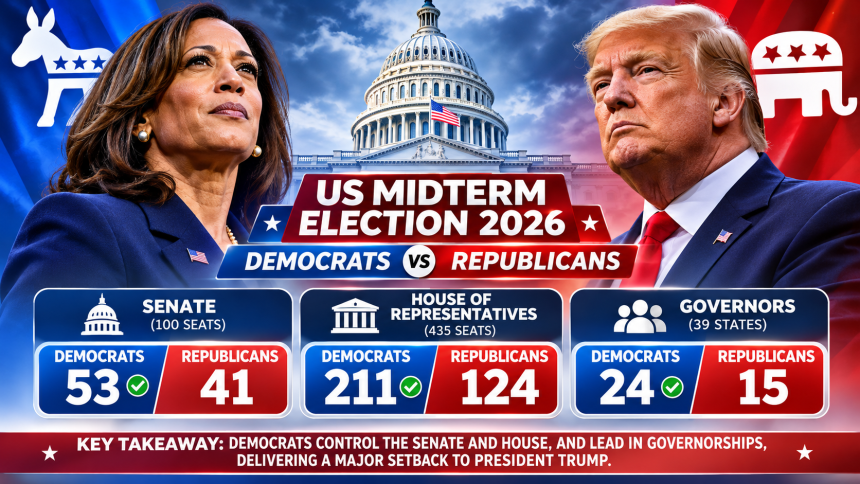
The Democratic Party has dealt President Donald Trump a significant political setback in the November 3 US midterm elections, winning control of the Senate and moving closer to securing a majority in the House of Representatives. The outcome has altered the balance of power in Washington and raised fresh questions about the direction of Trump’s second-term presidency.
Although the final composition of the House was still being determined as results came in, the Democratic advance was already evident. The party recorded important victories in states traditionally considered Republican strongholds, including Texas, Kansas, South Carolina, North Carolina and Ohio.
The Associated Press reported that Democrats had secured control of the Senate, ending the Republican majority, while making substantial gains in House races.
For Trump, the outcome goes beyond the loss of congressional seats. Midterm elections traditionally provide voters with an opportunity to pass judgment on the party occupying the White House. This contest became an assessment of his leadership, economic policies and handling of national and international affairs.
The result suggests that a significant number of Americans were prepared to use their votes to register dissatisfaction with the administration.
The headline, Democrats Deliver a Blow to Trump’s Tower of Babel, captures the political significance of the outcome. Trump’s political movement has been built around a strong personal following, an assertive nationalist message and a coalition of voters with different interests but a common attachment to his leadership. The election has exposed the difficulties of keeping that coalition together when campaign promises meet the demands of governing.
The new balance of power in Washington
The most significant outcome is the Democrats’ capture of the Senate, which gives the opposition greater influence over legislation, presidential appointments and congressional oversight.
The House of Representatives remains the other major battleground. Democrats have made substantial gains and are closing in on the 218 seats required for a majority. According to AP’s election reporting, they need three additional net gains to secure control of the chamber.
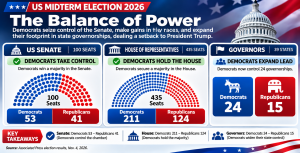
Source: Associated Press election reporting, November 4, 2026. House results remain provisional; graphic does not represent final seat totals.
The significance of the Senate result cannot be overstated. Control of the chamber gives Democrats considerable influence over the confirmation of presidential nominees, legislative negotiations and investigations into the conduct of the administration.
If they also secure the House, Trump will face an opposition-controlled Congress in both chambers during the final two years of his presidency.
That would make the passage of major legislation considerably more difficult and could open the door to more extensive investigations of his administration.
However, congressional control does not remove the president’s constitutional powers. Trump retains the authority to veto legislation, while Democrats would still need sufficient support to overcome such vetoes.
Washington is therefore heading towards a period of more difficult negotiations and potentially sharper political confrontation.
When campaign promises meet economic reality
The economy was among the central issues shaping the election. Rising living costs, inflation-related pressures, high fuel prices and dissatisfaction with the administration’s economic performance featured prominently in voters’ concerns.
The war with Iran and questions about government corruption also influenced the political debate.
These concerns are important because Trump’s political appeal was built substantially on his promise to improve the economic fortunes of ordinary Americans.
His message of economic renewal, protection of American industries and putting American workers first resonated with voters who felt left behind by previous administrations. But the responsibility of governing brings a different standard of accountability.
Voters are less interested in campaign explanations when household expenses remain high. They want to know whether government policies are improving their living conditions, creating jobs and making essential goods and services more affordable.
The Democratic gains suggest that the administration’s economic message did not persuade enough voters that progress was being made. This does not necessarily mean that voters have embraced the Democrats’ entire political programme. In many cases, the result may simply reflect dissatisfaction with the party controlling the White House. That distinction is important in understanding the election.
The cracks in Trump’s political coalition
Trump’s political strength has rested on an unusual alliance of traditional conservatives, religious groups, economic nationalists, working-class voters and business interests. Although these groups do not always agree on policy, his leadership has provided a common platform.
However, governing has a way of exposing differences that election campaigns can temporarily conceal.
Business interests may favour policies that do not always align with economic nationalism. Fiscal conservatives may disagree with supporters demanding greater government spending. Traditional Republican foreign-policy positions may also conflict with the administration’s approach to international affairs.
These differences do not necessarily threaten the Republican Party on their own. But when combined with economic dissatisfaction and declining confidence in the administration, they become more difficult to manage.
This is where the Tower of Babel metaphor becomes particularly relevant. In the biblical account, the builders of Babel shared an ambitious project but eventually lost the ability to communicate with one another. Their inability to maintain a common purpose brought the project to an end.
Trump’s political movement is not facing an identical situation, but the election has exposed the challenge of sustaining a broad political coalition around one personality. Personal loyalty can mobilise supporters, but it cannot always resolve competing interests or guarantee electoral success.
The Republican Party must now confront questions about its political direction, its relationship with the president and its ability to retain voters beyond Trump’s personal following.
The Democrats have their own challenges
While Democrats have reason to celebrate, their victory also comes with expectations. Winning elections by mobilising opposition to a sitting president is one thing; demonstrating the capacity to govern effectively is another.
The party must now show that it has practical answers to the economic and social concerns that helped it gain ground. Voters will expect progress on the cost of living, healthcare, employment, immigration and other issues affecting their daily lives.
There are also ideological differences within the Democratic Party. Its moderate and progressive factions have often disagreed over economic policy, immigration, social issues and the direction of the party.
These disagreements could become more pronounced as Democrats assume greater responsibility in Congress. The party must therefore avoid interpreting the results as a blank cheque from the electorate. Many voters may have supported Democratic candidates because they were dissatisfied with Trump rather than because they agreed with every position advanced by the opposition.
The challenge is to turn electoral success into credible legislative performance.
What the election means for the rest of the world
The outcome will also be watched beyond the United States. American foreign policy is shaped not only by the president but also by Congress, particularly when decisions involve funding, trade, security cooperation and international commitments.
With Democrats controlling the Senate, Trump’s administration will face greater scrutiny over its foreign-policy decisions. The extent to which this affects relations with America’s allies and trading partners will depend on the issues brought before Congress.
For Nigeria and other African countries, the development is worth watching. US engagement with Africa covers trade, security, investment, development assistance and diplomatic cooperation. Congressional decisions can influence the funding and implementation of several of these programmes.
A change in the balance of power does not necessarily mean that Washington will abandon its existing foreign-policy priorities. Nevertheless, African governments and businesses will need to pay attention to the emerging relationship between the White House and Congress.
For Nigeria, maintaining effective relations with the United States will require sustained diplomatic engagement with both the executive and legislative arms of government.
The road to 2028
The midterm results have also opened an important chapter in the political contest ahead of the 2028 presidential election. For Democrats, the victories provide an opportunity to rebuild confidence, strengthen their national organisation and develop a political message capable of attracting voters beyond their traditional support base.
For Republicans, the results raise questions about the future of a party whose identity has become closely associated with Trump. The president’s supporters remain an important political constituency, but the election shows that his influence does not automatically guarantee victory for every Republican candidate.
The party will have to consider how it balances loyalty to Trump with the need to broaden its appeal among voters who may support Republican economic policies but have reservations about the administration’s approach to governance.
Trump, on his part, must now contend with a more difficult congressional environment during the remaining two years of his presidency. His ability to negotiate with Democrats, manage disagreements within his party and respond to voters’ economic concerns will help determine how much of his second-term agenda can still be achieved.
A tower shaken, not demolished
The 2026 midterm election has delivered a clear political warning to Donald Trump and the Republican Party. The Democrats’ capture of the Senate, their gains in the House and victories in several traditionally Republican states show that the president’s political influence has limits.
But the election should not be mistaken for the collapse of Trumpism. His movement retains a substantial support base, and the president remains in office with considerable executive authority.
What has changed is the political environment in which he must govern. The biblical Tower of Babel was built on the belief that its builders could achieve an extraordinary ambition through collective effort. Its failure came when the unity required to sustain the project broke down.
Trump’s political tower has not fallen, but the midterm results have exposed weaknesses that the administration can no longer afford to ignore. For Democrats, the victory offers an opportunity to demonstrate that opposition can produce constructive leadership. For Republicans, it is a moment to reassess their political strategy. And for Trump, it is a reminder that the power of the presidency does not place an administration beyond the judgment of the electorate.
Ultimately, the American voter has delivered a message that should resonate well beyond Washington: no political movement, however powerful its leader or organised its supporters, can indefinitely escape accountability for the consequences of its decisions.