

Former President says weak institutions, flawed leadership recruitment and policy inconsistency are undermining national development; urges long-term reforms ahead of 2060 centenary.
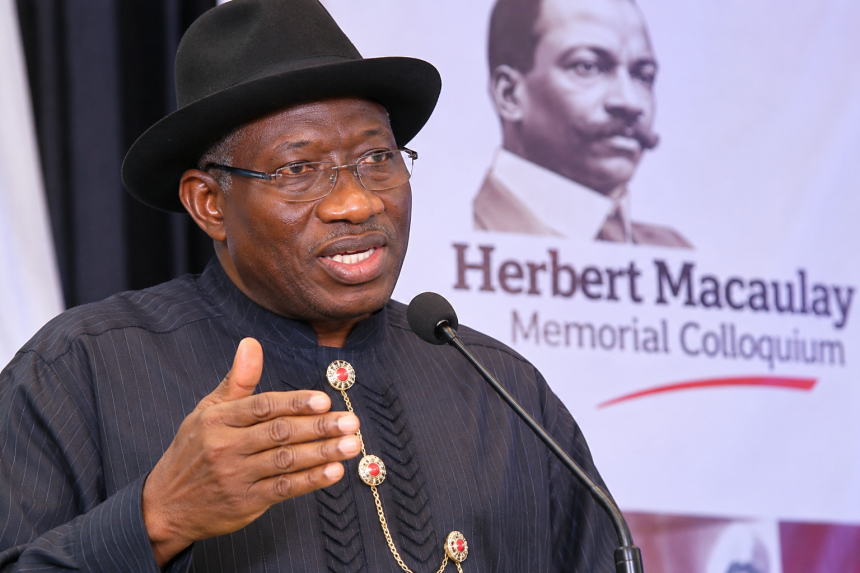
Former President Goodluck Jonathan has called for a fundamental overhaul of Nigeria’s democratic system, warning that weak institutions, divisive political considerations and flawed leadership recruitment are standing in the way of national development.
Jonathan made the call on Saturday in Lagos while delivering an address as Chairman of the Occasion at the Herbert Macaulay Memorial Colloquium.
He described Nigeria’s democratic practice as opaque and lacking a clearly defined institutional character, insisting that the country must return to the fundamental principles of democracy to achieve sustainable progress.
According to him, popular participation, the rule of law, separation of powers, respect for human rights, judicial independence and accountability must form the foundation of a reformed democratic system.
The former President also questioned Nigeria’s political recruitment process, expressing concern that religious, ethnic and linguistic considerations continued to influence the emergence of political leaders at the expense of competence, character and capacity.
He said the problem had persisted since the pre-independence era, limiting the country’s ability to produce leadership capable of addressing its development challenges.
Jonathan called for a departure from what he described as a primitive approach to leadership selection, stressing that national progress required a system that rewarded merit and demonstrated ability.
He further identified functional education as a critical pillar of national transformation, arguing that Nigeria could not achieve meaningful development without stronger educational institutions capable of supporting research, innovation, technological advancement and knowledge creation.
While acknowledging the presence of excellent universities and capable academics in the country, he said deliberate policies were needed to improve the effectiveness of educational institutions and prepare young Nigerians for future challenges.
2060: A defining national development target
Looking towards Nigeria’s centenary of independence in 2060, Jonathan challenged political leaders to develop a comprehensive national development agenda with measurable objectives, clear timelines and identifiable responsibilities.
He observed that children born today would be about 34 years old when Nigeria marks 100 years of independence, warning that another generation could inherit the same unresolved national challenges if structural reforms were not pursued.
He said political leaders must provide direction through a clearly established national vision, while public institutions, businesses and educational institutions must take responsibility for delivering development outcomes.
Jonathan identified leadership failures, corruption, institutional weaknesses, policy inconsistency, inadequate infrastructure, insecurity and dependence on raw material exports as major obstacles to national progress.
Drawing comparisons with South Korea, India and Singapore, he said Nigeria needed to convert its enormous human and natural resources into industrialisation, technological advancement, economic emancipation and improved living standards.
Macaulay’s legacy and Nigeria’s unfinished national project
The former President also called for renewed efforts to preserve Nigeria’s political history and recognise the contributions of its founding nationalists.
Describing Herbert Macaulay as an intellectual, engineer, surveyor, journalist and political activist, Jonathan said the nationalist played an important role in challenging colonial injustice and advocating greater political participation and self-determination.
He noted that Macaulay and other nationalists envisaged an independent country where Nigerians would control their resources, determine their collective destiny and enjoy equal rights and opportunities irrespective of ethnic, religious or cultural backgrounds.
Jonathan said their vision extended beyond the transfer of political power to indigenous leaders to include industrialisation, quality education, accessible healthcare, employment opportunities and social justice.
He urged younger Nigerians to advance that vision through innovation, enterprise, civic participation, responsible citizenship and accountability.
Earlier, Chief Olabode George, former Deputy National Chairman of the Peoples Democratic Party and a cousin of Macaulay, appealed to President Bola Tinubu to return the property housing the General Post Office in Lagos to the Macaulay family.
George said the family intended to establish a permanent memorial hall on the property to preserve the nationalist’s legacy and educate younger generations about his contributions.
He explained that Macaulay’s residence was demolished after his death in 1946, with the General Post Office subsequently constructed on the site.
Macaulay was born on November 14, 1864, and died in 1946, 14 years before Nigeria attained independence in 1960.