Wale Alonge
The great legend and godfather of Ibadan politics, Baba Lamidi Adedibu of Molete, is remembered for what may aptly be described as “Amala politics.” Baba Lamidi Adedibu, was a political genius of his generation. He understood, perhaps intuitively more than anyone, what modern political economists would describe as the intersection between poverty, patronage and political behavior.
He understood that a hungry electorate is an extremely vulnerable political constituency.
Baba Lamidi Adedibu probably harvested more votes and political loyalty than anyone of his generation by serving hot plates of amala to his teeming followers and supporters, whom he would subsequently mobilize during elections. The amala was not merely food. It was political currency. It created a transactional relationship between the politician and the voter:
I feed you today; you support me tomorrow.
Decades later, the technology of political mobilization has changed, but the underlying political economy has hardly changed.
Former Ekiti State Governor Ayo Fayose’s celebrated concept of “stomach infrastructure” may have sounded more sophisticated than Baba Lamidi Adedibu’s amala politics, but the underlying principle was essentially the same. Give the impoverished voter something immediate and tangible, and the politician gains political loyalty.
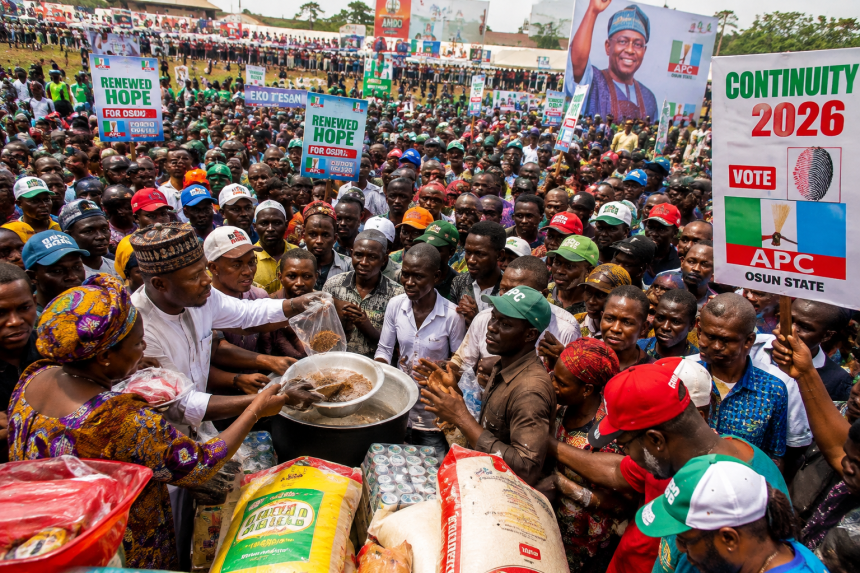
Today, the amala has been replaced by branded loaves of bread, bags and sachets of rice, garri, cash handouts and other token inducements. During elections, politicians routinely compete not only with manifestos and ideas but also with their capacity to distribute immediate material benefits.
We saw disturbing examples of this phenomenon during the recently concluded Osun State gubernatorial election, where reports and videos circulated showing voters receiving bread, food items and cash, sometimes reportedly as little as ₦5,000, in exchange for political support.
The amount is almost irrelevant.
What matters is the underlying transaction.
A citizen struggling to feed his family today can understandably attach greater value to ₦5,000 in hand than to a politician’s promise of economic transformation five years from now. The sad reality, born of decades of broken promises, is that many Nigerians have learned to treat political promises with deep skepticism.
That is the tragedy of poverty as a political instrument.
The Maslowian Trap
Poverty is often weaponized by the powerful to trap the poor in a perpetual cycle of dependency.
I use the term “Maslowian trap” here as a political metaphor—not as a formal description of Maslow’s psychological theory—to describe a condition in which citizens are so consumed by immediate survival that they are compelled to prioritize today’s meal over tomorrow’s prosperity.
There is nothing irrational about this behavior.
A hungry man does not eat a manifesto.
A mother whose children have not eaten does not experience the future benefits of macroeconomic reform.
A young unemployed graduate cannot pay today’s transportation fare with a promise that industrialization will create jobs five years from now.
This is precisely where the politics of poverty becomes powerful.
The politician who offers immediate relief has an enormous psychological advantage over the reformer who asks citizens to endure present hardship in anticipation of future prosperity.
The former says:
“Take this today.”
The latter says:
“Sacrifice today so that tomorrow can be better.”
The first is politically gratifying.
The second is politically hazardous.
The Pathology of Low Performance Expectations
One of the enduring myths about Nigerian politics is that Nigerians are difficult to govern.
I would argue the opposite.
Nigerians are, in fact, among the most tolerant of incompetent, corrupt and inept governance. Corrupt practices have become embedded in many aspects of daily transactions, from the traffic police officer demanding a bribe to the immigration official who is paid from taxpayers’ money to perform a service that is constitutionally and administratively guaranteed.
It does not matter how long one has lived in another, more functional country. Nigerians often know almost instinctively when and where a bribe may be required to get something done.
Politicians stealing billions of naira no longer shock many Nigerians. It has become almost normalized.
That is a pathology.
Nigerians have developed an extraordinarily low expectation of what government should actually deliver.
That may be one of the most damaging pathologies of our political system.
Over the decades, Nigerians have gradually accepted as normal the responsibility of providing privately for many of the basic services that government ought to provide.
We drill our own boreholes.
We generate our own electricity.
We educate our children in private schools, sometimes at enormous financial sacrifice, because many public schools are in such a deplorable state that only the most desperate parents or those with no other option will send their children there.
We provide private security.
We construct roads within our communities.
We visit pharmacies rather than risk exposure to dangerous pathogens in dilapidated, unhygienic and poorly equipped hospitals.
We purchase generators and fuel them to compensate for unreliable public electricity.
In other words, the Nigerian citizen frequently subsidizes the failure of the state.
Consequently, a governor who pays salaries and pensions on time, constructs a few major roads, installs boreholes and builds the ubiquitous, crazily expensive flyover to nowhere can easily be perceived as a high-performing governor—even when the state’s federal allocation has more than quadrupled and the broader institutional machinery of government remains dysfunctional.
A school may have dilapidated classrooms, overcrowded pupils and inadequate teaching materials, but a new flyover can become the symbol of development.
A hospital may lack essential equipment, doctors and medicines, but a newly commissioned building can be presented as evidence of achievement.
The political bar is therefore set remarkably low.
Citizens have become so accustomed to poor governance that mediocrity begins to look like excellence.
From Performance to Personality
This low expectation of government has another consequence.
It shifts political competition away from institutional performance and toward personality.
Where citizens do not expect government to fundamentally transform their lives, elections become contests over who appears more relatable, generous, accessible or personally trustworthy.
Political manifestos become secondary.
Party ideology becomes secondary.
Institutional competence becomes secondary.
The personality of the candidate becomes primary.
The politician who visits the market, dances with women, distributes food and speaks the language of the street can easily appear more effective than the technocrat proposing difficult structural reforms.
This is why political patronage remains so powerful in Nigeria.
The Nigerian electorate has learned from decades of experience that promises are cheap. Politicians make promises before elections and frequently forget them after taking office. Citizens have consequently developed little confidence in political manifestos.
They rationally ask themselves:
Why should I believe this politician’s promise when politicians before him made the same promises and failed?
And so the voter increasingly prefers something tangible.
Cash today is more credible than a manifesto tomorrow.
That is the political foundation upon which amala politics, stomach infrastructure and electoral inducement continue to thrive.
Why Tinubu’s Reform Agenda Is Struggling to Resonate
This brings us to the paradox confronting President Bola Ahmed Tinubu.
There is a legitimate argument that many of the economic reforms undertaken by his administration were overdue and necessary to address structural weaknesses that successive Nigerian governments had avoided.
Fuel subsidy reform, exchange-rate reform, fiscal restructuring and efforts to reposition the Nigerian economy are not reforms that can be undertaken without pain.
The fundamental problem is that the pain is immediate while the benefits are prospective.
The citizen experiences the higher price of fuel immediately.
They experience higher transportation costs immediately.
They experience increased food prices immediately.
They experience the erosion of their purchasing power immediately.
The structural benefits of reform—greater fiscal sustainability, improved investment incentives, increased production, stronger government finances, a more competitive economy and potentially greater employment—take time.
This resembles what political economists have described as the J-curve problem of economic reform: short-term disruption and pain can precede the realization of longer-term benefits.
This creates a devastating political asymmetry.
The costs of reform are personal, immediate and visible.
The benefits are collective, delayed and uncertain.
That is an extremely difficult proposition to sell to a population already trapped in economic insecurity.
It is therefore not surprising that Tinubu’s transformative reform agenda has struggled to resonate with large segments of the population.
The problem is not necessarily that Nigerians do not understand the need for reform. Many do.
The problem is that they are being asked to finance the transition with today’s income while waiting for tomorrow’s prosperity.
For most poor Nigerian households and a diminishing middle class, that is an enormous burden.
The Weaponization of Pain
This is where political opportunism enters the equation.
Politicians who understand the structural necessity of reform can nevertheless weaponize the immediate pain for partisan advantage. They do not necessarily need to offer a better alternative. They only need to amplify the pain for a citizenry already crippled under the oppressive weight of multigenerational and multidimensional poverty.
Every increase in the price of food becomes evidence of failure.
Every increase in transportation becomes evidence of incompetence.
Every hardship becomes political ammunition.
Yet the uncomfortable questions remain:
What was the alternative?
Could Nigeria indefinitely finance petroleum subsidies that disproportionately benefited those consuming more petrol?
Could the government continue maintaining an exchange-rate regime that distorted the economy?
Could Nigeria continue borrowing to finance recurrent expenditure without eventually confronting a fiscal crisis?
Could successive governments continue postponing difficult decisions simply because those decisions were politically inconvenient?
These are legitimate questions that deserve serious answers.
Unfortunately, Nigerian politics often rewards the politician who identifies the pain rather than the statesman who explains the cure.
The Politics of Immediate Gratification
There is an important distinction between legitimate criticism and political exploitation.
Citizens have every right to demand that reforms produce results. They have every right to question government policies. They have every right to ask where the promised dividends are. They have every right to demand accountability for public expenditure.
Reform should never become a shield against accountability.
But there is an equally dangerous tendency to judge structural reform exclusively by its immediate discomfort.
Nigeria’s challenge is therefore larger than Tinubu.
It is a challenge of political culture.
For decades, we have trained ourselves to celebrate the politician who distributes food rather than the leader who creates the economic conditions under which citizens can afford their own food.
We celebrate the politician who drills a borehole rather than demanding a functioning public water system.
We praise the politician who gives students notebooks rather than demanding an education system capable of producing globally competitive graduates.
We celebrate the governor who constructs a flyover while ignoring the quality of the institutions underneath it.
This is the essence of the pathology of low expectations.
President Tinubu and the Empathy Deficit
If there is one area where President Tinubu’s aides have poorly served him, it is in the area of empathy—the “I feel your pain” dimension of politics.
President George H. W. Bush lost his 1992 reelection bid to Bill Clinton amid, among other factors, a growing perception that he was detached from the economic anxieties of ordinary Americans.
The second presidential debate, conducted in a town-hall format, offered a powerful demonstration of the importance of political empathy. Clinton moved toward the questioner, addressed her directly, acknowledged her concerns and demonstrated an ability to connect the larger economic crisis to the lived experience of an individual citizen.
The lesson is larger than the debate itself.
People want to know that their leaders understand their pain.
That is the power of empathy.
During World War II, the British people endured the devastating Blitz. They did not simply need military strategy and government policy; they needed leadership that gave them courage, resilience and a sense of shared national purpose. Winston Churchill became the embodiment of that leadership.
A leader cannot tell citizens to bear extraordinary pain while appearing insulated from the circumstances in which that pain is being experienced.
Yes, presidential security is a huge challenge whenever the President steps out. Yes, the office requires a level of protection that ordinary citizens do not fully appreciate.
But citizens—especially in the midst of a devastatingly painful economic reform—need to feel the warmth, presence, touch and empathy of their President.
They need to feel that the pain is being acknowledged.
They need to see the President and his team tighten their belts as they are being asked to tighten theirs.
They need to see evidence that sacrifice is not a one-way street.
That is what is missing in President Tinubu’s public engagement.
And this is not an indictment of his intellectual capacity or commitment to reform.
President Tinubu is arguably one of the most policy-engaged and reform-minded presidents in Nigerian political history. His hands-on approach and intense focus on policy execution are unmistakable.
But his excessive task orientation and hands-on approach may also be robbing him of the soft but indispensable power of touch, warmth, presence, engagement with citizens and empathy.
Perhaps empathy is not his strongest personality suit.
But in the midst of tough, transformative and painful reform, it is absolutely indispensable.
A reforming president must not only explain what he is doing.
He must explain why.
He must not only explain why sacrifice is necessary.
He must demonstrate that the sacrifice is being shared.
He must not only promise tomorrow.
He must show citizens that their pain today is seen, understood and being addressed.
It is not too late for a course correction.
But that course correction is not merely a communications strategy. It requires an urgent and deliberate political shift toward greater empathy, visibility, social protection, public engagement and tangible evidence that government understands the economic reality facing ordinary Nigerians.
Great Nations Do Not Emerge from Low Expectations
History teaches us that no great nation has emerged by permanently institutionalizing low expectations.
Countries that transformed their economies did so because governments and citizens eventually accepted that development requires difficult choices, institutional discipline and sacrifice.
The transformation of nations does not happen through perpetual distribution of political largesse.
It happens when citizens move from dependency to productivity, from patronage to institutions, and from survival politics to development politics.
The ultimate objective should not be to create a government that can give every citizen a loaf of bread.
It should be to create an economy in which citizens can afford to buy the bread themselves.
That is the difference between stomach infrastructure and economic infrastructure.
One creates political dependence.
The other creates economic independence.
Nigeria Must Break the Cycle
Nigeria cannot become the undisputed economic powerhouse of Africa while millions of citizens remain trapped in a political economy of immediate survival.
We must raise the bar.
We must demand functioning public schools, reliable electricity, potable water, efficient healthcare, effective transportation systems, secure communities and institutions that work.
But raising expectations also means accepting that government cannot deliver transformation without citizens accepting some measure of responsibility, sacrifice and patience.
The citizen must stop asking only:
“What will government give me today?”
We must begin asking:
“What policies will make my children more prosperous tomorrow?”
That is a much harder political question.
It requires looking beyond the amala.
It requires looking beyond ₦5,000.
It requires looking beyond bread and bags of rice.
It requires looking beyond the next election.
Nigeria’s greatest political transformation will occur when the electorate begins to judge politicians not by what they distribute before elections, but by the institutions they build, the economy they strengthen and the opportunities they create.
Baba Lamidi Adedibu understood the politics of his time brilliantly.
The question for contemporary Nigeria is whether we will remain trapped in amala politics long after the country has outgrown the circumstances that created it.
The choice before us is ultimately between two political models.
One says:
“Give the people something today and secure their loyalty tomorrow.”
The other says:
“Build a country in which the people no longer need political patrons to survive.”
The first produces followers.
The second produces citizens.
And Nigeria cannot take her rightful place as the economic behemoth of Africa and the pride of the Black race until we exorcise the pathology of low expectations, dismantle the culture of stomach infrastructure and demand from our leaders—and ourselves—something far greater than survival.
We must demand transformation.
Adewale Alonge, PhD, Founder & President, Africa Diaspora Partnership for Empowerment and Development. www.adped.org