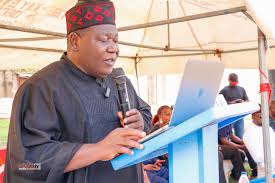
Makurdi, Benue State — Prominent historian and development scholar, Professor Yakubu Aboki Ochefu, has called for a comprehensive political, economic and social renewal in Benue State, urging leaders and citizens to seize the state’s golden jubilee as a defining moment to chart a new course for sustainable development.
Delivering the keynote address at the celebration marking Benue State’s 50th anniversary in Makurdi on Saturday, Ochefu reflected on the state’s history, assessed its achievements and shortcomings over the past five decades, and outlined an ambitious vision for the next 25 years.
Speaking before Governor Hyacinth Alia, former Head of State General Yakubu Gowon, traditional rulers, lawmakers, religious leaders and other dignitaries, the professor described Benue’s creation in 1976 as the culmination of decades of political struggle by Middle Belt leaders who sought greater representation within Nigeria’s federal system.
He said while the state had produced distinguished leaders in politics, academia, the judiciary, the military and entertainment, it continued to grapple with persistent security challenges, economic dependence on federal allocations, weak industrialisation and political divisions.
According to him, Benue’s greatest challenge remains insecurity and the displacement of thousands of residents caused by recurring violent attacks, insisting that lasting peace must become the foundation for development.
He advocated stronger community policing, greater collaboration between federal and state security institutions, improved intelligence gathering, deployment of technology and the eventual integration of traditional institutions into the proposed state policing architecture.
Ochefu also urged the state to move beyond its long-held reputation as Nigeria’s “Food Basket” by investing in agro-processing industries capable of adding value to agricultural produce.
He argued that exporting raw farm produce had denied Benue the full economic benefits of its agricultural potential and called for deliberate investment in processing facilities, storage infrastructure, irrigation and agricultural value chains.
The professor further proposed repositioning Benue as the “Knowledge Basket of Central Nigeria” through sustained investment in education, research, innovation and digital infrastructure.
He stressed that universities and tertiary institutions should become drivers of economic growth rather than merely centres for awarding certificates, while advocating technology parks, broadband connectivity and stable electricity to retain talented young professionals within the state.
On fiscal sustainability, Ochefu challenged the government to reduce dependence on monthly federal allocations by expanding internally generated revenue through economic growth rather than increased taxation.
He commended recent improvements in revenue generation and the state’s capital expenditure profile but maintained that fiscal reforms, transparent governance and a more attractive investment climate remained essential.
The historian also called for significant investments in transport infrastructure, inland waterways, rail connectivity, renewable energy and the development of Benue’s solid minerals and creative industries.
He noted that the River Benue, from which the state derives its name, remains an underutilised economic asset capable of transforming commerce through inland water transportation if properly developed.
Perhaps his strongest message centred on what he described as a “Benue Compact”—a renewed commitment to unity among the state’s diverse ethnic nationalities.
He urged the Tiv, Idoma, Igede, Etulo, Jukun and other communities to build stronger political consensus, promote inclusive governance and ensure equitable distribution of opportunities across the state.
Ochefu suggested that future political arrangements should reflect broader inclusion, including greater opportunities for historically underrepresented groups in key elective offices.
He argued that sustainable development would remain elusive without elite consensus and mutual trust among Benue’s constituent communities.
The scholar concluded by challenging young people to study the state’s history and preserve its heritage, warning that no society could build a prosperous future without understanding its past.
“Benue at fifty is not what its founders dreamed, but it is not yet what its founders feared,” he said, urging citizens to work collectively towards building a more secure, prosperous and united state over the next half-century.
The keynote formed part of activities commemorating Benue State’s Golden Jubilee, Governor Hyacinth Alia’s third anniversary in office, Nigeria’s Democracy Day celebrations and the governor’s 60th birthday.