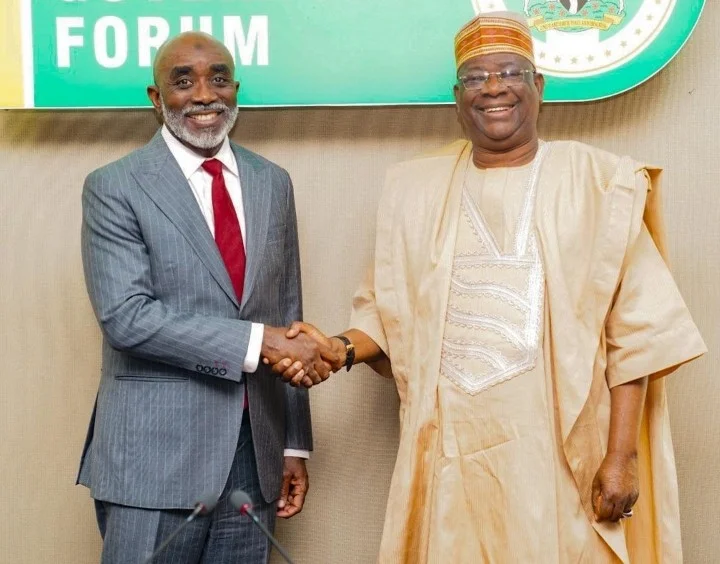
NGF Prioritises Sugar Production to Boost Industrial Development in Nigeria

“The Nigeria Governors’ Forum has agreed to prioritise sugar production as a key driver of industrial development, job creation and self-sufficiency, following engagement with the National Sugar Development Council.”
Governors Set for 2025 PHC Leadership Awards in Abuja

Nigeria’s 36 state governors will on Friday, December 12, converge in Abuja for the third edition of the Primary Health Care (PHC) Leadership Challenge Awards. The award is an initiative aimed at promoting accountability and performance in the delivery of primary health care across the country. The event, scheduled for 7:00 p.m., is organised by the Nigeria Governors’ Forum (NGF) in collaboration with the Federal Ministry of Health and Social Welfare, the National Primary Health Care Development Agency (NPHCDA), and UNICEF, with support from the Bill & Melinda Gates Foundation. The awards were introduced to encourage governors to fulfill the commitments made under the Seattle Declaration of 2019, where all 36 governors pledged to improve access to quality primary health care services in their states. Accountability Platform for Primary Health Care The PHC Leadership Challenge uses a performance monitoring framework that tracks progress in governance, financing, service quality, data use, and sustainability of state-level health systems. The framework, developed with input from national health stakeholders, is based on the principles of Meaningfulness, Availability, Movability, Measurability, and Simplicity (MAMMS). READ ALSO: https://nigeriananchor.com/n5bn-palliatives-fg-has-released-n2bn-to-states-fct-wale-edun/ https://nigeriananchor.com/cbn-opens-fx-price-verification-system-portal/ Following the inaugural edition, indicators from the Nigeria Health Sector Renewal Investment Initiative were integrated into the assessment process. The review system now rewards states not only for new investments but also for sustained funding, institutional leadership, and efficient management of PHC programmes. NGF Chairman AbdulRahman AbdulRazaq described the platform as “a clear example of how political will can translate into measurable outcomes,” noting that it has become “a beacon of what strong, accountable leadership can achieve in Nigeria’s health system.” Independent Review and Verification The judging panel consists of public health professionals, academics, traditional and religious leaders, media representatives, and members of civil society organisations. A statement released by Yunusa Tanko Abdullahi, NGF Director of Media and Strategic Communications explains that the assessments are conducted by independent verification agents recruited through the United Nations system to ensure objectivity and credibility. Governors are evaluated on a range of indicators, including functionality of PHC governance structures, budget releases, staffing, infrastructure readiness, use of reliable data, and efforts to institutionalize leadership at the Local Government Area (LGA) level. Awards and Incentives A total of 13 awards will be presented this year — two for each geopolitical zone and one national prize for the overall best-performing state. It was further explained tha the winners will share US$6.1 million, which must be reinvested in their state PHC systems. Previous editions have seen strong participation from states across the federation. Beyond Competition Organisers say the challenge has evolved beyond a competition into a structured accountability mechanism that fosters peer learning among states. Governors are expected to adopt and replicate effective strategies implemented by high-performing peers. “This is not just an award ceremony,” AbdulRazaq said. “It is a recognition of measurable impact and a collective commitment to improving the health and wellbeing of Nigerians.” The statement concludes that, “now in its third cycle, the PHC Leadership Challenge has become one of the country’s most consistent performance-based accountability initiatives, driving Nigeria toward the goal of universal access to functional, quality primary health care.”
Tinubu Tax Reform Bills: Buba Galadima Opens a Can of Warms

Engr. Galadima, an Elder statesman and stalwart of the NNPP says the Bills, in their present format have to be rejected because the process leading to its formulation lacks transparency. He said the bill is a contraption of Mr. Taiwo Oyedele, the Chairman of the tax reform committee and Mr. Babajide Sanwo-Olu, the Lagos State Governor, contending, the two of them practically wrote the bills before handing them over to President Tinubu. Engr. Galadima said that in fact, all members of the committee from other parts of the country have already disowned the bills because they discovered that the final bill did not reflect the contributions submitted by the various sub-committees. READ ALSO: TCN Announces 14 Days’ Power Outage in Parts of FCT, Nasarawa State Engr. Galadima who spoke as a guest of This Day Live, a programme on Arise TV. chided Dr. Reuben Abati whom he accused of deploying divisive narratives that had the tendency to pit regions of the country against each other. Galadima also stressed that the bills will never be allowed to scale through in their present format because of the approach of President Tinubu and his recent statement of ‘no going back.” He also accused the committee and President Tinubu of over reaching themselves by veering into the subject of derivation or revenue sharing, which is a constitutional issue. Contributing to the subject, Professor David Aworawo of the University of Lagos disagreed with the committee on several aspects of the Bill. READ ALSO: Trump to be Sentenced Before Inauguration He referred to a provision in the Bill which stated that by 2030 funding to the Tertiary Education Trust Fund (TETFUND) shall cease and be diverted to the National Education Loan Fund (NELFUND), saying that provision alone goes to show that the committee lacked adequate knowledge of contemporary Nigeria. Contending, Prof Aworawo explained that most modern physical structures in tertiary institutions in Nigeria are funded by TETFUND, asking, “If you phase out TETFUND and utilise the money as loans to students, where will they stay to receive the lectures?” Reacting to the position of Mr. Galadima, Taiwo Oyedele confirmed that members of the committee only met with the Governor of Lagos, who ended being the only governor that made input to the bills. He said even though the committee met with Mr. Uba Sani, the Governor of Kaduna state, they did not succeed in discussing the subject matter of the tax reform bills. He said that the committee did not succeed in having any engagement with the remaining 35 state governors. Mr. Oyedele said that at inception, the committee had planned to meet with a governor from each of the six geo-political zones of the country but succeeded in meeting with the Lagos state governor alone.