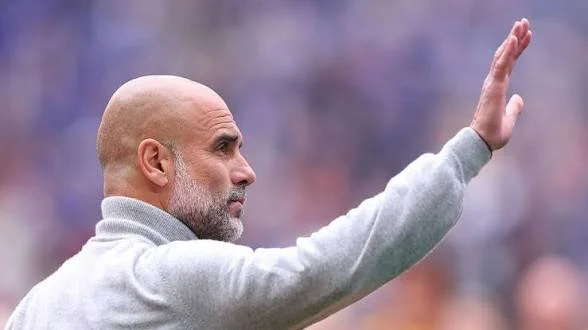
An era came to an emotional end on Sunday evening as Pep Guardiola bade farewell to Manchester City following a dramatic 2-1 defeat to Aston Villa at the Etihad Stadium.
The atmosphere inside the Etihad was filled with emotion long before the final whistle. Supporters arrived knowing they were about to witness the final chapter of one of the most successful managerial reigns in modern football history. By the end of the night, tears flowed freely among fans, players, and coaching staff as Guardiola officially closed the curtain on a transformative spell that changed Manchester City forever.
Although defeat to Aston Villa denied City a victorious send-off, the result ultimately mattered little compared to the overwhelming emotions surrounding Guardiola’s departure.
Speaking during his post-match press conference, the Spaniard reflected deeply on his journey at the club, insisting that the human connections and memories he built over the years would remain more valuable than the silverware that filled City’s trophy cabinet.
“The luggage of memories I put inside is more than any other,” Guardiola said emotionally.
“Without 20 trophies they would have sacked me before, but you are not at home and see the trophies and say, ‘Oh, how happy I am.’
“I don’t know, explain to me why the connection I had since day one for the city, but especially with the back-room staff, with the players. I know we were connected.”
For Guardiola, it was not simply about victories, records, or medals. It was about relationships forged through years of relentless pursuit of excellence. Throughout his tenure, he built a culture that transformed Manchester City from domestic contenders into one of the dominant football institutions in world football.
Emotional Farewell for Silva and Stones
The occasion became even more emotional as Guardiola paid tribute to two senior figures also preparing to leave the club — captain Bernardo Silva and defender John Stones.
Guardiola revealed that emotions overwhelmed him after seeing Bernardo Silva break down following the match.
“I don’t cry, but when I see Bernardo cry, I cry,” he said.
“It was such a special moment with Bernie. He said to me, ‘I’m so tired, I cannot run.’ And the emotions were so important today with John.”
Silva has long been regarded as one of Guardiola’s most trusted lieutenants on the pitch, admired for his work ethic, versatility, and technical brilliance. Stones, meanwhile, evolved into one of Europe’s finest ball-playing defenders under Guardiola’s guidance after initially struggling for consistency earlier in his City career.
Their departures, alongside Guardiola’s exit, signal the end of a golden generation that delivered unprecedented success to the club.
A Father Witnesses History
Adding a deeply personal layer to the evening was the presence of Guardiola’s 95-year-old father at the Etihad Stadium.
The veteran football manager acknowledged how special it was to have his father witness his final match in charge of Manchester City. The moment symbolised not only the end of a football era, but also a deeply human story of family, sacrifice, and achievement.
Supporters inside the stadium responded with prolonged applause and chants in Guardiola’s honour after the final whistle, recognising the immense impact he made both on and off the pitch.
A Legacy That Redefined Manchester City
Guardiola’s departure marks the conclusion of one of the most decorated managerial tenures in football history.
Appointed Manchester City manager on February 1, 2026, Guardiola oversaw a revolution in playing style, mentality, and global reputation. Under his leadership, City became synonymous with attacking football, tactical innovation, and relentless consistency.
Across his spell at the club, Guardiola won 20 major trophies, including six Premier League titles, establishing City as the dominant force in English football during his era.
Perhaps the crowning achievement of his reign came during the historic 2022-23 season when he guided Manchester City to their first-ever treble — winning the Premier League, the FA Cup, and the UEFA Champions League in the same campaign.
That achievement placed Guardiola among football’s all-time managerial greats and cemented Manchester City’s place in European football history.
Beyond the trophies, however, Guardiola’s greatest contribution may have been cultural. He elevated standards across every level of the club, developed multiple generations of elite players, and inspired a football identity admired around the world.
As fans lingered long after the final whistle on Sunday night, many understood they were not simply saying goodbye to a manager. They were saying goodbye to the architect of the most successful era the club has ever known.
And while the scoreline against Aston Villa will eventually fade from memory, Guardiola’s legacy at Manchester City almost certainly never will.