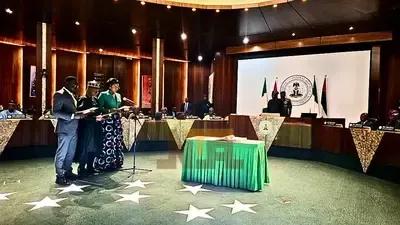
Tinubu Swears In 3 New Cabinet Members

President Bola Tinubu administered the oath of office to three new ministers during the second Federal Executive Council meeting held at the Council Chambers of the Presidential Villa in Abuja on Monday. The newly appointed cabinet members are as follows: Malam Balarabe Lawal from Kaduna State as the Minister of Environment, Jamila Bio-Ibrahim from Kwara as the Minister of Youths, and Ayodele Olawande from Ondo as the Minister of State for Youths. These appointments follow the creation of the Ministry of Youths, with Tinubu nominating these individuals to lead it and serve as a replacement for former Kaduna State Governor, Malam Nasir el-Rufai. Recall that El-Rufai’s nomination was previously rejected during the Senate ministerial screening due to a petition against him. Tinubu, who chaired the FEC meeting, oversaw the swearing-in ceremony and also posed for photographs with the new cabinet members. The council also observed a minute of silence in honor of Late Mobolaji Ajose-Adeogun, a former member of the cabinet who served as the Minister of the Federal Capital Territory. This second FEC meeting further solidified the administration’s commitment to delivering on its “Renewed Hope Agenda” and addressing the eight-point economic agenda unveiled by President Tinubu during the inaugural meeting held in August. The Federal Executive Council serves as a constitutional institution where government policies are discussed and endorsed by ministers, with the President serving as the Chairman and the Vice President as the Vice Chairman.
Questions For Akpabio’s Senate Over Confirmation Of Ministerial Nominees

When the Senate announced on 9 August that it would commence a recess and resume on 26 September, it left a few questions unanswered. Its major assignment until that point was the screening of 48 ministerial nominees forwarded to it in batches by President Bola Tinubu. On 7 August, the President of the Senate, Godswill Akpabio, announced that the Senate had confirmed 45 of the 48 ministerial nominees it screened over the previous week. Senator Akpabio blamed the non-confirmation of three nominees on security reports from the State Security Service. The nominees whose confirmations were withheld were Nasir El-Rufai, a former governor of Kaduna State; Stella Okotete, an executive director at NEXIM Bank and; Abubakar Danladi, a former senator. Mr Akpabio’s shocked many Nigerians, especially given Mr El-Rufai’s political standing. He is believed to have accepted El-Rufai’s nomination as minister only after considerable pressure from President Tinubu. His non-confirmation and those of his two colleagues, therefore raised questions about the entire screening process, who influenced it, the role of security agencies in it, and the options for redress by the persons of whom the purported security reports may have impugned. As the Senate resumed last week, it is yet to answer these questions or grapple with the implications of the constitutional provision, which deems a nominee to have been confirmed as minister, if no return is received from the Senate within 21 working days of receipt of his or her nomination. Who Confirms: The Senate or Akpabio? During the proceedings of 7 August, Mr Akpabio named the 45 confirmed ministerial nominees. And as mentioned, he announced the non-confirmation of the other three nominees, attributing the decision to security reports. There was no debate by the Senate on the content or merit of the security reports as it pertained to the nominees, neither was any vote taken on the matter. It felt more like diktat than a collegial or collective decision. Many senators were said to have been incensed that Mr Akpabio usurped their powers, and twisted what should be an institutional responsibility into an unprecedented exercise of personal power. That was believed to be one of the issues fuelling the grievance of some senators against Mr Akpabio, who recalled that despite its hostility to the executive, the Bukola Saraki Senate leadership did not embarrass President Muhammadu Buhari’s cabinet nominees in 2015. What Is the Status of the Three Nominees Yet To Be Cleared? While the Senate was on recess, President Tinubu nominated two more ministers. The Senate is likely to conduct their screening this week; an exercise that will remind everyone of the pending confirmations of Mr El-Rufai, et al. The expectation is that the Senate will be eager to clear up the issue once it resumes. But there are arguments by some people that Messrs El-Rufai, Okotete and Danladi are already deemed as confirmed ministers by virtue of Section 147 (6) of the Constitution, which states that “An appointment to any of the offices aforesaid shall be deemed to have been made where no return has been received from the Senate within twenty-one working days of the receipt of nomination by the Senate.” Whether or not this interpretation prevails, the Senate is expected to dispose of the hazard it hung on the neck of nominees like Mr El-Rufai, who was publicly courted, to join the Tinubu government and Mrs Okotete, who is serving in a senior role within a federal parastatal. Who Influences the Screening Process? Some aggrieved senators are alleging that external forces and personal interest influenced Mr Akpabio’s action. Influential figures from the executive branch are believed to have pressured Mr Akpabio to block the confirmation of certain persons. In persuading the Senate president to act as they desired, the figures from the executive branch recalled a similar event during the Buhari years, when security reports from the Lawal Daura-led DSS, a parastatal of the executive branch, was used to thwart the confirmation of Ibrahim Magu as EFCC chairman. But unlike Magu’s case, no security agency has owned up to issuing any adverse report on President Tinubu’s nominees. There is yet to be any valid security issue about the concerned nominees made known and neither have the so-called petitions nor security reports been brought to their knowledge. The Role of Security Agencies The creeping deployment of security reports as a tool for political intrigue, as seen in the latest ministerial confirmation saga and the past case of Ibrahim Magu risks making an issue of public trust in the integrity of security reports. Politicians are being accused of cloaking, as security reports, innuendos and angst arising from political differences, ruptured friendships, failed marriages and even ill-fated dalliances. For the health of the polity, politicians are advised to use other tools in their contestations, rather than imperil the objectivity of security reports and thereby devalue the hard work of the security agencies that compile them. Nigerians await Senator Akpabio-led Senate’s answers to these bewildering non-confirmation of President Tinubu’s nominees. *About the Author: Femi Falade is a teacher and public affairs analyst. He writes from Ijebu-Ode, Ogun State and can be reached via faladeolufemi2003@yahoo.com.