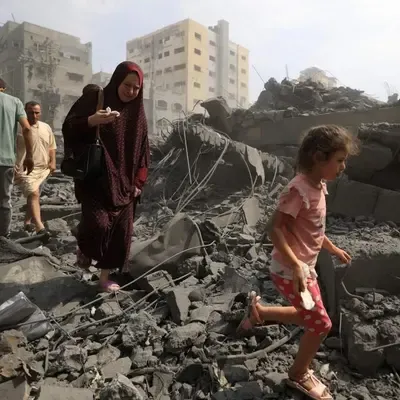
Israel Bombs More Than 200 Targets In Gaza Strip Overnight

Israel Bombs More Than 200 Targets In Gaza Strip Overnight

*123 Israeli soldiers killed large-scale Hamas attack Israeli jets are continuing to pound the Gaza Strip in retaliation for the unprecedented incursion of Hamas fighters into Israel at the weekend. The Israeli military said more than 200 targets were struck overnight, including a weapons depot used by Hamas and facilities belonging to Islamic Jihad, a separate Palestinian Islamist group. Hundreds of Palestinian attackers crossed the border into Israel on Saturday. Around 900 people were killed in the ensuing massacre. In Be’eri, a kibbutz in southern Israel, more than 100 bodies were found on Monday after the army regained control of the area. Hamas militants took at least 150 people captive and brought them back to Gaza, including women, children, and the elderly, according to an assessment by Israel. Hamas has threatened to execute one hostage for every unannounced Israeli strike on civilians in Gaza. The bodies of 1,500 militants have been found in Israeli territory so far, according to the Israeli army. Massive Israeli counter-attacks have killed at least 687 people and injured more than 3,800 in the Gaza Strip, according to the Health Ministry there. Meanwhile, at least 123 Israeli soldiers have been killed in the large-scale attack by the Islamist militant group Hamas, which rules the Gaza Strip, the Israeli military said on Tuesday. Israeli army spokesman Daniel Hagari also said that so far 50 families had been personally informed that their loved ones were being held hostage in the Palestinian coastal enclave. Israel believed at least 100 people were abducted, including soldiers, in Saturday’s multi-pronged attack that blindsided the Jewish state.

Israel: International Community Condemns Palestinian Attack

Israel: International Community Condemns Palestinian Attack

Leaders and officials from various countries have weighed in on the recent escalation of violence in Israel, with their statements reflecting a mix of concern, support for Israel’s right to self-defence, and a strong call for restraint. Dutch Prime Minister Mark Rutte expressed his dismay at the distressing images coming from Israel. He pointed out the involvement of the terrorist organization Hamas in what he described as an unparalleled assault on Israel. Rutte emphasized the urgent need for the violence to cease, underlining that Israel possesses every legitimate right to protect itself. Spain also joined in the chorus of international voices expressing their shock at the indiscriminate violence characterizing the attacks on Israel. The Spanish government’s statement underscores the distressing nature of the violence unfolding in the region. In a similar vein, Ukraine and the Czech Republic lent their support to Israel’s right to defend itself. Both nations acknowledged the complex and challenging situation faced by Israel and endorsed its efforts to protect its citizens in the face of threats and violence. Amidst the escalating tensions, the call for restraint has been a common thread among international stakeholders. Russia, through Deputy Foreign Minister Mikhail Bogdanov, has emphasized the importance of communication with all parties involved in the conflict, including Israelis, Palestinians, and Arabs. Bogdanov stressed that their consistent message is one of urging restraint. The situation in Israel is undeniably complex and multifaceted, with deep-rooted historical and political dimensions. The international community’s response reflects a recognition of the need for a peaceful resolution to the conflict. While expressing concern and support for Israel’s right to self-defence, leaders and officials are also making concerted efforts to encourage dialogue, de-escalation, and a return to stability in the region. As events evolve, the world is watching closely, hoping for an end to the violence and a path forward toward a lasting peace agreement that addresses the concerns and aspirations of all parties involved. The statements from various nations serve as a testament to the global community’s commitment to achieving a peaceful resolution in this long-standing and deeply sensitive conflict.