Nigeria’s intercity transport rises by 98.88% in June -NBS

Nigeria’s intercity transport rises by 98.88% in June -NBS

The average fare paid by commuters for bus journeys within the city per drop increased by 97.88 percent from N649.59 in May 2023 to N1,285.41 in June 2023, the National Bureau of Statistics (NBS) has said. In its Transport Fare Watch of June 2023 posted on its website, the NBS stated that on a year-on-year basis, it rose by 120.63% from N582.61 in June 2022. Analysts have attributed the astronomical increase to fuel pump price hike following the removal of fuel subsidy by President Bola Ahmed Tinubu. Transport Fare Watch for June 2023 covers the following categories: bus journey within the city per drop constant route; bus journey intercity (state route) charge per person; air fare charge for specified routes single journey; journey by motorcycle (Okada) per drop; and water way passenger transport. In another category, the average fare paid by commuters for bus journey intercity per drop rose to N5,686.49 in June 2023, indicating an increase of 42.09% on a month-on-month basis compared to N4,002.16 in May 2023. “On a year-on-year basis, the fare rose by 55.25% from N3,662.87 in June 2022. In air travel, the average fare paid by air passengers for specified routes’ single journey increased by 4.93% from N74,948.78 in May 2023 to N78,640.54 in June 2023. On a year-on-year basis, the fare rose by 40.22% from N56,082.64 in June 2022. “The average transport fare paid on Okada transportation was N618.52 in June 2023 which was 33.14% higher than the rate recorded in May 2023 (N464.55),” the statistics bureau stated. On a year-on-year basis, the fare rose by 48.34 percent when compared with June 2022 (N416.97). For water transport (waterway passenger transportation), the average fare paid in June 2023 increased to N1,366.22 from N1,045.15 in May 2023. On a year-on-year basis, it increased by 44.84% from N943.26 in June 2022

Nigeria’s currency circulation hits N2.60trn in June

Supreme Court Affirms Old, New Naira Notes As Legal Tender 

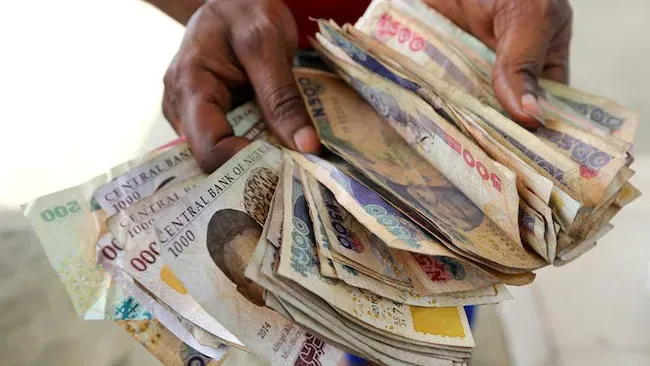
Nigeria’s currency in circulation climbed to N2.60 trillion in June 2023. Currency in circulation is the amount of cash in paper notes or coins issued by the CBN to conduct transactions. According to the latest data from the Central Bank of Nigeria (CBN), the figure rose by 88 percent from N1.39 trillion in January to N2.60 trillion in June 2023. The amount of currency in circulation in Nigeria fluctuated in the first half of 2023. In January, it stood at N1.39 trillion and fell to N982,097 billion in February. However, currency circulation rose to N1.68 trillion in March. In April, May, and June, it increased to N2.48 trillion, N2.53 trillion, and N2.60 trillion, respectively. In October 2022, the CBN announced that it would be redesigning three of the existing banknotes: the N200, N500, and N1000 notes. The new notes were due to be circulated on December 15, 2022, while the old notes would remain legal tender until January 31, 2023. The apex bank said it decided to redesign the banknotes because of concerns about the management of currency in circulation, particularly those outside the banking system. The CBN said currency management has faced several challenges in recent years, including counterfeiting, the use of cash for illegal activities, and the hoarding of banknotes by members of the public. Crude oil prices may rise on demand increase Experts say the prices of crude may likely increase in days to come as demand outpaces supply following a cut by the Organization of Petroleum Exporting Countries (OPEC), particularly that of major producer Saudi Arabia. The International Energy Agency (IEA) and the Organization of the Petroleum Exporting Countries (OPEC) earlier projected oil demand to outpace supply this year, leading to overall inventory draws to the tune of 400,000 to 500,000 barrels per day (bpd), mostly accounted for by the second half of the year (2023). Reacting to the development, experts at JP Morgan believe that the disparity between demand and supply will lead to increased oil prices. “It appears that the voluntary cuts announced by eight OPEC countries in April plus the additional 1 million bpd of unilateral Saudi cuts that just started in July are having the desired effect, with sour barrels becoming scarcer.” JP Morgan also stated that a rise in driving and flying activities this summer has put a strain on supplies as refineries are struggling to cope, meanwhile, there was also a drop in Russian crude supplies in July 2023. When demand outweighs supply, prices will rise, and analysts expect that the recent rise in crude oil will extend even further. Earlier this month, Secretary General of the International Energy Forum (IEF), Joseph McMonigle, told CNBC that crude oil demand bounced back to pre-Covid levels quickly, but supply is having a tougher time catching up. “So, for the second half of this year, we are going to have serious problems with supply keeping up, and as a result, you are going to see prices respond to that.” If crude oil prices rise on the global market, it means two things for the Nigerian market: Increased oil revenues are needed as Nigeria plans to roll out intervention schemes to cushion the effect of the fuel subsidy removal on the country’s citizens. In a prior announcement, the government has made it known that among other plans; it is focused on mass transportation, and alternative energy sources like compressed natural gas as well as reducing the impact of transportation costs as intervention schemes. An increase in the cost of fuel will be unavoidable because the country has no refining capacity as citizens await the end of the current rehabilitation of the Port Harcourt, Warri and Kaduna refineries. So, as more fuel imports come into the country, facilitated by private companies, fuel pump prices could increase. This also means that Nigerians need to increase their earnings, to survive a possible fuel pump price hike in the future.