NIMASA, Navy To Partner On Blue Economy

The Nigerian Maritime Administration and Safety Agency, NIMASA, and the Nigerian Navy have inaugurated a Committee to establish ways in which the synergy between both organs of government can be channeled into creating a welcoming environment for investment in the Blue Economy. Assistant Director, Public Relations, NIMASA Osagie Edward, in a statement said, Flag Officer Commanding (FOC West), Rear Admiral Mustapha Hassan, who inaugurated the 8-Man Committee charged them to come up with policies to create a welcoming maritime environment for investment in the Nigerian Blue Economy. Membership of the 8-Man Committee includes on the Navy side, Rear Admiral Mustapha Hassan, FOC, Western Naval Command; Cdre K.O. Oguntuga, Commander NNS Beecroft; Cdre N.S. Kaman, COO Western Naval Command and Capt. A. U. Tijani. The Committee members representing NIMASA namely, Director Deep Blue Project, Chief Otonye Obom; Head Shipping Development, Kurahson Inuwa; Head, ISPS, Isa Mudi; and Deputy Director, Cabotage Services, Aisha Usman Dangote. You will recall that the Agency’s Director General, Dr. Bashir Jamoh OFR, during a visit by a delegation from the Nigerian Navy to the Agency’s headquarters in Lagos recently, had announced the constitution of an 8-Man committee, comprising four each from the Navy and NIMASA.
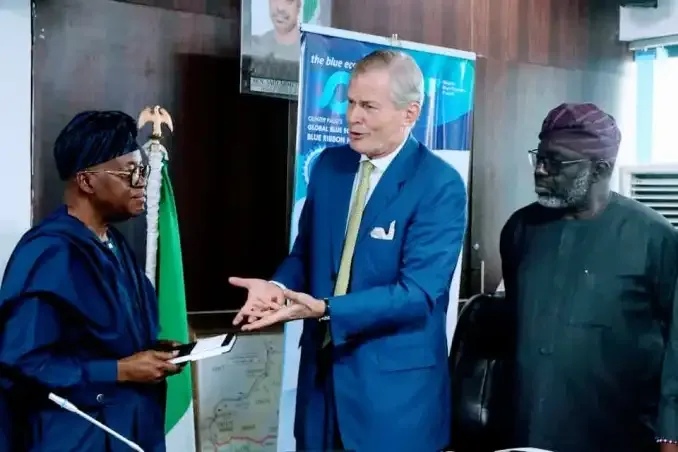
Blue Economy Top Agenda As Jamoh, Pauli Meet In Abuja

The Director General of the Nigerian Maritime Administration and Safety Agency (NIMASA), Dr. Bashir Jamoh, has met with Professor Gunter Pauli to discuss how Nigeria can advance its Blue Economy. Assistant Director, Public Relations, NIMASA Osagie Edward, in a statement said, the Abuja meeting is a follow up to the session the Minister of Marine and Blue Economy, Adegboyega Oyetola, had with Professor Pauli, where the need for the NIMASA DG to meet with experts like Gunter Pauli, was highlighted. Jamoh noted that having Professor Pauli interphase with stakeholders of the new Ministry would definitely help develop viable policies for the smooth take-off of the Marine and Blue Economy Ministry. “I had the opportunity to meet the man that formulated the global policies around Blue Economy, and we have discussed various ways to harness the resources in the Nigerian waters in a sustainable manner. He has expressed his willingness to work with the Ministry of Marine and Blue Economy to formulate policies that will help Nigerians begin to enjoy the gains of the establishment of the Ministry,” Jamoh said. On his part, Prof Pauli said he is willing to assist the Nigerian government develop policies around the Blue Economy for the benefit of Nigerians. Prof. Pauli, an economist and entrepreneur, created models of the Blue Economy, which is now a global concept. He has worked with many countries to draw policies for their blue economies.
Blue Economy Can Provide 350m Jobs If Harnessed Properly —NIMASA DG

The Director-General, Nigerian Maritime Administration and Safety Agency (NIMASA), Dr Bashir Jamoh has posited that Nigeria’s blue economy has the capacity to offer 350 million jobs if adequately harnessed. Jamoh, who was represented by the Acting Coordinator of NIMASA, Abuja Office, Hajia Rakiya Lamai, said during the NIMASA Special Day at the 18th Abuja International Trade Fair, Abuja. According to him, Nigeria’s vast under-utilised blue economy offers huge opportunities for growth and development to overcome its present economic challenge. “The blue economy has enormous potential as it offers the country the opportunities of 350 million new jobs if adequately harnessed. “Ocean resources like fishes, shrimps and other sea foods have not been satisfactorily harnessed, just as ship repairs are done in neighbouring countries and in faraway Turkey because the facilities are lacking locally. “With a combination of modern technology, relevant laws and support from the Federal Government, relevant agencies and stakeholders, disbursement of CVFF Funds, NIMASA is working to fulfill its mandate of regulating operations in the maritime industry,” he said. He said NIMASA was intensifying efforts to secure the Nigerian maritime environment and develop indigenous capacity for shipping expansion to provide value addition for sustainable growth and development of the Nigerian economy. Jamoh further said waterways expansion would be a much better incentive than tax waivers as it would encourage more Foreign Direct Investment (FDI) and private sector involvement in the maritime transport business. According to the NIMASA boss, moving toward waterways expansion will boost Port services and encourage the much-needed development in the industry. “While we await a cohesive policy to fully kick into gear, we must all become ‘Blue Ambassadors’ (Advocates for the Blue Economy). “The Blue Economy is every Nigerian’s Economy; the Media, Civil Society and other non-state actors, all have a role to play in galvanizing greater national awareness and participation. “We must rethink our waters, we need a total rethink from a ceremonial view; events such as Argungu Fishing Festival as well as others which must be redesigned and repackaged from the standpoint of the blue economy,” he said. He said efforts ought to be doubled to banish sea blindness amongst Nigerians and make seaward and sea-related activities more mainstream and attractive. He added that a Public Private Partnership (PPP) ought to be harnessed for maritime cluster development.
Blue Economy: Prof Pauli Tasks FG On Private Sector Partnership, Job Creation

The creator of Blue Economy, Prof Gunter Pauli, has said that, for the policy to succeed, the Federal Government must aggressively collaborate with the private sector to attract investment into the sector. While hailing President Bola Tinubu for creating the Ministry of Marine and Blue Economy, Pauli said in six months the ministry can facilitate the creation of a hundred thousand jobs by exploiting opportunities provided by the blue economy. Prof Pauli, who listed shipping, paper conversion from wastes and maggot farming for poultry and fishing as low hanging fruits, urged the ministry to embrace job and wealth creation. In his remarks, the Minister of Blue Economy, Gboyega Oyetola expressed happiness on the interest shown by Prof Pauli in assisting the country tap its idle capacity from the oceans and the blue economy, while also promising to work with private investors in opening up the sector. “I want to say that it’s not by accident that this ministry was created. It was part of the economic diversification policy of our country. We believed so much in oil but we now realize that 70% or so of the resources available actually come from the ocean and we have it in abundance here but neglected it for long. “I must commend the president for creating the ministry. I want to assure you that we are up to the task and I believe so much in the PPP arrangement because government has no business in business. Government should just provide the enabling environment for business to thrive,” the minister said. He disclosed that efforts have been stepped up to improve transportation infrastructure, including automation of port operations for efficiency and increase in revenue. “We now have sufficient control over insecurity and I want to tell you that for the past two years there has been no record of piracy on our shores. That is re-assuring to investors. I also assure you that we are ready to collaborate with investors, we are willing and ready and we will support all the initiatives that will bring all this to reality,” the minister promised,” he said.
We’ll introduce reforms to enhance Blue Economy success, says Oyetola

*Visits Nigeria Shippers Council Headquarters in Lagos The Federal Government is committed to creating a conducive working environment for the Nigerian Shippers’ Council (NSC) to streamline the handling of overtime cargoes at all ports in Nigeria, ensuring effective and efficient service delivery. Adegboyega Oyetola, the Minister of Marine and Blue Economy, made this commitment during his recent visit to the NSC Headquarters in Lagos. Oyetola expressed his assurance that the government would address challenges faced by the NSC and implement necessary reforms to advance the Blue Economy agenda of the current administration. While he applauded the NSC’s contributions and achievements, he also voiced concerns over the deteriorating condition of port infrastructure, cargo overstay, and the activities of foreign fishing firms. The Minister emphasized that cumbersome bureaucratic processes contribute significantly to prolonged cargo clearance times, leading to frustration among shippers and the abandonment of containers at ports. Oyetola pledged to engage with the leadership of the Nigeria Customs Service (NCS) to resolve the issue of abandoned cargoes and address related bottlenecks. During his visit, Hon. Emmanuel Jime, the Executive Secretary of the NSC, highlighted key issues that require immediate attention, including amending the NSC Act to establish effective port economic regulation. Jime emphasized the NSC’s role as a policy-making laboratory in the marine sector and its objective to position Nigeria as the Maritime Hub in the sub-Western Region. Jime also cited ongoing concerns for the NSC, such as implementing a one-percent (1%) freight stabilization fee on imports and exports, enforcing the International Cargo Tracking Note (ICTN), and establishing a National Fleet. He expressed confidence in Minister Oyetola’s commitment to making a positive impact on the maritime sector. In addition to the NSC visit, Minister Oyetola also met with the Council for the Regulation of Freight Forwarding in Nigeria (CRFFN). Chinyere Uromta, the Acting Registrar, appealed to the Minister to reconsider the exclusion of CRFFN from the federal budgetary allocation. She highlighted the crucial role the Council plays in the freight forwarding sector, contributing to the integrity of the supply chain and the Nigerian shipping industry. Uromta emphasized that CRFFN operates as a federal regulatory agency and serves as an international regulator of freight forwarding practices on a global scale. She called for an urgent amendment to the CRFFN Act to align with its professional status. Oyetola commended CRFFN’s efforts and expressed a willingness to consider their request.
FG proposes creation of national shipping carrier to revitalise maritime sector

The Federal Government is committed to revitalizing the maritime sector in alignment with President Bola Tinubu’s Renewed Hope Agenda, aiming to enhance the welfare of Nigerians. During a recent facility tour of the Nigerian Maritime Administration and Safety Agency’s (NIMASA) Headquarters and various centres in Lagos, the Minister of Marine and Blue Economy, Adegboyega Oyetola, outlined his vision for the sector. Oyetola emphasized the need for transformative measures in the maritime industry to position Nigeria as a major player. One of his key recommendations is the establishment of a national carrier through a Public Private Partnership (PPP) arrangement to facilitate freight transport within the country. Notably, Nigeria stands as the only member of the Organization of the Petroleum Exporting Countries (OPEC) without a national shipping line flying its flag. The Minister highlighted that creating a national carrier would help eliminate the burden of the 30% freight charge associated with chartering vessels. However, he clarified that his call for a national line should not be confused with advocating for the revival of the defunct Nigerian National Shipping Line (NNSL). Furthermore, Oyetola expressed interest in NIMASA’s Modular Floating Dock, recognizing its potential to generate employment opportunities and curb capital flight. He urged the agency to engage stakeholders to support this initiative. Addressing the potential of the Blue Economy, the Minister underscored that Nigeria, with one of the world’s largest wetlands, is well-suited for coastal tourism development. He also committed to exploring opportunities in fishing and other sectors to stimulate economic growth. Bashir Jamoh, the Director General of NIMASA, expressed gratitude to President Bola Tinubu for establishing a dedicated Ministry for the Maritime sector. This move has long been advocated by stakeholders and Nigerians. With the creation of the Marine and Blue Economy Ministry, Nigeria joins seven other countries worldwide with standalone Blue Economy Ministries. Jamoh assured that this development positions NIMASA to elevate Nigeria’s global maritime presence.