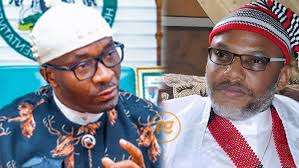
Deputy Speaker Kalu Advocates Political Means for Nnamdi Kanu’s Release

Deputy Speaker of the House of Representatives, Hon. Benjamin Kalu, revealed ongoing efforts to secure the release of Mazi Nnamdi Kanu, leader of IPOB, through a combination of legal processes and political negotiations. Speaking on “The Ben Kalu’s Mandate” radio show, Kalu emphasized the importance of behind-the-scenes political maneuvers in achieving Kanu’s release and fostering peace in the South East region. Kalu highlighted the role of the Peace In South East Project (PISE-P) in advocating for reconciliation and acknowledged Kanu’s significance in the peace agenda.  He stressed the need for political solutions and urged the involvement of Igbo elders in discussions with the federal government. Kalu said: “The Peace in South East Project (PISE-P) has reconciliation in the mix of what we are trying to achieve. We recognise the importance of our brother, Nnamdi Kanu in the peace agenda we are pushing. That’s the truth. And I have been very vocal about it. I am not hiding it. “I have always told people that I will never deny Nnamdi Kanu. He’s my brother. We come from the same place and I will never be happy having him incarcerated when we can have him out and increase our pursuit towards peace. But we may not advance all the things we are doing behind our backs but I can assure you that all the powers-that-be in this country know that people like us are not sitting on the fence.” Addressing the South East Development Commission (SEDC) Bill, Kalu noted its progress in the conference committee stage, emphasizing the importance of resolving related matters to advance the region’s development. Kalu called for peace and loyalty to the government while pursuing concessions, underscoring the imperative of maintaining stability in the region.

Advocates call for transparent measures in combatting sports corruption

Advocates call for transparent measures in combatting sports corruption

Sports enthusiasts have called on stakeholders in the sector to uphold the virtues of transparency and accountability in the fight against corruption in the industry. They spoke at a one-day International Conference on Corruption in Sport, Whistleblowing, and Transparency in Abuja on Saturday. The conference was organised by the Africa Centre for Media Information and Literacy (AFRICMIL), Centre for Journalism Innovation and Development (CJID), HEDA Resource Centre, and PLAY!YA Nigeria. Beverly Agbakoba-Onyeijanya, a Sports, Entertainment, and Technology legal practitioner, said that the sports industry had been so heavily politicised which has led to corruption in the sector. She said that member states of various Federations are involved in wars over who has the right to vote, with elections being a major source of contention and disputes in the sports industry. “We’ve seen the rancour that has torn apart the Basketball Federation in Nigeria with factions, and of course with this comes the possibility of bribery, corruption, and inducements,” she said. She said that given the amount of money involved in the prosecution of sports, there was a need for the anti-graft agencies to focus attention on financial crimes in the sports industry. According to her, the establishment of an anti-corruption sports desk in agencies such as the Economic Financial Crimes Commission (EFCC), and ICPC, would checkmate the excesses of sports administrators in the country. In a remark, Usman Kaltungo of the EFCC explained that the commission’s powers to fight sports-related corruption cases in the country were been hindered by undue interference from International Sports organisations such as FIFA, FIBA, and others. Francis Obih, President, the Badminton Federation of Nigeria (BFN), said the issue of favoritism and sentiments must be stamped out from sports. “As far as I am concerned, it doesn’t matter where you are coming from, once you are going out to represent Nigeria, you are representing the country and not any ethnic group or a particular religion. “So, such things should be taken away from sports, it doesn’t matter whether you are my brother or not, it should be purely based on merit and competence. “Also one of the disturbing areas is also the sexual harassment of female athletes by their coaches. “This is a no go area for me and the height of indiscipline to have officials, the coaches or technical personnel to have any sexual relationship with their athletes. “We must do everything to stop it because it hampers the performance of the athletes,” he said. He said every stakeholder, be it administrators, ministry, journalists, must come together, join hands and set certain ethical standards. “These standards should guide the growth and development of sports in the country, in order to bring corruption to its barest minimum. “No one person cannot do it alone, all hands must be on deck and in agreement, even though in every group, there are always some bad eggs and that’s the truth. “However, we must find a way of isolating those elements and minimise the damage that they can do, so that the whole body is not seen in a bad light,” he said. Also speaking via Zoom, an Investigative journalist based in Germany, Grit Hartmann, said that journalists outside the shores of Africa were not ignorant of corruption stories from the continent, especially Nigeria. She called for synergy and transnational corporation among stakeholders, adding that the issue of corruption in sport in Nigeria and the African continent at large was a systemic problem. Stanis Elsborg, a Senior Analyst also based in Germany, said that corruption in sports was not limited to Africa. He said that Europe and other parts of the globe are also susceptible to corruption tendencies in the area of sports. Joshua Umeifekwe, a professor at the University of Nigeria, Nsukka, said the essence of measuring and managing multiple sports governance crises was to maintain the credibility and transparency of the sector. “Transparency as you know, ensures trust and so what we are saying is that there is a need to measure the nature of the crisis that we have. “For one to talk about ways of managing the crisis, you need to have an assessment of these crises. “Some of the ways include; collecting qualitative data, running a survey, and interviews, to mention a few. “Having done this, we must ensure we manage the crisis by ensuring transparency and ethical standards are followed and maintained,” he said. Chido Onumah, Coordinator, AFRICMIL, and Oluwashina Okeleji, a sports journalist for BBC Sports, among others, said that the role of whistleblowers in the sector cannot be overemphasized. They said for sports to grow, there was a need to have whistleblowers to expose some of the ills and corruption going on in the sector. They also called for the establishment of legislation to protect whistleblowers, as well as investigative journalists in the country.