President Tinubu’s Multi-layered Communication Team: A genius contraption or Disaster in the making: Only Time Will Tell

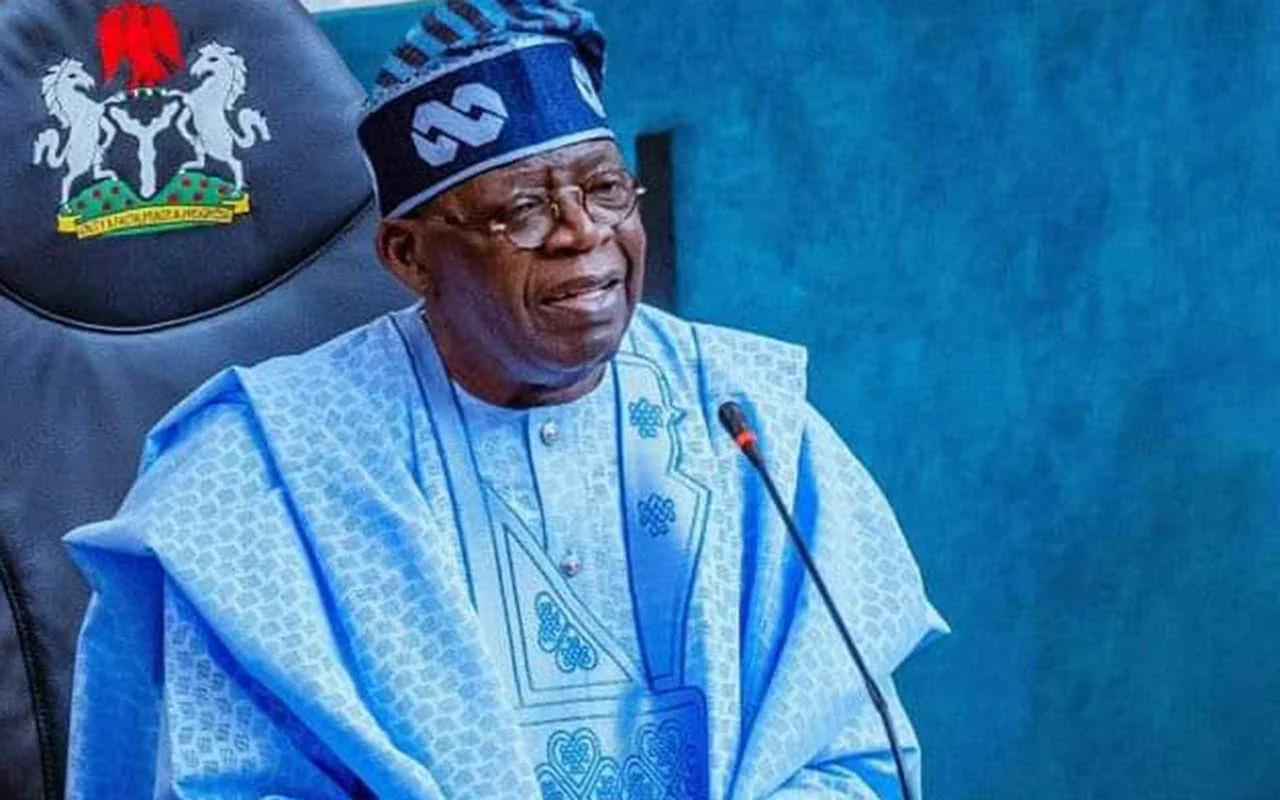
When President Tinubu started his first day in Aso Rock with the bold or what many would consider a bone-headed political Kamikaze move of removing oil subsidy, and then proceeded with his excruciatingly painful economic and structural reform agenda, he made a decision that has put his presidency on an irreversible trajectory that will either seal his place as the transformational leader Nigeria has waited for or a catastrophic disaster. He locked himself into that irreversible trajectory, when unlike all his predecessors, he took what many have considered the Nigeria equivalent of the kiss of death by withdrawing the oil subsidy and floating the currency.Nigerians have taken it as their citizenship right and as the only benefit accruable to them from the corruption-ridden national oil reserve, access to cheap oil. To take that away from them was like taking away a child’s only Christmas toy. Since the Arab oil embargo fueled oil boom of 1973 when the god of crude oil smiled on Nigeria with massive inflow of petrodollar which unfortunately the country’s young president General Gowon knew not what to do with it, Nigerians have measured the health of their economy by the value of their heavily subsidized and overvalued local currency even though it was not backed by any measurable productivity to justify its valuation. We all now talked with great nostalgia of the era when our Naira exchanged for twice the dollar as if it were the apogee of economic genius, when in fact it led to the kind of insane conspicuous consumption which saw Nigerians clogging Heathrow airport runway with our useless imports. We spent money like a drunken sailor who just won a lottery jackpot. While it was obvious to everyone that artificially juicing and propping our currency was hemorrhaging life out of our economy, yet no president until Bola Tinubu had the courage to withdraw the addictive heroin from the dying drug addict. Floating the Naira exchange rate and in the process pauperizing the citizen was therefore another third rail of Nigerian politics that President Tinubu was courageous enough to touch. To do one was bad enough, but to do both, that is remove the oil subsidy, and at the same time float the currency was a political equivalent of jumping off the cliff of Mount Kilimanjaro without a parachute. It is for that precise reason that every Nigerian president for decades has promised to remove the oil subsidy but have chickened out even as everyone knew it was the bitter pill Nigerians had to swallow to stop the insane plunder of our commonwealth but a small but powerful oil mafia. This explains why President Tinubu has become one of the most divisive political figures in Nigeria history, who is virulently hated and despised by his detractors, and beloved by his loyalists and those who believe in him. With President Tinubu you either hate or love him. Many have compared him to blood thirsty Abacha while others have lost their minds to the point of equating him to genocidal Hitler. Whether you like or hate President Tinubu and yes, we may argue whether or not his reform policy could have been better deployed, or whether he could have taken more time to properly put in place palliative measures to ameliorate its excruciatingly painful impact, however, no rational or objective analyst will deny that President Tinubu deserves the presidential medal of courage for putting the country’s future above his political calculus. If anyone has wondered why I have been unwavering and unapologetic in my support for the President, that exactly is the reason, his political courage to do the unpopular and to risk his political career if that was the price. I have never met the President nor anyone in his circle, however, I believe in his reform policy as the necessary painful therapy our country needs. Our country desperately needed the very painful reform that President Tinubu has taken on if we were to have any chance to dig our country out of the economic grave it was in. A grave many past presidents have dug deeper and deeper to the point of no return. PLEASE READ: TINUBU SUBMITS INEC REC NOMINEES TO SENATE As a member of the baby boomer generation who enjoyed the stupendous prosperity of the heady days of the oil boom of the 1970s, when a college degree was a ticket to the middle class, I believe the last act of our generation, was to make this one last sacrifice to patch up this country whose huge potential we frittered away, to give the next generation a fighting chance of salvaging a livable country from the mess we have made of it. Regrettably, members of the same baby boomer generation who bear much culpability for the mess our country is in, are also the most vociferous in opposing President Tinubu’s reform agenda to salvage it. So, readers might ask, what is the connection between the presidential communication architecture and his economic reform agenda? A lot. One of the major mistakes President Tinubu made which has done so much damage to his bold economic reform agenda was his failure to have a presidential communication team in place at its launch, that was up to the challenge of selling it especially since they knew it was going to impose so much excruciating pain on the citizens. That mistake has turned out to be a costly error for this presidency especially in a fast-moving social media era where bad news travel at the speed of light, shaping perceptions along its path. Social media with its information overload has unfortunately made us less contemplative and more susceptible to perception manipulation which are often hard to shake off. It is easy to get the policy right and yet lose it all with a poor communication infrastructure. That has been the Achilles heel of this presidency as it has embarked on some of the toughest, excruciatingly painful but much needed economic reform agenda. It was
Tinubu affirms Nigeria’s commitment to tackling global challenges

Nigeria’s President Bola Tinubu has expressed the commitment of the Federal Government to addressing global challenges. President spoke at the ongoing G20 summit in Rio de Janeiro, Brazil. This years summit has been hosted by President Lula da Silva of Brazil. The theme of this year’s summit centers on creating a fair and sustainable world, with the key talking points being economic, social, and environmental development. Tinubu reaffirmed Nigeria’s dedication to tackling hunger and poverty through the Global Alliance Against Hunger and Poverty, a major initiative led by President Lula. The alliance aims to unite governments, international organizations, and civil societies to combat both the immediate and root causes of poverty. In his address, the Nigerian leader also called for a reform of the UN Security Council to better represent global diversity, positioning Nigeria as a key representative for Africa. He further highlighted the importance of reforming global taxation systems to promote fairness and reduce the gap between wealthy and developing nations. READ ALSO: N1.3T FRAUD: OKOWA’S DETENTION SPARKS CALLS FOR PROBE OF EX-GOVERNORS
Rivers APC Chairman Refutes Claims of Wike’s Health Issues

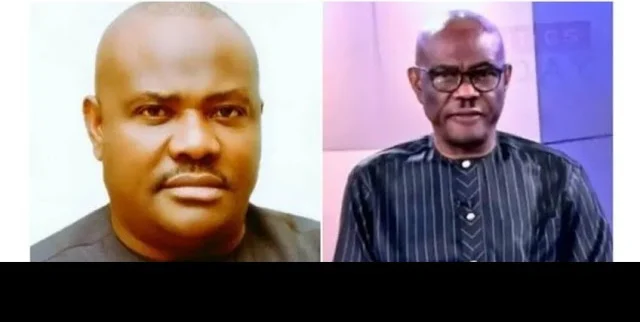
Tony Okocha, the Chairman of the Rivers State All Progressives Congress (APC) Caretaker Committee, has dismissed rumors suggesting that Minister of the Federal Capital Territory, Nyesom Wike, is unwell. Okocha, who is a close ally of Wike, addressed the speculations in an exclusive interview, following a media briefing on recent developments within the state’s APC and the court’s ruling blocking federal allocation access to Rivers. These rumours surfaced after Wike appeared on national television, looking frail while responding to an allegation from Governor Siminalayi Fubara. Social media users expressed concern over Wike’s appearance, questioning whether his weight loss indicated a hidden illness. Some even suggested he should step back from his political duties to focus on his health. Okocha quickly dismissed these claims, stating that Wike’s health is not an issue. He emphasized that such rumors were baseless, as the minister continues to fulfill his duties with vigor. Okocha noted that it is normal for individuals, especially those in demanding positions like Wike’s, to face criticism regarding their physical appearance, but he assured that Wike is neither sick nor struggling with any health issues.
2027: No chance for Atiku in PDP, says Wike

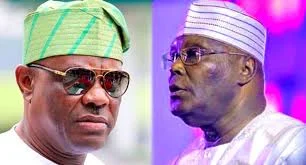
In yet another display of his enormous control over the leadership of the Peoples Democratic Party (PDP), FCT Minister, Nyesom Wike has ruled out any likelihood of former Vice President Atiku Abubakar clinching the party’s ticket for the 2027 general election, saying it will simply not happen. This declaration further affirms the source of the unrelenting strife that has dogged Nigeria’s main opposing and former ruling party. Speaking during a live media parley on Wednesday evening in Abuja, Wike said Atiku had severally presented his blueprint to Nigerians and he had been serially rejected. Atiku who was the PDP Presidential Candidate in 2023 had recently said if he had won the election, he would have done things differently from President Bola Tinubu and Nigerians would not have been faced with the current level of hardship Wike said; “Did he (Atiku) not present it (blueprint) before Nigerians? Did Nigerians choose him? He is lobbying for another chance. The chance will not be there. In which party? How can we use one man for how many years? “Look at America, I am sure you all did not support Trump saying he is this, he is a racist, he is that, we are crying, Americans were thinking about something else, thinking for the good of their own country made a decision. “You presented your blueprint in 2023, Nigerians heard you clear and said thank you, but it will not work, we will not support you. Criticisms do not mean opposition is working”.
How not to revamp the national economy

ALHAJI Bola Ahmed Tinubu violently shook and severely unsettled the national economy in the first few hours after he assumed office eighteen months ago. That of its own could not have been a problem. What manifested down the line was the real issue – Tinubu had no discernable plan to methodically work on an economy that, it must be acknowledged, had been dealt a severe blow by a serial bungler, one Maj.-Gen Muhammadu Buhari, the affliction who passed through here masquerading as a president. If this country were to be a human being what Buhari inflicted on it between 2015-2023 would have had more severe and deadlier outcome than the COVID-19 pandemic that swept through the globe in 2020/2021, leaving millions dead in its wake, destroying economies, and permanently impairing the health of many people worldwide, especially those with pre-existing health challenges. And Nigeria when Tinubu took the helm had pre-existing political and economic conditions. But instead of stemming the hemorrhaging, he made it worse. Tinubu clearly mistook naivety bordering on ignorance for courage when he declared on May 29 last year that subsidy was gone. The spirit that he said led him to act in such a manner was the evil spirit. That same spirit drove him to act in such a manner in the foreign exchange market. The combined effects of those impulsive actions are responsible for our severely depressed and damaged economy and the littering of the landscape with human skeletons. Everything that followed had added to compound the dire straits this country has been consigned to in less than two years. The greater tragedy is that the regime is still digging, assuring only itself that it was on the journey of great economic reforms. Though it has no benchmarks and timelines for its promised dividends of democracy, it keeps assuring of light at the end of the tunnel. It’s now obvious that this regime believes that the vigorous and mindless application of a narrow monetary policy instrument alone will cure the many ills afflicting Nigeria’s economy. Through the central bank of Nigeria (CBN), it has misguidedly pursued taming the rampaging inflation which, by the way, it caused by its own impulsive decisions early in the life of the administration through the so-called petrol subsidy removal, and the attempt at market-determined value of the Naira. Both policies have spectacularly failed in spite of the concerted efforts by the regime to put a spin to them. Let’s explain why we argue that the twin policies have already failed. When Tinubu announced the scrapping of the so-called petrol subsidy in May 2023, Nigeria had no petroleum resources minister and no cabinet. And 18 months down the line, the country still does not have an oil minister. Information adviser to the president, Bayo Onanuga, said this much recently in a national television interview. Crude oil generates about 80% of our national revenue, and until recently the country imports 100% of the petroleum products for domestic consumption, and has had no dedicated minister for almost two years. It only has a junior minister or what we call minister of state. Furthermore, there has been no physical manifestation of the gains from the removal of subsidy. If anything, we have suffered from the illusion of money, that is, a situation where the federal and state governments get more money from the federation account which has had no tangible impacts in the lives of the people. The national minimum wage has been increased from N30000 to N70000, but in real terms the value of the minimum wage is less than what it was about 40 years ago. Indeed, the Nigerian Labour Congress (NLC) and other workers’ unions are gearing for a further upward review of the minimum wage barely two months after it was passed into law. More than 70% of the country’s 36 states and the federal capital territory have not even started implementing the new wage. Every increment in salaries and wages impacts inflationary trends. In Nigeria it has been a constant case of the monetary and fiscal policies in misalignment. It’s obvious that salaries and wages are the least of the problems at the root of galloping inflation. The government is implicated with its voracious appetite to borrow in our name, and steal or spend on consumption. At a time the CBN pretends to be fighting inflation by mopping up money in circulation, bank credits to the government are experiencing a phenomenal rise. Data from the central bank showed that credit to the government rose by 89.9% year-on-year to hit N42.01 trillion in September, up from N22.13 trillion in the corresponding month last year. The clear implication is that the Tinubu regime relies almost exclusively on offshore loan facilities and domestic borrowings to run. According to the report, “When government credit levels rise, it indicates that it is increasingly borrowing from the financial sector, particularly from domestic banks and other lenders. This rise in borrowing generally reflects an increase in government debt, as funds are sought for financing various operations, social programmes, and budget deficit coverage”. The surge in banks’ credit to the government is in conflict with the stated drive of this administration. In August 2023, President Tinubu had vowed that his government will break the reliance on borrowing for public spending. One year on the evidence points to the contrary. Domestic and foreign borrowings have surpassed every projection, and there’s no end in sight. When a government sucks up credit from banks other potential investors are crowded out and production is negatively impacted. So where’s the basis and expectations for economic revival? When Tinubu spoke last year of curbing government’s appetite for credit from domestic banks it was at the inauguration of the presidential committee on public policy and tax reforms. Coincidentally, the report of that committee chaired by Taiwo Oyedele, one of the tax czars of Tinubu, which has taken the form of a bill now with the national assembly, is facing a vigorous pushback from
EFCC Rejects Sanwo-Olu’s Legal Challenge Over Alleged Arrest Plans

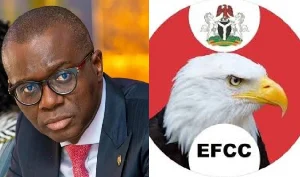
The guilty is always afraid. That explains the current judicial play being simulated by Lagos State Governor, Babajide Sanwo-Olu who has sued the Economic and Financial Crimes Commission (EFCC) against any future trial in the event that any evidence of stealing is found against him. According to the Nigerian constitution state governors and the president of the country are immune from criminal prosecution while in office. Further to this however, Mr. Sanwo-Olu has sued the EFCC to insist that even if evidences of stealing are found against him, he should not be tried for the theft after his term of office. Miffed by this affront on the performance of its duties, the EFCC has asked a Federal High Court in Abuja to dismiss the case filed by Babajide Sanwo-Olu, which challenges potential investigations and arrest plans after his tenure. The anti-corruption body described the governor’s claims as speculative, arguing that they lack legal merit. Sanwo-Olu, in his lawsuit, sought several declarations to protect his fundamental rights. Among his requests, he asked the court to affirm his right to privacy and prevent any perceived harassment or intimidation by the EFCC during or after his term as governor. He alleged that political opponents might use the agency to orchestrate his arrest based on unfounded corruption allegations. In its response, the EFCC maintained that no investigation or arrest threats had been made against Sanwo-Olu. The agency clarified that it follows due process in all cases, using official channels for communication and investigation. The EFCC further argued that Sanwo-Olu’s concerns are hypothetical and intended to mislead the court. The case, initially filed in June, was updated on October 31. Justice Joyce Abdulmalik has scheduled the next hearing for November 26. There are indications that the suit may be withdrawn before the adjourned date.
EFCC Arrests Chinese Nationals, Nigerians Over Illegal Solid Minerals Export in Enugu

In a timely move aimed stemming ongoing solid mineral heist, the Economic and Financial Crimes Commission (EFCC), Friday, announced the arrest of two Chinese nationals and Nigerians, attempting to illegally export solid minerals out of Nigeria. The suspects, identified as Wang Jiang, Wang Richard, Donatus Agupusi, and Michael Benneth Agu, were apprehended due to the lack of necessary export permits, as confirmed by Dele Oyewale, Head of Media and Publicity at the EFCC. Wang Jiang was arrested at the Akanu Ibiam International Airport in Enugu after security screenings uncovered suspicious stones in his luggage, believed to be solid minerals. Following this, further arrests were made at the EFCC’s Enugu Zonal Directorate, where Agupusi and Agu were taken into custody. The arrests came after a tip-off from the Federal Airports Authority of Nigeria (FAAN) on November 3, 2024, regarding Jiang’s attempt to smuggle the minerals out of the country. Initial investigations revealed that Agupusi, the owner of Great Wall Construction Limited, had employed the other suspects, and that Jiang was attempting to ship the minerals to China for testing. None of the suspects were in possession of the necessary legal documentation to export the minerals. The EFCC has assured the public that all suspects will face legal proceedings once the investigation is concluded. The agency emphasized that these arrests are part of its ongoing efforts to combat illegal mining and the unauthorized exportation of Nigeria’s mineral resources. This follows similar previous actions by the EFCC, such as the arrest of two Chinese nationals, Yang Chao and Xiao Jiang, in Ilorin for their suspected involvement in illegal mining activities. The EFCC continues to prioritize the protection of Nigeria’s natural resources and the prevention of illegal exploitation. INTERESTING READ: STOP THE IN-FIGHTING AT FUHSO
Tinubu Advocates for Stronger UK-Africa Ties During Foreign Secretary’s Visit

President Bola Ahmed Tinubu met with UK Foreign Secretary David Lammy at the State House, emphasizing Nigeria’s dedication to enhancing partnerships with the United Kingdom. The discussions centered around vital areas such as trade, culture, and security, which directly affect the livelihoods of citizens. During the meeting, Tinubu expressed gratitude for the UK’s ongoing support and underscored Nigeria’s role as a key partner in Africa. He urged the UK to extend its focus beyond conflicts like those in Ukraine to include pressing humanitarian issues in African nations, particularly Sudan. The President pointed out that security challenges in West Africa are exacerbated by the influx of displaced persons from neighboring countries, such as Mali and Burkina Faso, and called for greater collaboration to foster stability. Lammy, visiting Nigeria to explore avenues for strengthening ties, highlighted the UK government’s interest in economic growth across the continent and the necessity for innovative partnerships to address emerging challenges. He acknowledged the enduring relationship between Nigeria and the UK, noting that shared historical values within the Commonwealth continue to bind the nations together. The discussions also covered Nigeria’s progressive economic reforms aimed at long-term growth, with Lammy acknowledging the importance of Nigeria’s economic stability to bolster investor confidence. Ambassador Yusuf Tuggar, Nigeria’s Minister of Foreign Affairs, confirmed that agreements signed during the visit focus on job creation, enhanced security, and migration management, all aimed at modernizing the partnership between the two nations.
Kid-hostages and the trial of T-Pain’s regime

THE pictures match. Perfectly. Whenever freelance and hardened criminals released their kidnapped victims, those fortunate victims looked haggard, jaded, famished, hungry, disorganised, disoriented, and generally forlorn. Fortunate kidnap victims? Yes. The unfortunate ones do not come back alive even after family, friends and relatives had paid the usual steep ransom, or the negotiated variant. The pictures and videos of the #ENDBADGOVERNANCE protests prisoners who were arraigned in an Abuja court last week were replicas of the fares we have treated to and will still be treated to in our collective march into further darkness. The message embedded therein is that no matter who kidnapped you, you will end up being treated the same way. If the street kidnapper abducts you in your home or on the highway, you will be roughened up, starved, and tried. The torture and trial are embedded in the ransom negotiations and the constant threats to kill and throw your body to wild animals. If the security agencies of this emerging totalitarian state kidnap you, you will undergo similar experience. You will be imprisoned even before you get a day in court. You will be tortured possibly inside an underground dungeon. You will be starved. Like the victim of street kidnappers, you could be killed execution style. The street kidnapper has no mandate to preserve your life. The state kidnapper has a bounding duty of care for you. But it does not. And it is not often held to account. It has been said that if you want to measure the health or otherwise of any country, visit its prisons. Our country does not allow you to break that sweat. They bring the evidence of our diseased country to the court of law, and put it in open and public display. That was what happened in Abuja last weekend. Some Nigerians who protested against poverty, privations, hunger, and hopelessness imposed and inflicted on them by the dumb economic policy options taken by Nigeria’s president, Alhaji Bola Ahmed Tinubu’s regime, were arbitrarily arrested and herded into prisons. Many of the prisoners were minors even though the government worked hard to make us not to believe the glaring evidence before our eyes. All the prisoners looked withered and weather -beaten. But as we know, especially those of us who were in Biafra during the Nigeria -Biafra civil war (1967-1970), malnutrition has a way of ravaging and savaging younger people. If the minors who were shamelessly brought to court by agents of the state were to stay a little longer in prison, the footage the world would have seen could have competed with what was seen during the civil war. The minors of Abuja were in prison for three months and their images competed vigorously with the images of Biafran kids at the receiving end of starvation as a weapon of war for three years. This administration brought our children to court ostensibly pretending to seek justice but the world saw a demonstrably insecure regime which came to court not to prosecute but to persecute and to intimidate. The regime must have reasoned that if they made an example of their present set of hostages they could succeed in cowering the rest of Nigerians who do not agree with the direction that the country is headed. The irony which regime enforcers may not in their life be able to comprehend is that the minors and the young adults that they brought to court for persecution were the children of Tinubu. Yes, they were to the extent that in our part of the world the president is generally, even if sometimes misguidedly, regarded as the father of the nation. Since obviously Nigeria is not yet a nation, Tinubu might as well pass as the father of the country, a benighted one at that. If Tinubu is the father of the country, then Nigerian children and youths do not really need a father. A father protects, Tinubu does not. A typical father fights for his children, this one stands aloof. A father sacrifices for his children, this one gorges the children’s dinner and ravishes the grand children’s breakfast. If the minors of Abuja manifested tell-tale signs of starvation and malnutrition, could it not be because the state is focused in serving the vanities of our president and his cohorts by providing appointed jets, spectacular yacht, fancy sport utility vehicles (SUVs), vacations abroad, and luxury mansions in choice locations. If this regime were to have its way it would love for the spectacle of last week to continue. That explains why a captured judge in a cowed judiciary adjourned the sham case to January of 2025. In which jurisdiction except under an aspiring dictatorship would a citizen, and a minor for that matter, be slapped with charges of treason for protesting against bad governance, deprivation, and hunger? Where else? Without doubt, this regime has its designs for Nigeria and Nigerians, and those designs are not for the good of a majority of the people. And in this regard, Nigerians need to pay special attention to the Nigerian Police Force (NPF). This security agency does not leave Nigerians in any doubt that they are not on the side of the people. The hackneyed slogan that police is your friend is a ruse to lure citizens to sleep. This police is a friend of the regime, and the regime alone. If you are in doubt read and analyse the statement issued in the name of the inspector – general of police by the Force’s spokesman. Study what that statement said, and especially what it failed to say. The IGP said 76 persons were arraigned on charges including ‘terrorism, arson, and treasonable felony’. The statement proceeded to claim that the ‘suspects were initially presented in court, where they were formally charged, and a remand order was issued by the court’. You are invited to note that the date the suspects were presented in court was not stated, the cadre of the court was not
Federal Government Exits Tertiary Institutions from IPPIS, Shuts Down Platform

The Federal Government has officially taken Federal Tertiary Institutions (FTIs) off the Integrated Personnel and Payroll Information System (IPPIS), resulting in the platform’s shutdown for these institutions. According to the Office of the Accountant General of the Federation (OAGF), this change aligns with a recent directive to transition FTIs to an alternative payroll management system. Starting this month, salaries for staff in these institutions will be processed via the Government Integrated Financial Management Information System (GIFMIS), requiring institutions to submit payroll data in Excel format for verification. The OAGF has assured workers that there’s no need to alter their salary account details as no mandate for account changes has been issued. The office emphasized the focus on maintaining workers’ welfare, encouraging financial institutions to ensure robust handling of salary-related accounts. Employees who choose to change their salary accounts are advised to use the official channels provided by the OAGF for a seamless transition.