




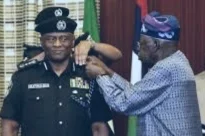




The appointment of Tunde Disu as Acting Inspector General of Police (IGP) has continued to generate intense public controversy, with critics accusing President Bola Tinubu of nepotism and a growing disregard for Nigeria’s federal character principle.
Across social media and political commentary spaces, Nigerians have questioned both the timing and rationale behind Disu’s elevation, arguing that it undermines seniority within the Nigeria Police Force and reinforces perceptions of regional and ethnic imbalance in key national appointments.
One of the most vocal critics, social commentator Isaac Fayose, openly condemned the decision, describing it as nepotistic and difficult to justify on professional grounds.
Fayose queried why the president would overlook a more senior officer, Frank Mbah, whom he referred to as a “Super Cop” who holds the rank of Deputy Inspector General of Police, in favour of a junior officer appointed only in an acting capacity.
According to Fayose, the appointment aligns with what he described as a pattern under Tinubu’s administration with the concentration of strategic security, defence, and economic positions among individuals from the South West and of his Yoruba extraction.
He cited several top offices, including the Chief of Defence Staff, Director General of the Department of State Services, Chairman of the Independent National Electoral Commission, Governor of the Central Bank of Nigeria, Chairman of the National Revenue Service, and the Minister of Finance.
Fayose questioned what he described as the president’s apparent fear of broadening appointments to reflect Nigeria’s ethnic and regional diversity.
The criticism gained further momentum following comments by former presidential candidate and human rights activist Omoyele Sowore, who called for the immediate appointment of a substantive Inspector General of Police.
Sowore stressed that Disu’s position is inherently temporary, noting that the acting IGP is expected to retire from the Nigeria Police Force in April.
Speaking during an interview on Channels Television, Sowore acknowledged the acting nature of the appointment as announced by the presidency.
“Tunji Disu is retiring in April, and it is clear that once he is no longer in the police force, he must give way,” he said. “What we know for now is that he has been appointed in an acting capacity, pending the appointment of a substantive IGP.”
Sowore went further to warn against any arrangement that would allow a retired officer to continue leading the police force.
He argued that Disu’s elevation had already resulted in the displacement of more than 30 senior police officers, an outcome he described as unnecessary and destabilising for an institution already grappling with public trust challenges.
With an estimated strength of between 300,000 and 450,000 officers, Sowore insisted that the Nigeria Police Force has no shortage of experienced and competent senior officers capable of assuming the role without controversy.
He maintained that adherence to seniority, professionalism, and constitutional balance would help restore confidence in the force and the government’s commitment to fairness.
As the backlash continues to grow, analysts say the controversy underscores broader national concerns about equity, inclusion, and transparency in high-level appointments.
Pressure is mounting on the presidency to clarify its long-term plan for police leadership and to reassure Nigerians that competence and constitutional principles, rather than ethnicity or political loyalty, will guide decisions at the highest levels of national security.