President Bola Ahmed Tinubu has announced that Nigeria will end the practice of running multiple budgets by March 31, 2026, transitioning fully to a single annual budget supported by a single revenue cycle from April 2026.
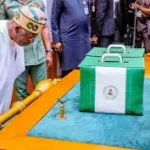
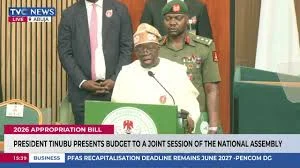
The president made this known on Friday while presenting the 2026 Appropriation Bill of ₦58.18 trillion to a joint session of the National Assembly in Abuja.
The budget, titled “Budget of Consolidation, Renewed Resilience and Shared Prosperity,” aims to address longstanding fiscal challenges and deepen ongoing economic reforms.
Tinubu said the multiple-budget system—characterised by inherited obligations, abandoned projects, and unpaid contractual liabilities—has undermined effective budget execution.
He disclosed that all outstanding capital liabilities from previous years would be fully funded and closed by March 2026.
“From April, Nigeria operates on a single budget, backed by a single revenue cycle. No overlaps, no excuses and no rollover cultures,” the president said.
Describing the 2026 budget as a defining moment in Nigeria’s reform journey, Tinubu acknowledged that recent economic reforms had imposed hardships on families and businesses but insisted the sacrifices were yielding results.
According to him, Nigeria has emerged from a period of uncertainty and economic volatility, noting that the economy grew by 3.98 per cent in Q3 2025, compared to 3.86 per cent in Q3 2024.
“The economy has turned the corner. Though the path of reform is seldom smooth, it remains the surest route to lasting stability and shared prosperity,” Tinubu said.
He added that the budget is designed to consolidate macroeconomic stability, enhance competitiveness, create jobs, boost incomes, and improve living standards nationwide.
In his remarks, Senate President Godswill Akpabio defended the collaboration between the Executive and the National Assembly, saying such cooperation was essential for national progress.
“The 2026 Appropriation Bill is more than figures. It is a statement of intent, a reflection of priorities, and a roadmap for Nigeria’s next phase of renewal,” Akpabio said.