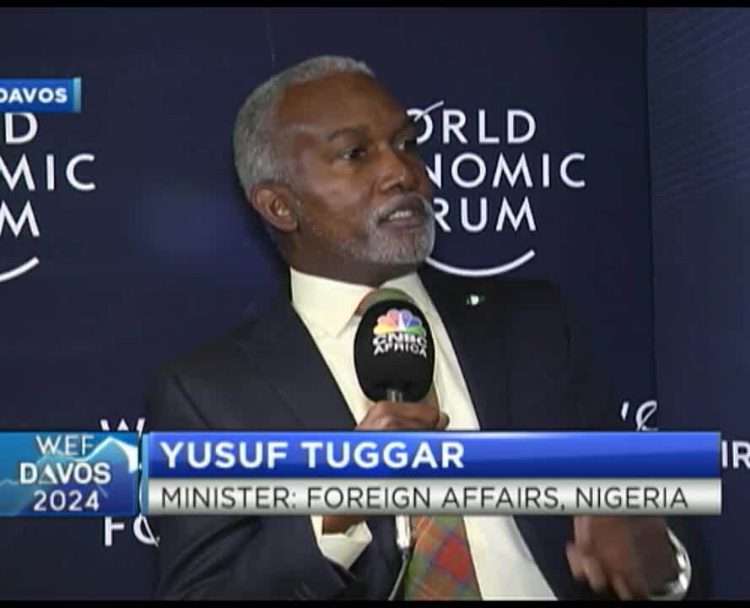
Tuggar advocates for Africa’s permanent seat at UN security council

Amb. Yusuf Tuggar, Minister of Foreign Affairs, has advocated for Africa’s permanent membership on the UN Security Council, emphasising Nigeria’s suitability to represent the continent in the global body. This position was made in a statement by Alkasim Abdulkadir, Special Assistant on Media and Communication Strategy to the minister, on Wednesday in Abuja. Tuggar made these remarks during a panel discussion on the theme “Africa’s Momentum” at the ongoing World Economic Forum (WEF) summit, which runs from January 20 to 24, 2025, in Davos, Switzerland. Tuggar criticised Africa’s exclusion from the Security Council, noting that nearly 60 per cent of the Council’s resolutions addressed issues affecting the continent, yet Africa had no permanent seat. READ ALSO: Police intensifies crackdown on kidnapping and robbery, rescues 13 victims He pointed out that many of the Council’s decisions, such as the deforestation law that banned the purchase of goods from deforested land in Africa, have negative consequences for the continent. He also highlighted the failure to hold companies accountable for contributing to deforestation in Africa. The discussion, moderated by Bronwen Maddox, Director of Chatham House, also featured prominent speakers including Mohammed Nafti, Foreign Minister of Tunisia; Therese Wagner, Foreign Minister of the Democratic Republic of Congo; and Matia Kasaija, Ugandan Minister of Finance. The panel discussed Africa’s role in global governance and the significance of the first 2025 G20 summit, which will take place in South Africa. Tuggar further elaborated on Nigeria’s global outlook under President Bola Tinubu’s administration, emphasising Nigeria’s strategic autonomy and nonalignment principles in its foreign relations. He also pointed out that the G20 summit in South Africa provided an opportunity to advocate for Nigeria’s inclusion as a member. “Nigeria’s involvement in South Africa’s liberation struggle and its ongoing support for South Africa solidifies our ties,” Tuggar noted. He highlighted Nigeria’s significant contribution to African development through initiatives like the Technical Aid Corps, which sent volunteer professionals across Africa, the Caribbean, and the Pacific. READ ALSO: Africa has what it takes to develop itself Tuggar also stressed Nigeria’s non-threatening nature, stating that the country enjoyed good relations with its neighbours, which strengthened its global position. He argued that Nigeria’s unique role in the African Union’s Peace and Security Council further supported its case for representation on the global stage. Tuggar called for a return to commitments made by developed nations during the Rio Summit, particularly regarding the transfer of technology to developing countries. He emphasised that Africa, as a continent of 54 nations, should not be seen as a single entity but as a diverse and powerful region. Tuggar argued that Nigeria, with its large population and economic strength, was well-positioned to represent Africa on the global stage. He further highlighted Nigeria’s track record of supporting both African and global causes, asserting that these factors made the country a suitable candidate for representing the continent in the UN Security Council and other international forums.
Foreign Affairs Minister, Tuggar calls for Nigeria’s Membership of UN Security Council

Nigeria’s Minister of Foreign Affairs Ambassador Yusuf Maitama Tuggar, has said there is a need to democratise the United Nations (UN) security council and Nigeria with its population, economic size and strategic role in Africa has earned the right to be part of the UNSC. Ambassador Tuggar made the call while speaking at a panel discussion on the theme “Securing an Insecure World” at the World Economic Forum (WEF), Davos, Switzerland. Tuggar said the values of democracy – such as the rule of law – should be replicated in the world’s highest decision organs. Tuggar said the UN security council, as constituted, is not leaving up to its purpose. “What we have to do is collectively practice what we preach. The values that we uphold – democracy, rule of law – need to be practised, and we need to see them being practised in the very decision-making bodies or entities for the planet,” the minister said. “So, to begin with, the UN Security Council needs to be democratized. Clearly, it is not fit for purpose. “We should do away with the veto powers on the UN Security Council; clearly, it’s clumsy and not working. Again, when you look at the global security architecture, it is impacted by such undemocratic entities that influence decisions. “We have a situation where, in the past, during the bipolar world, there was neutral ground for diplomats to engage, allowing diplomacy to resolve issues, preempt conflicts, and diffuse them. Unfortunately, we don’t have that anymore. “We are increasingly seeing a situation where diplomats and diplomacy are taking the backseat, and disagreements are being securitized.” Tuggar expressed dismay that security chiefs and defence policymakers are taking the front seat in world security issues. “Of course, for the guy with the hammer, everything is a nail,” he said. Other speakers on the panel with Mr. Tuggar were, the Secretary of NATO, Jens Stoltenberg, Minister of Foreign Affairs of the Kingdom of Saudi Arabia, Prince Faisal bin Farhan Al Saud, Minister of Foreign Affairs of Finland Elina Valtonen, Senator from Delaware United States Christopher A. Coons, President, World Economic Forum Børge Brende, and Federal Minister of Foreign Affairs Federal Foreign Office of Germany Annalena Baerbock Discussions at the parley dwelled on persistent conflicts, the intensifying climate crises, the fragile global economies and the potential risks of new technologies that were creating a complex global security environment. The forum provided an opportunity for the participants to interrogate what the true state of global collective security looked like today and how leaders can strengthen it for the future.