Warawa Faults Rising Nomination Fees, Urges ADC to Reverse Policy Shift

Dr. Aminu Abdurahman Anas Warawa addressing journalists during a media briefing on political nomination fees and democratic reforms in Nigeria.

Former Kano State governorship running mate in the 2023 general election, Dr. Aminu Abdurahman Anas Warawa, has criticised the growing trend of exorbitant nomination fees among political parties in Nigeria, warning that the development threatens democratic inclusion and public confidence in the electoral process. Speaking during a media briefing, Warawa expressed concern over what he described as the increasing commercialisation of political participation, particularly within party primary elections. According to him, internal party processes that should ordinarily strengthen democracy have gradually become sources of division, exclusion, and widespread disenchantment among party members and the electorate. “Party primaries are no longer widely perceived as fair contests of ideas, competence, and leadership capacity,” he said. “Instead, they are increasingly characterised by disputes, allegations of manipulation, and perceptions of exclusion.” Warawa argued that the rising cost of expression of interest and nomination forms has effectively shut out many qualified Nigerians from contesting elective offices, especially young people, professionals, and women without significant financial resources. He warned that the trend sends a dangerous message that political leadership is reserved for wealthy individuals and political elites. The former governorship running mate particularly criticised the recent decision of the African Democratic Congress (ADC) to introduce high nomination fees, describing the move as a departure from the party’s founding principles. According to him, the ADC had previously distinguished itself as a reform-oriented platform by lowering financial barriers and encouraging broader political participation through concessional and, in some cases, free nomination forms. He said the reversal risks undermining the party’s credibility among Nigerians seeking alternatives to the dominant political parties. “By adopting a pricing structure similar to that of the APC, the ADC risks diluting its identity as a reform-oriented platform,” Warawa stated. He added that excessive nomination costs could deepen patronage politics and encourage office holders to view public office as an investment to be recovered after elections. Warawa also drew comparisons with democratic practices in other countries, noting that political parties in the United Kingdom maintain relatively modest administrative fees, while South Africa places greater emphasis on grassroots support and internal vetting processes. He further observed that in the United States, access to party primaries is not conditioned on exorbitant nomination fees despite the influence of campaign financing. Calling for urgent reforms, Warawa proposed a new framework for nomination fees aimed at balancing administrative realities with democratic inclusion. Under his proposal, nomination fees should not exceed ₦500,000 for State House of Assembly seats, ₦1 million for the House of Representatives, ₦3 million for Senate seats, ₦5 million for governorship positions, and ₦10 million for presidential aspirants. He urged political parties, particularly the ADC, to reconsider current policies and prioritise affordability and inclusiveness in their internal processes. “Nigeria’s democracy cannot thrive if access to leadership is determined primarily by wealth rather than competence, vision, and integrity,” he said. Warawa concluded by stressing that the future of Nigeria’s democracy should depend on the quality of leadership aspirants can offer rather than their financial capacity.

Tinubu’s Silent Domination: A Threat to Nigeria’s Democracy

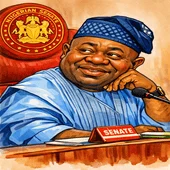
Presiding officer addresses the Nigerian Senate chamber during a plenary session

By Editor President Tinubu does not need to threaten a “do-or-die” election. By capturing institutions, absorbing opposition structures, and weakening electoral safeguards, he is shaping the outcome long before voting begins. When referees are loyal and rules are rewritten, elections become ritual, not choice. The events of last Wednesday at the Nigerian Senate left a bitter and lingering taste in the mouths of many Nigerians. For a public already exhausted by broken promises and eroded trust, the handling of the 2026 Electoral Act Amendment Bill felt less like a disappointment and more like a confirmation of long-held fears. For weeks, citizens waited with restrained hope, believing, perhaps naively, that the Senate might finally take a step toward restoring confidence in governance and the electoral process. Instead, what unfolded appeared to be the final straw, a moment that exposed, in stark terms, where power truly lies and whose interests are being served. When Olusegun Obasanjo infamously described the 2003 election as a “do-or-die affair,” he revealed his mindset with startling clarity. It was the language of conquest, not consent; of domination, not democracy. The backlash was immediate, but the damage was irreversible. That election has since become a grim reference point, a reminder of what happens when incumbents abandon restraint and treat democratic competition as a personal survival exercise. Yet for all his brazenness, Obasanjo made one critical error: he spoke too plainly. He announced his intentions. He warned the public. And in politics, forewarning invites resistance. President Bola Tinubu has learned that lesson well. He has not threatened Nigerians with “do or die.” He has adopted a far more effective strategy: silent domination. There is no bluster, no dramatic declarations, no rhetorical excess. Instead, there is method, cold, patient, and systematic. Tinubu is not engaging in speculation or theatrics; he is locking down the very mechanisms that decide electoral outcomes. This is not opposition paranoia or conspiracy theory. It is observable, sequential, and intentional. Tinubu is not preparing to contest the 2027 election; he is preparing to control it. The foundation of this control is institutional obedience. Elections in Nigeria are no longer stolen primarily by ballot-box snatching; they are shaped long before voting begins, inside institutions that determine how votes are counted, challenged, secured, and enforced. Tinubu has therefore ensured that the most critical offices—the judiciary, electoral management bodies, the police, intelligence services, and military command, are headed by individuals whose loyalty is dependable and whose independence is, at best, compromised. This has nothing to do with merit or federal character. It has everything to do with predictability. When disputes arise, when injunctions are sought, when security decisions must tilt one way or another, the president does not want doubt. He wants alignment. In such a system, instructions need not be given. The expectations are already understood. Yet institutions alone do not guarantee victory; geography still matters. That is why the ruling party has pursued a ruthless campaign of political absorption across the country. Governors are defecting not out of conviction, but out of calculation. Nigerian politics is unforgiving to dissent and generous to surrender. Federal power is wielded as a weapon, through control of funds, security pressure, and administrative chokeholds. Faced with these realities, many governors have chosen capitulation over confrontation. The result is a weakened opposition and a ruling party that now controls the very state machinery responsible for administering elections. In Nigeria, whoever controls the states controls logistics, security coordination, and the practical implementation of electoral rules. This is not competitive democracy; it is political enclosure. Then came the most decisive move: rewriting the rules themselves. Nigerians had placed what little faith remained in technology as a shield against fraud. Electronic transmission of results was imperfect, but it disrupted decades of rigging culture by limiting human discretion at collation centres, the traditional graveyard of the popular will. That disruption made it dangerous. And so it had to be neutralized. The Senate’s decision to weaken electronic transmission and preserve manual handling of results was not the product of confusion or incompetence. It was deliberate. Lawmakers understood precisely what they were doing. They chose the system that allows figures to “change,” results to “adjust,” and outcomes to “emerge.” They acted openly, confidently, and without fear, because they know the system shields them from accountability. Calling the Senate a rubber stamp is no longer rhetorical excess; it is an accurate description. In that moment, the chamber made clear that it represents power, not voters. It did not fail Nigerians by accident, it betrayed them by choice. By dismantling electronic safeguards, it restored the most dangerous phase of Nigeria’s electoral process: the opaque journey between polling units and final collation, where votes lose meaning and manipulation thrives. Government defenders will insist, as always, that everything done was legal. They are correct, and that is precisely the danger. Authoritarianism in the modern age does not announce itself with tanks and decrees. It advances quietly, through laws, appointments, and procedural camouflage. It smiles, quotes the constitution, and pretends neutrality while suffocating competition. Tinubu’s approach may be legal, but it is fundamentally illegitimate. It drains democracy of substance while preserving its outward form. The real danger is not that Tinubu may win re-election. Incumbents often do. The danger is that Nigeria is sliding toward a system where elections exist without real choice, opposition exists without real power, and voters exist without real consequence. When outcomes are engineered in advance, participation becomes ritual. Citizens vote, but nothing changes. Tinubu does not need to rig ballots if he controls the referees. He does not need to intimidate voters if he controls collation. He does not need to threaten rivals if he absorbs or neutralizes them. This is domination without spectacle, power without noise, and manipulation without fingerprints, cleaner than Obasanjo’s blunt-force tactics, and far more corrosive. History is unforgiving to such arrangements. Before they collapse, they extract a heavy toll: public cynicism, voter apathy, institutional decay, and the slow suffocation of accountability. Nigeria has

COAS reaffirms military’s commitment to Nigeria’s democracy

COAS reaffirms military’s commitment to Nigeria’s democracy

The Chief of Army Staff (COAS), Lt.-Gen. Taoreed Lagbaja, has reaffirmed the commitment of the Nigerian Army to supporting and protecting democracy in Nigeria. Lagbaja said this at the Passing Out Parade and Commissioning/Oath Taking Ceremony for Executive Commission Course 1/2023, on Saturday in Jaji, Kaduna State. This is contained in a statement by the Director, Army Public Relations, Brig.-Gen. Onyema Nwachukwu, on Saturday in Abuja. According to Lagbaja, the only thing better than democracy for Nigeria in this modern era is more democracy. He said that subordination of the military to constituted authority remains the most fashionable means of promoting military professionalism. The COAS said that the desire of every Nigerian was to have a flourishing and uninterrupted constitutional democratic governance that promotes national values and the interest of every well-meaning Nigerian, irrespective of ethnic or religious affiliation. “I therefore charge all Nigerian army personnel to be proud champions of our flourishing democracy and remain apolitical in discharging their constitutional duties. “The Nigerian army remains committed to ensuring the security of lives and property across the country. “We are working assiduously to protect the territorial integrity of the nation and support relevant security agencies in ensuring the security of lives and property within the country,” he said. The Commandant, Nigerian Army School of Infantry, Maj.-Gen. Oluyemi Olatoye, who superintended the training of the cadets, said that the commissioned officers had been imbued with the requisite skills to function as officers. Olatoye said that the newly commissioned officers had been trained to be loyal, courageous and dedicated in their service to the nation. According to the statement, Nwachukwu said the COAS, afterwards, conferred Presidential Commission on the Passing out Cadets, to the rank of Lieutenant, after which the Oath of Allegiance was administered to them. He said the 239 passing out cadets comprising 12 females and 228 males were already in service as soldiers drawn from various corps who were selected for Executive Commissioning, after three months of intensive military training. According to him, three cadets emerged in flying colours amongst their contemporaries. Cadet A Saminu came first in order of merit, while Cadet SC Nwokanta came second and Cadet OY Yahaya bagged the third position. “Highpoint of the event was the presentation of Parchment of Commission to the newly commissioned Officers. “After the Commissioning ceremony, the COAS paid an empathy visit to officers and soldiers who were wounded in action during operational engagements at the 44 Nigerian Army Reference Hospital, Kaduna.”