Nigerian Government Withdraws Charges Against Gambaryan, Binance Exec

The Nigerian government has unexpectedly dropped the case against Tigran Gambaryan, a Binance executive facing money laundering allegations. Gambaryan, who has been detained since April, appeared at the Federal High Court in Abuja where charges were withdrawn just days ahead of the initially scheduled October 25 hearing. Gambaryan, a U.S. citizen, was detained on five counts related to money laundering and currency speculation, involving over $34 million. Despite two unsuccessful bail attempts, citing his health and being deemed a flight risk, the charges were suddenly dropped during a low-profile hearing. The unexpected move comes after prolonged diplomatic negotiations between Nigerian and U.S. officials. His detention at Kuje Correctional Centre and previous bail rejections drew attention from U.S. lawmakers, who advocated for his release. Another Binance official, Nadeem Anjarwalla, had earlier escaped from pre-trial custody in March, adding complexity to the case. This development concludes the case that has drawn international scrutiny, with Binance still facing separate tax evasion charges in Nigeria. Gambaryan’s health conditions had played a central role in his legal journey, but the court consistently maintained its stance against his bail, citing procedural concerns.

Supreme Court Reserves Judgement In Governors Suit Challenging EFCC’s Establishment

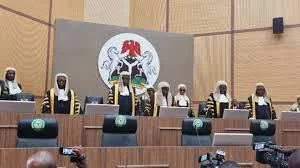
The Supreme Court has reserved its judgment on a significant legal challenge brought by 16 state governments against the constitutionality of the laws that establish the Economic and Financial Crimes Commission (EFCC). The case, presided over by Justice Uwani Abba-Aji and a seven-member panel of justices, reached this phase on Tuesday after extensive arguments from the involved parties’ attorneys. Originally initiated by the Kogi State Government through its Attorney General and Commissioner for Justice, the suit has seen multiple states join as co-plaintiffs. The states involved in the suit, marked SC/CV/178/2023, include Ondo, Edo, Oyo, Ogun, Nasarawa, Kebbi, Katsina, Sokoto, Jigawa, Enugu, Benue, Anambra, Plateau, Cross-River, and Niger. In a turn of events, the Attorneys General of Anambra, Adamawa, and Ebonyi have withdrawn from the case, with the Supreme Court panel granting their request. The suit addresses critical questions about the federal scope of anti-corruption enforcement, challenging the legal foundation of the EFCC’s establishment under current laws. The decision of the Supreme Court will be keenly awaited, as it holds substantial implications for federal and state powers in the governance and administration of justice. ReplyForwardAdd reaction

EFCC Accuses Yahaya Bello, others of acquiring property in Abuja, Dubai 

Court Adjourns Suit Challenging Olukoyede As EFCC Chairman To 2024

The Economic and Financial Crimes Commission (EFCC) has filed fresh charges against the immediate past Governor of Kogi State, Mr Yahaya Bello and two others at a High Court of the Federal Capital Territory.   In the suit marked: CR/7781/2024, Bello, Umar Shuaibu Oricha and Abdulsalami Hudu, are accused of spending over N110 billion of public funds to acquire several properties in Abuja and in Dubai.   The suit dated September 24 but filed on September 25, by the anti-graft lawyer, Mr kemi Pinheiro, SAN, accused the defendants of criminal breach of trust, an offence punishable under Section 312 of the Penal Code Laws of Northern Nigeria, 1963.   Count one of the charge reads: that you, Yahaya Adoza Bello, Umar Shuaibu Oricha and Abdulsalami Hudu sometimes in 2016 in Abuja, within the Jurisdiction of this Honourble Court agreed amongst yourselves to cause to be done an illegal act to wit: criminal breach of trust in respect of the total sum of N110, 446, 470, 089.00 (One Hundred and Ten Billion, Four Hundred and Forty six Million, Four Hundred and Seventy Thousand, Eighty Nine Naira) entrusted to you”.   In count two they were alleged to have sometime in 2023, in Abuja, whilst having dominion over the state’s treasury, dishonestly used the total sum of N950,000,000.00 (Nine Hundred and Fifty Million Naira) for the acquisition of a property known as No: 35 Danube Street, Maitama District, Abuja.   In count 11, the defendants were alleged to have used over Five million Dirhams to acquire a property in Khalifa, Municipality, Dubai.   Count 14 reads: That you Yahaya Adoza Bello, Umar Shuaibu Oricha and Abdulsalami Hudu sometime in 2021, in Abuja, within the jurisdiction of this Honorable Court, whilst having dominion over the state’s treasury, dishonestly sent the total sum of $570,330.00 (Five Hundred and Seventy Thousand, Three Hundred and Thirty United State Dollars) to account No. 4266644272 Domiciled with TD Bank, United State of America.   Count 15 claimed that the defendants sometime in 2021, in Abuja, whilst having dominion over the state’s treasury, dishonestly sent the total sum of $556,265.00 (Five Hundred and Fifty Six Thousand, Two Hundred and Sixty Five United State Dollars) to account No. 4266644272 Domiciled with TD Bank, United State of America.   Meanwhile, the former governor in count 16 was alleged to have sometime between 2017 and 2018, in Abuja, had under his control the total sum of N677, 848,000 (Six Hundred and Seventy Seven Million, Eight Hundred and Forty Eight Thousand Naira) unlawfully obtained from BESPOQUE BUSINESS SOLUTION LIMITED.   In the last five months, the Commission have attempted to arraign the former governor before a Federal High Court, Abuja, on an alleged money laundering charge to the tune of over N80 billion, but has not been successful.   The anti-graft agency reacting to Bello’s absence in court on Wednesday, pointed out that the former governor “should be more interested in clearing his name than playing the victim and crying persecution, where none exists.   The Commission however stated that it is not deterred by this, and other shenanigans by the ex-governor.   ” The Commission remains committed to ensuring that the law takes its course in the money laundering charges already filed against Yahaya Bello in Court.   “EFCC is eager to engage the former governor in the courtroom where the avalanche of evidence so painstakingly assembled can be presented and arguments marshalled for justice to be served to all parties involved in this saga.   ” The true test of Yahaya Bello’s willingness to abide by the law in the criminal proceedings instituted against him at the Federal High Court Abuja by the EFCC, is to present himself to the court in obedience to the order of Justice Nwite. His presence in court is the only step that will convince Nigerians that his touted submission to the EFCC which was widely reported in the media on September 18, was not a stunt”, Head, Media and Publicity of the EFCC, Mr Dele Oyewale had said in the statement.    

BREAKING: NFIU Alerts Banks, Others As ‘Scammers’ Devise New Method To Claim Funds From Abroad

The Nigerian Financial Intelligence Unit (NFIU) has issued a warning regarding scams involving tracing and recovering digital wire transfers from international banks into local accounts. In a June 2024 report, the NFIU mentioned its dedication to offering prompt advice or guidance to its partners using a method grounded in real-life examples. The agency’s report offers detailed insights into the latest trends, recurring patterns, questionable behaviours, and techniques aimed at taking advantage of the financial system for illegal and fraudulent purposes. The NFIU indicated that its research points to a growing problem of fraudulent petitions that target the tracing and recovery of funds supposedly sent from foreign banks to local ones. This issue, it said, poses a significant risk to the intended victims, Financial Institutions, Law Enforcement Agencies (LEAs), and other governmental bodies. “This advisory became necessary due to numerous petitions received by the NFIU from financial institutions, government agencies, and other third parties seeking assistance towards the tracing and recovery of funds transferred from foreign entities to their business partners in Nigeria. “The advisory aims to draw the attention of relevant stakeholders and the general public to the red flags as well as the emerging trends that have been observed, most especially the use of forged documents by fraudsters to defraud unsuspecting members of the public,” the NFIU report stated. The agency reported receiving numerous false petitions, including one where a law firm represented a non-governmental organization (NGO) and requested the NFIU and other related authorities to locate and reclaim €30 billion (Thirty Billion Euros) that had been moved from an international bank to a Nigerian bank, alleging that the funds were frozen by a Nigerian financial institution. According to NFIU, the NGO intended to use the funds for investments in the property sector. The NFIU also mentioned that a law firm had submitted a petition on behalf of its client to trace and recover €6 billion (Six Billion Euros) that had been transferred from international banks to the client’s Nigerian bank account. In response, the NFIU urged financial institutions and the public to remain cautious and to follow guidelines that would help protect crucial documents from being easily accessed to prevent their misuse in similar petitions. It said, “The public should exercise some level of scepticism when dealing with telegraphic transfer documents from major European banks as nearly all frivolous claims emanate from same jurisdictions and banks abroad.” In its recommendations to banks, NFIU said, “Upon receipt of a letter from a customer anticipating huge inflow, evidenced by the usual Telex copy, the financial institution should immediately conduct Enhanced Due Diligence, sufficient to establish authenticity or otherwise of the document presented. “Where issues of forgery are suspected, the financial institution must take steps to quickly respond in writing to the letter from the customer, clearly stating the non-existence of such pending transaction of funds. “This action must be taken immediately upon receipt of the complaint by the bank to avoid their use of the acknowledgement of the letters for fraudulent purposes. “Financial Institutions are advised to immediately file Suspicious Activity Report (SAR) on any entity or individual who presents such frivolous claims to the NFIU.” It advised the public to be “Aware of the threat posed by fraudulent individuals and their fictitious telegraphic inflows whilst noting the listed red flags as well as the mode of operations contained in this document. “The public must also take necessary steps geared towards scrutinizing potential business opportunities before committing financial resources. “The public should recognize the imminent risk of making investment on the strength of unverifia

CBN unveils ‘SabiMONI’ platform to promote financial literacy, inclusion

CBN sensitizes Gombe stakeholders on new payment systems, economic policies

The Central Bank of Nigeria (CBN) has unveiled an e-learning platform, SabiMONI to promote financial literacy and to deepen financial inclusion. Speaking at the ceremony, the CBN Governor, Mr Godwin Emefiele said that the platform was a fully digital national e-learning platform that provided a knowledge base for financial literacy. According to him, SabiMONI is aimed at providing individuals with the opportunity to be trained and to become Certified Financial Literacy Trainers (CFLT) through self-service. “The platform is aimed at supporting our efforts toward ramping up the number of experts that can be used to drive financial education in the country and perhaps beyond. “One of the key drivers of financial inclusion today, is no doubt financial literacy. “It is a prerequisite for greater financial inclusion, which would lead to the stability of the financial system and ultimately economic growth and development,” he said. Emefiele said that the absence of or low levels of financial literacy constituted an impediment to financial inclusion. “In other words, the pace of financial inclusion is directly related to the level of financial literacy and financialcapability.’’ He said that to address the financial inclusion gaps, the National Financial Inclusion Strategy 2022, identified increasing adoption andusage of financial services in priority demographics. He said that such demographics comprised of the most vulnerable segments such as women, youth, MSMEs and rural dwellers. “And especially, the Northern part of the country as well as expansion of digital financial services and platforms amongst its strategic priority areas. “To enable us to achieve these, we must take deliberate steps to upscale financial capability through financial education programmes. “The shortage of skilled and experienced persons to drive financial education remains a major hindrance. “Interestingly, the National Financial Inclusion Strategy 2022 places high priority on financial and digital learning. “This will serve as a strategy that would enable the creation of a conducive environment for serving or ensuring the inclusion of the most excluded groups,” he said.

2023 Budget: We’ve nothing to hide, NDDC tells NASS

Lauretta Onochie NDDC

Following concerns by the lawmakers in the Upper Chamber of the National Assembly over the budget of the Niger Delta Development Commission (NDDC), the Commission has told the Senate it has nothing to hide. The Senate, on Wednesday, May 10 at its session, constituted an ad hoc committee to probe the financial activities of the NDDC for 2021 and 2022 Budget estimates.  The Senate also stood down consideration of the 2023 Budget of the NDDC for further clarification on the figures contained in the budget. While appreciating the concerns raised by the Senate, the NDDC, in a statement by its Director, Corporate Affairs, Dr. Ibitoye Abosede, said that the Commission would continue to respect its oversight functions. The NDDC said that it was ready to cooperate with the investigative committee insisting that it was committed to transparency and accountability in its operations. “It is important that we clarify that the Senate has not accused the Board and Management of the NDDC of corruption or misappropriation of N1.4 trillion. “The Senate only thinks that the funds were expended without approval or appropriation by the National Assembly. This misunderstanding can be quickly resolved by providing the necessary documents and explanations. “The NDDC also wishes to explain that the delays in submitting its budgets and audited accounts to the National Assembly were due to factors beyond its control, such as bureaucratic bottlenecks and frequent leadership changes.  “The Commission has, however, taken steps to address these issues to ensure timely compliance with all statutory requirements. “We appeal to the general public to refrain from making hasty judgments based on the Senate’s decision. The NDDC assures all stakeholders of its dedication to the development of the Niger Delta region and the welfare of its people,” the Commission said.