Trump Threatens 25% Tariff on Countries Doing Business With Iran Amid Protests

President Donald Trump threatens 25% tariff against any country that trades with Iran

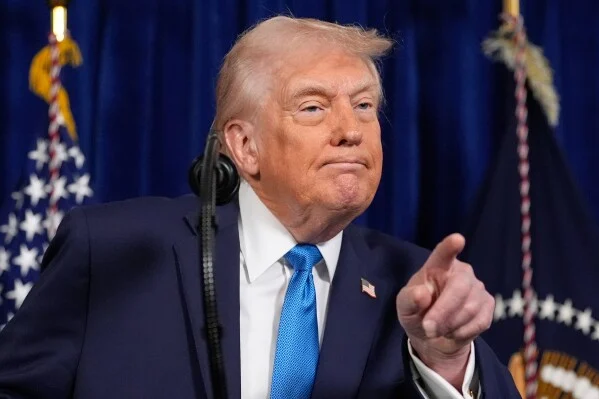
WASHINGTON — President Donald Trump said the United States would impose a 25 per cent tariff on all trade with any country that does business with Iran, escalating economic pressure on Tehran as it faces its largest anti-government protests in years. “Effective immediately, any Country doing business with the Islamic Republic of Iran will pay a Tariff of 25 per cent on any and all business being done with the United States of America,” Trump said in a post on Truth Social, adding that the order was “final and conclusive.” No official documentation outlining the policy appeared on the White House website, and the administration has not clarified the legal authority for the proposed tariffs or whether they would apply to all of Iran’s trading partners. The White House did not respond to a request for comment. Under U.S. law, tariffs are paid by American importers, meaning the cost would likely be borne initially by U.S. companies and consumers. Iran, a member of the OPEC oil-producing group, has been under extensive U.S. sanctions for years. It exports most of its oil to China, with Turkey, Iraq, the United Arab Emirates and India also among its key trading partners. China criticised Trump’s announcement, with its embassy in Washington opposing what it called “illicit unilateral sanctions and long-arm jurisdiction.” A spokesperson said China would take “all necessary measures” to safeguard its interests, adding that “tariff wars and trade wars have no winners.” Japan and South Korea, both of which reached trade agreements with the United States last year, said they were closely monitoring developments. South Korea’s trade ministry said it would consider its response once U.S. actions became clear, while Japan said it would examine the potential impact and respond appropriately. Trump’s comments come as Iran grapples with widespread unrest that has evolved from protests over economic hardship into calls for the overthrow of the country’s clerical leadership. The demonstrations represent one of the most serious challenges to Iran’s ruling establishment since the 1979 Islamic Revolution. U.S.-based rights group HRANA said it had verified the deaths of 599 people since protests began on December 28, including 510 protesters and 89 members of security forces. Iran, which fought a brief war with U.S. ally Israel last year and whose nuclear facilities were bombed by U.S. forces in June, said it is keeping communication channels open with Washington. Trump has said the U.S. may meet Iranian officials and that he has been in contact with Iran’s opposition, while also threatening military action. “Diplomacy is always the first option for the president,” White House press secretary Karoline Leavitt said on Monday, though she acknowledged that other options remain on the table. The tariff threat is consistent with Trump’s broader trade strategy in his second term, during which he has repeatedly used tariffs to pressure countries over trade practices and ties with U.S. adversaries. However, his approach faces legal uncertainty, as the U.S. Supreme Court is considering whether to strike down a wide range of existing Trump-era tariffs. According to World Bank data, Iran exported goods to 147 trading partners in 2022, underscoring the potentially wide-reaching implications of Trump’s proposal if it is formally implemented.

G20 Summit: Low Expectations on Final Day

G20 Summit: Low Expectations on Final Day

As the G20 summit in India enters its final day today (Sunday), there are no major expectations for groundbreaking resolutions. The group of 20 leading developed and emerging economies has been engaged in diplomatic talks throughout the summit, but no significant joint decisions are anticipated. Indian Prime Minister Narendra Modi is scheduled to pay a visit to the memorial site of Mahatma Gandhi, a prominent Indian freedom fighter, in New Delhi in the morning. The concluding day of the two-day summit will feature the third working session of the roundtable, themed “One Future.” The focus of this session will be on discussing practical approaches to address issues such as reforms of development banks and international financial organizations. Following challenging negotiations, G20 leaders reached a compromise on Saturday, culminating in an agreement on a joint summit declaration. The initial difficulty stemmed from a struggle to find sufficient consensus to issue a traditional summit declaration outlining policy concerns and the forum’s direction. Ultimately, the declaration included softer wording regarding Russia’s war in Ukraine, which allowed the document to be finalized. Unlike the previous G20 summit in Bali, Indonesia, where a “complete and unconditional withdrawal” from Ukraine was demanded of Russia, this year’s declaration did not explicitly condemn Russia’s invasion of its neighbour. Instead, the document emphasized the importance of all states refraining from attacks on the territorial integrity or political independence of other nations. It also indirectly criticized Russia’s nuclear weapons threats. While some diplomats view this wording as a compromise on the lowest common denominator, it prevented the summit from collapsing. German Chancellor Olaf Scholz hailed the final wording related to Ukraine in the joint declaration as a success.

Crude oil flies to $86bpd over Gabon coup concerns

Nigeria’s Underperforming In Oil, Gas Sector Due To Insecurity – Lokpobiri

The coup in Gabon has fueled a modest increase in the prices of crude oil due to threats to the country’s 200,000 barrels per day (bpd) of crude oil exports.  Gabon is the second-smallest OPEC producer. Earlier on August 30, a cohort of senior military officers declared that they had assumed control following the announcement by the state election body that President Ali Bongo had secured a third term. Bongo’s father Omar had ruled as president for 42 years. According to a report by Wall Street Journal, since Gabon’s coup announcement, global crude oil prices have seen a modest increase due to seeming threats to exports from the country. “The coup and the threat of disruptions to Gabon’s oil exports are supporting oil prices, but only modestly as the nation is a minor OPEC oil producer, DNB Markets analyst Helge Andre Martinsen says. Brent crude oil is up 0.3 per cent at $85.19 a barrel. “The nation’s output stands at a modest 190,000 barrels a day, but it has been the only African OPEC member to hit its production quotas. So far, there has been no sign of disruption to Gabon’s oil output. Still, the coup serves as a reminder of the geopolitical risk in the oil market, Martinsen says.” It is important to note that as of 12:50 PM (GMT+1) on Wednesday, August 30, Brent crude price was at $86 per barrel. The Gabon coup is raising supply concerns alongside Hurricane Idalia in the United States, which has raised oil supply concerns as well. Meanwhile, on Wednesday, Amena Bakr, OPEC’s chief correspondent posted on Twitter that so far, it appears that oil production from fields in Gabon is not affected by the military coup. Similarly, Assala Energy, which is wholly owned by Carlyle Group (CG.O), said its oil production in Gabon has been unaffected by the military coup in the country. “We can confirm that all our personnel are safe, our operations continue as usual and our production is not affected,” a company spokesperson said. The private equity fund’s non-U.S. energy arm first invested in Assala in 2017 when it acquired Shell’s (SHELL) ageing operations in Gabon for $628 million. However, earlier this month, Carlyle agreed to sell Assala to French producer Maurel & Prom which owns and operates oil and gas assets in Africa, Europe and Latin America, including three licences in Gabon, for $730 million.

World Bank puts Nigeria’s GDP at $477.4bn in 2022

World Bank approves $1bn to improve World Bank puts Nigeria’s GDP at $477.4bn in 2022security for Lake Chad Region

A new report by the World Bank Group showed that Nigeria’s recorded an estimated Gross Domestic Product of $477.4 billion in 2022. The report showed that the country ranks 18th position on the continental ranking of countries by GDP per capita for 2022. The 2022 ranking showed that Nigeria notched one point up from the 19th position it ranked in the previous year when the GDP stood at $440.8 billion. According to the World Bank’s latest data, Nigeria recorded a 5.7 per cent increase in its GDP per capita, which rose to $2,184 in 2022, from the $2,066 reported in the preceding year. In terms of nominal GDP, the country’s economic performance demonstrated remarkable resilience, registering an 8.3% nominal year-over-year expansion in 2022, in spite of the whirlwinds across the global and regional economy. Broadly analyzed, the World Bank’s report showed that the African economy slowed to 3.8% in 2022, dipping the continent’s nominal GDP to an estimated $2.75 trillion. In addition, the report Indicated that the Sub-Saharan region recorded a slow growth rate of 3.6%, in contrast to 4.1% recorded in 2021, with a projected growth rate of 3.1% in 2023, due to what the bank attributed to sluggish global economic growth, high inflationary pressure, and tough financial conditions exacerbated by the high debt profiles of the countries in the continent. A further analysis of the report in terms of GDP per capita, which is a more accurate measure of productivity in an economy, the continent’s economy recorded an average of $2,705 in 2022, indicating a 6.6% increase compared to $2,538 recorded in the previous year. The report further covered the top 10 countries in Africa based on GDP per capita in 2022 with Seychelles topping the ranking table with an impressive GDP per capita standing at $15,875, followed by Mauritius, which recorded a 12.7% upswing in its GDP per capita, which climbed to $10,216; and Gabon which came third with 2.1% increase in its GDP per capita to $8,820 in 2022. Others are in order of ranking, Botswana which came fourth, boasting an average GDP per capita of $7,738; Equatorial Guinea with a GDP per capita of $7,053 in 2022, representing a 6% decline compared to $7,507 in 2021; the 6th position in ranking was South Africa at $6,776 GDP per capita; Libya at number 7th with $6,716 GDP per capita; Namibia ranked 8th with $4,911 GDP per capita; Egypt followed with $4,295; and Algeria came 10th with $4,274 GDP per capita in 2022.

Global current account balances to narrow in 2023 -IMF

Beware Of China, India, Saudi Arabia Loans, IMF Warns Nigeria

Global current account balances increased for the third consecutive year in 2022 and are projected to narrow in 2023, the International Monetary Fund (IMF), has said. According to the Fund, the widening over the three years reflects several factors, including the unequal impact of the COVID-19 crisis in 2020–21 and the increase in commodity prices fueled by the economic recovery in 2021 and supply concerns following the Russia-Ukraine war.   In a report titled, ‘External rebalancing in turbulent times; the Fund stated that the absence of widespread sudden stops during the pandemic enabled deficit economies to avoid an abrupt contraction of their current account deficits. “Currency markets exhibited significant fluctuations in 2022, driven by changes in the terms of trade and monetary tightening,” the Fund stated.   The report stated that an accumulation of official foreign exchange reserves played a limited role in net capital outflows from emerging market and developing economies just as net creditor and debtor positions remained at historically high levels. “Over the medium term, global current account balances are expected to narrow as the impacts of the pandemic and Russia’s war in Ukraine recede. However, several risks surround this outlook, including a renewed increase in commodity prices, a slower-than-expected recovery in China, or a slower fiscal consolidation in economies with current account deficits. While the impact of geoeconomic fragmentation on global current account balances is unclear, it would unambiguously reduce global welfare. The excess global current account balances (defined as the sum of absolute values of current account surpluses and deficits in excess of their norms) have remained unchanged since 2021, after being on a declining trend for several years. While the widening of global current account balances is not necessarily a negative development, excess global current account balances can fuel trade tensions and protectionist measures or increase the risk of disruptive currency and capital flow movements. “Narrowing excess global current account balances would reduce the risk of financial crisis and improve welfare. Policy efforts, in both excess surplus and deficit economies, are required to promote external rebalancing. Where excess current account deficits in 2022 partly reflected larger-than-desired fiscal deficits, fiscal consolidation will help stabilize debt-to-GDP ratios and close current account gaps.” The Fund pointed out in the report that in economies where excess current account surpluses persist, higher fiscal spending in targeted areas will help them to meet their goals in climate, digital, and energy security, while reducing their excess surpluses. “Economies with lingering competitiveness challenges will need to address structural bottlenecks. Multilateral cooperation will help counter risks of geo-economic fragmentation, including efforts to strengthen the current rule-based trading system, and facilitate the green transition. Successfully completing the 16th General Review of Quota would ensure that the IMF is adequately resourced to serve as an anchor of the global financial safety net,” it further explained.