FCTA Sweeps 607 Beggars, Mentally Challenged Persons Off Abuja Streets

The Federal Capital Territory Administration has removed 607 beggars and mentally challenged individuals from Abuja streets since July 2025 as part of an ongoing security and sanitation crackdown.
Wike Names Galadima as New SSA on Development

ControlThe Minister of the Federal Capital Territory (FCT), Nyesom Wike, has approved the appointment of Mukhtar Galadima as Senior Special Assistant on Development Control and Planning. The announcement was made on Wednesday in Abuja by Lere Olayinka, Senior Special Assistant to the Minister on Public Communications and Social Media. Galadima, a seasoned town planner, brings more than three decades of professional experience in urban planning and administration within the FCT Administration. Over the years, he has served in strategic capacities, including the Department of Development Control and the Satellite Towns Development Agency, before his appointment as Director of Development Control under the Abuja Metropolitan Management Council in 2016. He retired from the civil service in November. Olayinka noted that Galadima has served on key committees such as the Abuja Masterplan Restoration Task Team and the Committee on the Review of Revoked Land Titles and Change of Land Use. The appointment, he added, takes immediate effect.
Surge of Kidnappings: FCT Minister Summons Emergency Meeting

In response to the alarming surge in violent crime within the nation’s capital, Minister of the Federal Capital Territory (FCT), Nyesom Wike, has initiated a crucial emergency security meeting. Recent incidents involving brazen bandit operations, including the tragic killing of several residents, including a 13-year-old Secondary School Student, have prompted heightened concerns. Addressing the gathering, Minister Wike reassured FCT residents about their safety, emphasizing the government’s commitment to providing security forces with necessary resources to combat the rising insecurity. The closed-door summit, presently in session, brings together heads of security agencies in the FCT, key officials from the Federal Capital Territory Administration (FCTA), council chairmen, and traditional rulers. Stay tuned for more updates on this developing situation.
FCTA Demolishes 11,705 Shanty Colonies, Generates N2.5bn Revenue

The Department of Development Control, Federal Capital Territory Administration (FCTA) has demolished 11,705 shanty colonies across the city, Abuja, from January to October, according to an official. The department also generated N2.5 billion and created 13,873 direct and indirect jobs within the period. Mr Mukhtar Galadima, Director, Development Control, Abuja Metropolitan Management Council, FCTA, disclosed this during a media briefing on the activities of the department in Abuja on Sunday. Galadima explained that the shanties and illegal developments were demolished in conjunction with the Ministerial Enforcement Task Force Team. He identified the affected areas as Kabusa, Kasuwan dare, Galadimawa junction, Mabushi scavenger colony and Gudu District along Oladipo Diya way. He equally said that the department also removed obstructing structures on waterways at Lugbe, Jahi and Lokogoma. This, according to him, has curtailed the flooding being experienced within the city in recent years. He also said that the encroachment on rights of way and security black spots were equally dismantled in collaboration with security agencies in the FCT. The director also disclosed that a total of 1,764 building plan applications were received within the period, out of which 1,422 were granted approvals, including backlogs of previous years. On revenue generation, Galadima said that the N2.5 billion was generated from building plan approval and land use contraventions from January to October. He said that amount represents 68.5 per cent of the N3.7 billion target for the year, adding that of the N2.5 billion, N1.7 billion was generated from building plan approval alone. The director also explained that the 13,873 direct and indirect jobs were created at different stages of construction at various sites as approved by the department. Another achievement according to Galadima included the inauguration of One-Stop Vetting Team to treat backlog of files and fast -track of building plan approval for Plots within areas serviced with infrastructure. He added that the department also established Regional Offices to decentralise monitoring and enforcement activities in the Area Councils and Satellite Towns. “We equally inaugurated a Committee on the Prevention of Building Collapse in the FCT to proffer modalities and institutional framework to avert building collapse in the territory. “The department also inaugurated a Post-Development Audit which commenced at Dawaki as a pilot scheme. “The staff of the department equally carried out routine monitoring of physical development activities within the territory where contravening developments are served either with stop work, quit notice or demolition notice,” he said. On staff welfare, Galadima said that the department has institutionalised end of year activities where it appraises itself, enhances staff bonding as well as presents awards to deserving staff to boost morale. “There is also a monthly medical fitness check for all staff and monthly sporting activities to boost physical fitness of staff,” he added. He identified increasing cases of land grabbing and harassment of the department staff by security agencies as some of the challenges recorded within the period under review. “There is also the problem of non-resettlement of indigenous communities which created pockets of expanding slums throughout the city. “Another challenge is the inadequate and obsolete utility vehicles for monitoring and heavy-duty equipment for enforcement to cover the ever-growing territory. “Others are inadequate office accommodation, slow adoption information and communication technology, and non-0utilisation of land after removal of squatter settlements. “There is also the challenge of slow pace of infrastructural development especially in the satellite towns and abandoned buildings serving as criminal hideouts among others,” he said.
FCTA Shuts Down 2 Substandard Schools In Abuja

The Federal Capital Territory Administration (FCTA) has closed two private schools for operating below minimum standard in the FCT. The affected schools are Erudite Bright Kids at Kagini and Jane’s Angela School in Abuja Municipal Area Council The schools were closed during an operation to close all substandard schools operating in the FCT. The Mandate Secretary, Education Secretariat, FCTA, Dr Danlami Hayyo, who led the team in Abuja on Wednesday, explained that the measure was to ensure quality of teaching and learning in FCT schools. Hayyo said that the move was in line with the mandate of the Department of Quality Assurance charged with the core responsibility of proper accreditation of schools, monitoring and inspection. This, according to him, is to ensure quality educational services, compliance to the requirements for the establishment of schools and enforcement of minimum standards as stipulated in the operational guidelines for Schools. “In a normal situation, no school should be allowed to operate in the FCT without due registration, payment of dues and obtaining the necessary requirements. “The secretariat through the Department of Quality Assurance is determined to sanitise the system for a better teaching and learning process. “We will also intensify its efforts to ensure FCT schools compete favorably in the global education space,” he said. He called on the National Association of Proprietors of Private Schools (NAPPS) to enlighten their members on minimum standards and the need to key into FCT Administration educational policies. Hayyo, also called for robust partnership of the private sector in the delivery of quality educational services to the teeming residents of the FCT. The mandate secretary also frowned at the attitude of some school proprietors who denied evaluators and inspectors from accessing school premises. On her part, the Director, Department of Quality Assurance, Dr Favour Nse-Edem, explained that the sealed schools failed to satisfy the conditions of establishment of regular schools. Nse-Edem added that there were no records of their existence and has been operating for years, adding that the closure was key to maintaining standards in schools. She said that the department would continue to ensure that both public and private schools operate within expected standards. She added that all schools must operate in line with minimum requirements, duly accredited, registered and adhere to operational guidelines. The director said that the closure exercise was with the approval of the Minister of FCT, Mr Nyesom Wike. She explained that the department had created awareness through public announcements in various media organisations on the need to comply with operational guidelines to provide quality educational services. The director said that the announcement served as a warning signal to defaulting and substandard schools operating in an unconducive environment. “There are other schools operating in an environment that predisposes students to health hazards and those operating in faulty physical structure among others. “The department has continued to advise the schools owners on what is expected of them but have continued to ignore such professional advice of quality assurance evaluators,” he said.
Illegal Operations: Again, FCTA Crushes 470 Motorcycles In Abuja

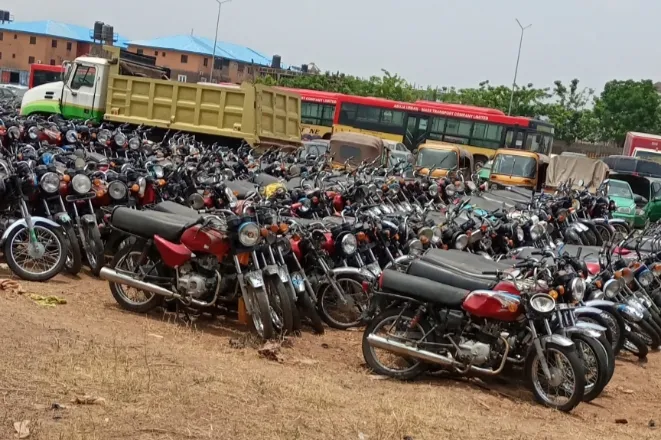
The Joint Task Force of the Federal Capital Territory Administration (FCTA) on Thursday crushed more than 470 motorcycles impounded for operating illegally in the capital city, Abuja. The motorcycles were impounded by the taskforce during an operation that began from the Carwash Bus Stop, Lugbe, through Gosa, Bill Clinton Drive, Trademore Estate, Lugbe Junction and Kubwa. Over 400 motorcycles were earlier impounded and crushed on Aug. 31, during a similar operation for the same offence. Mr Obokutom Nyah, Secretary, Transportation Secretariat, FCTA, told journalists during the exercise that the decision to crush the motorcycles was in line with the provisions of the law. Nyah warned commercial motorcyclists to limit their operations to designated areas, stay clear of the city centre and stop constituting a security threat in the city. He explained that there are areas designated for different kinds of vehicles, adding that commercial motorcycles are only allowed to operate in the suburbs. “So, we encourage the operators to respect their boundaries, because if you cross the line, you will face the full wrath of the law,” he said. Also, the Director, FCT Directorate of Road Traffic Services, Mr Abdulateef Bello, said that the number of motorcycles operating within the city was outrageous. Bello said that the taskforce would extend its operations to night hours, adding that currently, between 200 and 400 motorcycles are being impounded on weekly basis. He added that the taskforce was considering arresting residents that patronise motorcycles as part of efforts to strengthen the level of enforcement. He advised residents against patronising motorcycles but should learn to walk short distances where possible, for their own safety. The director further advised those investing in commercial motorcycle business to have a rethink, stressing that the FCTA would invest its resources to curtail them.
We’re Taking Legal Action Against Owners Of Impounded Vehicles, Tricycles, Others- FCTA

The Federal Capital Territory Administration (FCTA) says owners of 149 impounded vehicles, 100 tricycles and motorcycles in the FCT will appear before a mobile court for various traffic offences. Dr Abdulateef Bello, the Director, FCTA Directorate of Road Traffic Services, also known as Vehicles Inspection Officers (VIO), stated this in Abuja at the weekend, after inspecting the impounded vehicles. Bello, who visited some of the VIO Commands where the impounded vehicles, tricycles and motorcycles were kept, said that the owners would pay dearly for their sins. He explained that the offences included parking in unauthorised areas, driving against traffic, and operating unregistered and unpainted taxis as well as illegal motor parks. “I always advise that it is cheaper to be on the side of the law to obey simple rules and regulations. “We have asked commercial motorists to register and operate within the defined routes and motor parks and not to pick indiscriminately from the road corridors. “We have also told the tricycle operators to operate within the confines of the road plan, already agreed upon. “They are not supposed to come into the city. They are supposed to transport people that are going into estates and towards suburbs of the city,” he said. He said that traffic regulations have been reviewed, adding that fines will equally be reviewed upward. He said that traffic offenders would pay hugely when they face mobile court, “but I am sure it will serve as a deterrence”. The director said that the directorate was working with the Transport Secretariat of the Federal Capital Territory Administration to review existing road traffic policies on traffic management. This, according to him, will ensure effective regulation of road traffic management. He noted that until the Abuja Mass Transit become fully operational to meet the needs of commuters, the directorate would continue to battle with unregistered vehicles operating illegally in the city. “This is because it is a function of demand and supply, but I am sure in no distant time, all these will be a thing of the past,” he said.
FCTA partners South Korea, Turkiye on vocational education, agriculture – Wike

The Minister of the Federal Capital Territory (FCT), Mr Nyesom Wike, has said that the FCT Administration (FCTA) would partner with the Republic of South Korea on vocational education. Wike also expressed willingness to partner with Turkiye on agricultural development. The minister stated this when the Ambassadors of South Korea to Nigeria and his Turkiye counterpart visited him in his office. He told the Ambassador of South Korea to Nigeria, Kim Young-Chae, that he visited the country while he was the minister of education and discussed the issue of vocational education. He described South Korea’s vocational education model as “impressive”, saying that the model enables students who do not want to go further, to have some skills. “It was my desire that we would have concluded with that partnership then, but unfortunately, that was not to be. “I would also like to reintroduce that as the FCT minister to see how we can also have that vocational school,” he said. Wike added that he would like to introduce a hands-on model to the vocational schools and skill acquisition centres in the FCT. This, he said, would be in partnership with the Republic of South Korea. He said that he was impressed when he visited Samsung and noticed that sometimes, the company supplies refrigerators and cars to the vocational schools for practical purposes. “I think we have to see how we can come back to that issue because vocational education is very key to us,” he said. Earlier, Young-Chae informed the minister about his country’s collaboration with the Ministry of Agriculture and the Rural Electrification Agency. He said that the aim was to build a mini electricity grid in the FCT which was ongoing. He also disclosed that South Korea plans to introduce a grant project to help young businessmen start new businesses. This, he said, was in addition to the Nigeria-Korea Model School in the FCT and other training programmes for teachers. “In addition to that, we have launched a smart school project, one in each of the six geopolitical zones, to help innovate schools in terms of communication technology and teachers’ education,” he said. In a related development, the FCT minister, while hosting the Turkiye Ambassador to Nigeria, Mr Hidayet Bayrakter, on Monday, said that FCT has large arable land for agricultural development. He said that collaboration with Tirkiye in that regard would be beneficial for both countries. On the Abuja metro rail line, the minister said that the FCT Administration has an open-door policy and would be willing to discuss with companies from Turkey. Wike, however, appealed for a review of Turkish visa policy, pointing out that the policy of short-term, single-entry visas may not be good enough to enhance business collaborations. Earlier, Bayrakter sought the collaboration of the FCT Administration in the construction of the second phase of the ongoing Abuja metro line system. The ambassador said that Turkiye had very capable construction companies with experience in rail constructions as well as suspension bridges. Some of the companies, he said, were involved in the construction of the metro system in Dubai and Qatar, in addition to building one of the biggest suspension bridges in the world. He said that the companies have expressed interest in partnering with the FCT Administration. He expressed the readiness of Turkish investors to meet with the FCT minister for further discussions on the second phase of the rail project.
We’re Upholding the Law By Crushing Impounded Commercial Bikes -FCTA

In a bid to reinforce the ban on commercial motorcycles, commonly known as “Okada,” within the city centre of Abuja, the Directorate of Road Traffic Services (DRTS) under the Federal Capital Territory Administration (FCTA) recently conducted an operation to impound and crush 400 illegally operating motorcycles. This move, according to Mrs. Deborah Osho, the Head of Operations at DRTS, was in strict compliance with the provisions of the law. According to her, the ban on Okada operations within the city centre of Abuja has been in effect since 2006, as directed by the Federal Capital Territory Road Transport Regulation of 2005. This regulation designates specific areas where Okada riders are permitted to operate, excluding the city center districts, including Wuse, Central Business District, Maitama, Asokoro, and others. “The enforcement of this ban became necessary due to several concerns. Okada operators had been associated with security threats, quick getaways from crime scenes, kidnappings, snatching valuables, mobile phone theft, and a rising number of accidents within the city. “Therefore, the decision to crush impounded Okada motorcycles aligns with the law, which provides for such action against motorcycles seized for constituting security threats or those impounded with a court forfeiture order. “Despite prior sensitization and awareness campaigns conducted even before the ban in 2006, Okada operators within the city centre continued to defy the regulations. Authorities have also held meetings with Okada leadership to emphasize the ban and its consequences for non-compliance,” Osho explained in an interview. She said that to strengthen the enforcement of the ban and address issues of alleged corruption in the seizure process, the FCTA amended the ban to include the forfeiture of impounded commercial motorcycles to the government. “This approach aims to prevent officials from collecting bribes and releasing the motorcycles back onto the streets. Instead, the impounded motorcycles would be crushed and sold to recycling companies, with the proceeds deposited into a government account. “The decision to crush impounded Okada motorcycles reflects the government’s commitment to upholding the law, ensuring public safety, and minimizing security threats within the city centre. It also serves as a deterrent to both operators and potential buyers of these impounded motorcycles,” she explained further. She concluded by saying that the recent operation to impound and crush illegal commercial motorcycles in Abuja’s city centre is a clear demonstration of the FCTA’s determination to enforce the ban on Okada operations in designated areas.
Scandal rocks FCTA Park & Pay investment project

*Original owners seek justice from Tinubu, Wike Trouble appears to be brewing in the Federal Capital Territory as an ongoing scandal involving the Park & Pay investment has sent shockwaves through Abuja, raising concerns about transparency and justice. Otumba Olusegun Olarewanju, CEO of Platinum Parking Management, and Iliyasu Abdu, MD/CEO of Integrated Parking Managers, who claim to be the pioneers behind the recently reintroduced Abuja Park and Pay project, are demanding fair treatment from President Bola Ahmed Tinubu and the newly appointed FCT Minister, Nyesom Wike. To attract investments from Nigerians in the Diaspora, especially in the Capital Territory, Olarewanju and Abdu assert that President Tinubu and Minister Wike should investigate the activities of top officials within the Federal Capital Territory. The duo allege that they were unjustly sidelined by the Adesola Olusade-led leadership of the FCT, despite having initiated the Abuja Park and Pay project. It’s reported that the former Minister of the FCT, Bello Mohammed, had upon leaving office, advised the Permanent Secretary to prioritize the pioneer companies’ right of refusal to ensure fairness and prevent the perpetuation of impunity. However, the Permanent Secretary and his colleagues allegedly disregarded this advice, moving swiftly to bring in their proxies and seized the concept developed by the original initiators. The situation is complicated further by an existing court judgment requiring the FCTA to pay damages for the abrupt disengagement of the two companies, causing significant financial losses. Olarewanju and Abdu detailed their journey, explaining that they returned to Nigeria as a response to then-President Olusegun Obasanjo’s call for Diaspora investments. They designed an “On-Street Parking Management” solution for Abuja, aiming to generate revenue and provide employment opportunities. “At the onset of democracy in 1999, the then President Olusegun Obasanjo invited people in Diaspora when we tried to romance with his government. He said we should come back home, bring all our ideas, and come and invest in the country. “This gingered us to come back home, and looking at the esthetics, the design, and the road network of Abuja, we came on board that we could do ‘On street Parking management’ on the streets of Abuja in other to generate revenue for the FCT and also to create massive employment for the teaming youths of Nigeria. “And we also had it in mind that one day the influx of vehicular movement in Abuja city will be uncontrollable. So, in other to have a plan in place was what necessitated us coming up with ‘On street parking’ project in the street of Abuja. “And we came with everything, we came with all our technical partners, we set it up, we did everything, and we tendered for the project. The FCT Minister later set up a technical committee to look into the proposal and here we are, we signed an agreement with them in 2010. “When we started, we put the entire infrastructure in place, synergies or what have you. We did all the line markings in all the roads of Abuja. I and my PPMS went back abroad and brought technical partners to set up all the infrastructure. We engaged thousands of Nigerians. “My company engaged over four hundred and fifty direct and indirect labour to start the project, same with my friend. We brought the state-of-the-art applications to manage the projects and start setting everything up, until one day we saw two companies that took over the street of Abuja saying the Minister said they should drive us away from the streets. “And then these people took over the streets, and then mayhem started; chaos, and pandemonium on the streets of Abuja. This was what led to Justice Peter Afe to place a suspension on the project because people sued us, they sued one of the illegal operators in court. And when they suspended us they told FCT to go and get a proper traffic law to support the project,” Otumba Olarewanju explained. However, their vision was derailed by the actions of FCT officials, who allegedly favored their own interests over the original initiators’ rights. The two entrepreneurs stressed their demands: a return of their original zones for operation, compensation for incurred losses due to disengagement, and adherence to the arbitration judiciary award. “This is because as pioneers, and in the agreement we had with FCDA we have the right of first refusal. It’s in the agreement, and that agreement has been certified by a court of competent jurisdiction, so our agreement is valid and subsisting and anything contrary to that is against the law. And number two, the arbitrary award is a legal thing that nobody can wish away except the court of competent jurisdiction. Since they have gone to the High Court, the high court could not set it aside; the Court of Appeal court did not set it aside, and even the Supreme Court will not set it aside because arbitration has a time limit. If you cannot do anything within those ninety days that means it’s only God that can intervene,” he stated. Their plea hinges on their agreement’s legal validity, their certified rights of first refusal, and the binding nature of the arbitration award.