9 Years After, CBN Removes Restriction To FX On 43 Items

CBN Eyes Explicit Inflation-Targeting Framework To Enhance MP Effectiveness

The Central Bank of Nigeria says it has removes restriction to foreign exchange placed on forty-three in 2015. According to a statement signed by Director, Corporate Communications, Isa AbdulMumin, importers of those items are now free to access the FX market to purchase foreign exchange. Former CBN Governor, Godwin Emefiele had in 2015, placed a restriction on 43 items that cannot access forex at the FX market. According to Emefiele, at the time, it was part of effort to encourage local production. “Importers of all the 43 items previously restricted by the 2015 Circular referenced TED/FEM/FPC/GEN/01/010 and its addendums are now allowed to purchase foreign exchange in the Nigerian Foreign Exchange Market,” the Apex Bank said. The regulator added that it will continue to promote orderliness and professional conduct by all participants in the Nigerian Foreign Exchange Market to ensure market forces determine exchange rates on a Willing Buyer – Willing Seller principle. “The CBN reiterates that the prevailing Foreign Exchange (FX) rates should be referenced from platforms such as the CBN website, FMDQ, and other recognised or appointed trading systems to promote price discovery, transparency, and credibility in the FX rates. “As part of its responsibility to ensure price stability, the CBN will boost liquidity in the Nigerian Foreign Exchange Market by interventions from time to time. As market liquidity improves, these CBN interventions will gradually decrease. “The CBN is committed to accelerating efforts to clear the FX backlog with existing participants and will continue dialogue with stakeholders to address the issue. “The CBN has set as one of its goals the attainment of a single FX market. Consultation is ongoing with market participants to achieve this goal. Participants and the general public are to be guided by the above,” it further said.

Naira Weakens Despite CBN’s Intervention

Naira Plunges Across Forex Segments Amid Liquidity

Since the unification of all the official foreign exchange (FX) windows, the Naira has continued to depreciate against the US dollar, down by 39.6 per cent to N765.83/$ as of 11 October 2023 from N462.88/$ at the I&E Window. Based on the half-year financial markets report of the Central Bank of Nigeria, it has maintained its intervention in the foreign exchange market in an attempt to alleviate demand pressures and ensure exchange rate stability. A total of $6,439.33 million was sold at the foreign exchange market made up of spot sales of $1,557.47 million and forward sales of $4,881.86 million. The spot sales comprised $612.41 million sold at the inter-bank Secondary Market Intervention Sales (SMIS) window, $455.31 million sold to Small and Medium Enterprises (SMEs), $441.75 million for Invisibles, and $48.00 million sold at the I&E window while the bank purchased a total of $655.53 million in the FX market. However, the shocks of the policy have been more pronounced at the parallel market leading to a steep depreciation of the Naira to N1020/US$ on 10 October 2023. With little control over the depreciation of the nation’s currency, the then acting governor of the Central Bank of Nigeria (CBN), Mr. Fola Shonubi, announced plans to put in place new policies that would guide the dealings of FX to boost supply in the market. Apparently, the measures put in place have not been effective as demand for FX continues to rise amidst an acute shortage of supply. “We have always argued that while we believe the unification of the various FX rates is a pro-market policy that will be positive for the economy in the long term, the short to medium-term impact will be hard too hard on the average consumer. “A focus on rate convergence without structural reforms to increase the supply of FX will be a case of treating the symptoms while ignoring the underlying cause of the problem which is an acute shortage of supply amidst a growing demand for FX. Meanwhile, while crude oil sales and Foreign Portfolio Investments (FPIs) are two major sources of FX that have declined significantly, Oil production remains depressed, reported at 1.57 mbpd in September (highest so far this year) and are yet to see any significant foreign capital inflows. According to the Nigerian National Petroleum Company Limited (NNPCL), between September 30 and October 6, 128 crude oil theft incidents were recorded across the oil-producing areas of the Niger Delta. In the specific timeframe mentioned, there were numerous illicit activities in the oil sector. These included 17 cases of unauthorized connections, 27 illegal refineries, 11 infractions related to vessel tracking systems (AIS), and 49 instances of wooden boat arrests.

Cardoso Pledges Conducive Atmosphere For Foreign Investments

Cardoso Pledges Conducive Atmosphere For Foreign Investments

Following his confirmation as the Governor of the Central Bank of Nigeria (CBN), Mr. Olayemi Cardoso has said that the CBN will do all within its statutory functions to address identified distortions and ensure a conducive atmosphere for different categories of investors.  He gave the assurance in his office on Thursday, when a group of investors paid him a courtesy visit, noting that under his leadership, the new management team at the Bank will do its best to tackle the impediments to liquidity in the foreign exchange market in Nigeria. While disclosing plans to formally unveil his agenda for the monetary and financial sector in the days ahead, Mr. Cardoso stressed the importance of credibility and transparency in implementing the Bank’s monetary policy. To achieve this, he said the Bank would focus on strengthening its data-gathering system to ensure that only verifiable data will be relied upon for evidence-based decisions. According to him, the CBN would also adhere to rules that are known, acceptable and transparent for the conduct of monetary policy. Speaking further on liquidity management, he said his team had a short-term goal of addressing structural issues within the financial system that gave rise to the liquidity challenge in the first instance.  On the relationship between the monetary and fiscal authorities, the new CBN Governor said there would continue to be consensus between both authorities to harmonise their positions on the interest rate and inflation. He, however, said the Bank would remain open to different views in its push for greater transparency. Meanwhile, Mr. Cardoso said the Bank would only provide strategic policy support to critical sectors of the economy while allowing experts to take charge of such critical sectors, given that the expertise lies within other relevant agencies.  In their remarks, the investors, led by Mrs. Ireti Samuel-Ogbu, said they were at the CBN to discuss ways of strengthening collaboration to boost foreign investment in Nigeria. The group also emphasised issues around the Bank’s independence and the need to grow the country’s foreign exchange reserve, among other issues.

CBN Formally Confirms Emefiele’s Resignation As Cardoso Assumes Duty

CBN Eyes Explicit Inflation-Targeting Framework To Enhance MP Effectiveness

The Acting Governor of Central Bank of Nigeria (CBN), Dr. Olayemi Michael Cardoso, on Friday, formally assumed duty pending his confirmation by the Senate. This is as the Central Bank officially confirmed the resignation of former CBN Governor, Godwin Emefiele. President Bola Ahmed Tinubu, recently appointed Cardoso, and other Deputy Governors.    This follows the resignation of Mr. Godwin Emefiele as Governor of the Central Bank of Nigeria (CBN). A statement by the Director, Corporate Communications, Dr. Isa AbdulMumin which was made available to journalists on Friday in Abuja, added that the Deputy-Governors-Designate have also assumed duties in acting capacities, sequel to the formal resignation of former Deputy Governors, Mr. Folashodun Shonubi, Mrs. Aishah Ahmad, Mr. Edward Lametek Adamu, and Dr. Kingsley Obiora. Dr. Cardoso and his colleagues subscribed to the relevant oaths of office at a brief ceremony held at the Bank’s Head Office in Abuja, on Friday and have since settled down to the task of administering monetary and financial sector policies of the Federal Government. An Economic and Development Policy Advisor, Financial Sector Leader, former Chairman Citi Nigeria and Commissioner for Economic Planning and Budget in Lagos, Cardoso brings over three decades of managerial experience on board. He is an alumnus of Aston University, Birmingham, United Kingdom, where he studied managerial and administrative studies. He also holds a Master’s degree in Public Administration from the Harvard Kennedy School, United States of America. It would be recalled that Dr. Cardoso and his colleagues were appointed by President Bola Tinubu to their respective positions at the Bank on September 15, 2023, subject to their confirmation by the Senate. Meanwhile, The Central Bank of Nigeria (CBN) has confirmed the resignation of Mr Godwin Emefiele as its governor, three months after being suspended from office by President Bola Tinubu.

FG’s Fiscal Deficit To Further Decline In Q3, Q4 -MPC

CBN Shifts Monetary Policy Committee Meeting

Some members of the Monetary Policy Committee (MPC) of the Central Bank of Nigeria (CBN) have projected that the federal government’s fiscal deficit will continue to decline in the third and fourth quarters of 2023. Their projections are predicated on the recent efforts by the government to manage expenditures better and also improve oil and non-oil revenues.  Their prediction contained in their various personal statements during the last MPC meeting, as posted on the CBN website.                In his personal statement, the Permanent Secretary, the Federal Ministry of Finance, Budget, and National Planning, Aliyu Ahmed, said: “The fiscal deficit is expected to decline in the third and fourth quarters of 2023 on the back of recent efforts by the new government to manage expenditures better and also improve oil and non-oil revenues. “With expenditure reprioritization and fiscal wisdom at both the federal and state levels, there is an expectation that the government debt ratio may fall at least marginally by the end of 2023.  “Speaking on the fiscal sector, Adenikinju Adeola, a member, explained that both government revenue and expenditure underperformed between January and May 2023. He explained that the Federal Government’s retained revenue stood at N1.67 trillion, lower than the pro-rata target of N1.96 trillion due to the underperformance of Federation Account Allocation Committee (FAAC) receipts and gross independent revenue.       However, on the positive side, he stated: “Total FGN expenditure as of May 2023 was N4.76 trillion, 27.8 percent lower than the budget estimate of N6.606 trillion. The shortfall came mainly from allocations for debt service, interest on Ways and Means, and capital expenditure. “Overall budget deficit reduced by -18.15 percent in the first five months of 2023.   “The underperformance of the budget is especially felt in the capital expenditures, thus impacting negatively on economic development”, he added.  On his part, another member, Obadan Mike, noted that although the new government is making serious efforts to boost revenue generation, fiscal deficits and associated public debt accumulation will continue to elicit deep concerns.      Meanwhile, the MPC members also called for a review of border closures to increase food supply in the country while expressing concern about the decline in growth of the agricultural sector in the first quarter of 2023.                                                            Adenikinju said, “The continuous closure of the borders should also be reviewed. This is to expand food and non-food supply to the economy and force down domestic prices, especially food.  Also expressing concern about the declining growth in the agricultural sector, Ahmed said: “The decline in growth in the agriculture sector is particularly worrisome, given its role in food production and employment generation.    “Targeted intervention by the fiscal and monetary authorities in the agriculture sector is crucial to ensuring medium- to long-term food security and price moderation. The recent initiative by the CBN to offload grains from the national strategic grain reserves to lower food prices could not have come at a more auspicious time. “There is also a need to leverage the African Development Bank (AfDB) Agro Pocket Wallet to support farmers in the production of grains and fertilizers.”

Exclusive: ABP Failure: FG, RIFAN Initiate Nationwide Loan Recovery Drive

Exclusive: ABP Failure: FG, RIFAN Initiate Nationwide Loan Recovery Drive

*Orders formation of loan recovery taskforce nationwide In the wake of the Federal Government’s recent threat to recover loans issued to Nigerians during the previous administration, the Rice Farmers Association of Nigeria (RIFAN) has taken swift action by issuing a directive to its members nationwide to reclaim loans disbursed to farmers during the 2018-2021 cropping seasons under the Anchor Borrowers’ Program (ABP). At inception in late 2015, the Central Bank of Nigeria (CBN) had said the programme thrust of the ABP is the provision of farm inputs in kind and cash (for farm labour) to smallholder farmers to boost production of these commodities, stabilise inputs supply to agro-processors and address the country’s negative balance of payments on food. By 2022, at least 4.8 million people had benefitted from the Anchor Borrowers Programme, authorities said at the unveiling of stacked paddy rice pyramids produced by rice farmers under the ABP initiative. While some beneficiaries have cited insecurity, flooding, climate change and crop failure as reasons for their inability to repay the loans, government officials have said that while the farmers’ reasons are somewhat valid, many of the farmers saw the loans as ‘their share of the national cake’ which do not need to be repaid. But the programme has been marred by loan default, even as food prices rose significantly within the years it took effect. There are also reports that several farmers collected the loan to travel to Hajj or married additional wives from the proceeds of the Anchor Borrowers Programme. This, among other reasons, is why authorities resolved to take legal action. “We find it very difficult to recover this loan,” Sahabi Augie, the immediate past Chairman of the Kebbi State chapter of the Rice Farmer Association of Nigeria (RIFAN), had said. In a recent report on Nigeria, the International Monetary Fund (IMF) said that only 24% of loans under the ABP had been repaid. The CBN, however, disagreed with the IMF, saying N503 billion of loans under the ABP had been repaid. This figure represents 52.39% of the total loans collected by farmers under the programme, according to the bank. But a recent statement from CBN’s corporate communications department restated that only 48 per cent of the loan has not been repaid. The CBN said it released N1.079 trillion under the programme, out of which over N500 billion is due for repayment. Interestingly, the All Farmers’ Association of Nigeria (AFAN) seemed to tilt towards the IMF when, in December 2022, it said the CBN was having difficulties recovering the loans because most beneficiaries of the ABP were not Nigerian farmers. Experts believe the failure of farmers who benefitted from the ABP to repay more than N500 billion extended to them by the CBN underscores a weakness in the initiative. However, the critical decision to set up a taskforce and recover the loans by all means is following a high-level executive meeting between RIFAN and the Department of State Security (DSS) on August 29, 2023. During the meeting, the recovery of loans issued to rice farmers between 2018 and 2021 was discussed extensively, leading to the issuance of a directive by RIFAN’s top leadership. In the confidential memo addressed to RIFAN members, which was leaked to the NIGERIAN ANCHOR, Aminu Mohammed Goronyo, the National President of RIFAN, and Chief Livinus Ngwangwa, the National Secretary, provided detailed instructions on how the loan recovery process should proceed: “Immediate Loan Recovery: All loans disbursed to beneficiary farmers from 2018 to the present date must be swiftly and effectively recovered. Farmers are given the flexibility to repay in either cash or paddy. “Loan Repayment Account: Beneficiary farmers are required to channel their loan repayments to the designated loan recovery account: Account Name: RIFAN 2020/2021 Wet Season; Account Number: 0054122612; Bank: Unity Bank PLC. “Documentation: Farmers are mandated to ensure that copies of their loan repayment records are sent promptly to RIFAN Headquarters. This documentation process is essential for maintaining accurate records. “Recovery Task Force: RIFAN state chapters have been instructed to establish a dedicated recovery task force without delay. These task forces will work in close collaboration with law enforcement agencies, including the police, Department of State Security (DSS), Nigerian Civil Defense, and local traditional rulers, to oversee and facilitate the loan recovery process,” the memo instructed. Beneficiary farmers were encouraged to fully cooperate with their respective RIFAN state chapters to facilitate the successful recovery of loans in adherence to the provided directives. For additional information and updates, beneficiaries are advised to contact their local RIFAN chapter or visit the RIFAN website. RIFAN Contact Information: Website: www.rifan.ng, Email: info@rifan.ng. The Rice Farmers Association of Nigeria (RIFAN) is a prominent agricultural organization dedicated to supporting and advancing rice farming in Nigeria. RIFAN plays a pivotal role in facilitating the Anchor Borrowers’ Program (ABP) to empower rice farmers and enhance food security in Nigeria.

Banks secured ₦12trn in borrowings over 8 months -CBN

Nigeria’s Q1 fiscal deficit moves to N1.430trn – Report  

Central Bank of Nigeria (CBN) data indicates that between January and August of the current year, commercial and merchant banks accessed a total of ₦12.46 trillion in borrowings. This data underscores an escalating dependence on the regulatory body for liquidity. Comparatively, this amount signifies a 79% Year-on-Year surge in borrowing when contrasted with the ₦6.96 trillion recorded during the same period in 2022. The increased reliance on borrowing was mainly triggered by the CBN’s new naira note policy, which led to a cash crunch in the economy, impacting the initial months of the year. Banks interact with the CBN through two avenues: the Standing Lending Facility (SLF) for liquidity access and the Standing Deposit Facility (SDF) for cash deposits. The growing trend of banks seeking liquidity from the SLF mirrors the expanding currency outside banks and currency in circulation (CIC) in the economy. In the initial five months of 2023, borrowing from the CBN surged to ₦7.5 trillion, marking a remarkable 276% increase from the ₦1.99 trillion recorded in the same period of 2022. This upward trajectory continued into the first half of the year (H1), reaching ₦10.25 trillion, a 138% Year-on-Year surge from the ₦4.3 trillion borrowed in H1 2022. A detailed monthly breakdown of the 2023 borrowing figures reveals that ₦528.16 billion was accessed by banks in January. The following month, February 2023, saw the figure slightly decrease to ₦453.7 billion. March 2023 experienced a substantial spike of 776.22%, soaring to ₦3.98 trillion. April 2023 witnessed banks borrowing ₦4.47 trillion from the CBN. Subsequent months reflected borrowing amounts as follows: ₦590.29 billion in May, ₦235.06 billion in June, ₦908.43 billion in July, and ₦1.3 trillion in August.

Taraba State and oppositions to Gov Kefas’ planned N206bn loan

Taraba State and oppositions to Gov Kefas’ planned N206bn loan

I’m compelled to put up this rejoinder in a bid to the ongoing effort by the Executive Governor of Taraba State Dr. Agbu Kefas to access some loan to the tune of N206, 776,000,000, from the commercial banks. One concerned citizen of the State, Mallam Abdulluhi Umar has petitioned the Acting Governor of Central Bank of Nigeria Mr. Folashdun Shounbi not to grant the loan to the Taraba state government. At the same time, he also urged the Acting CBN Governor to immediately instruct the affected commercial banks to suspend any consideration of granting the requested loan facilities. The petitioner noted that he was worried and concerned because the loan facilities being sought by the state Government were characterized by the brazen violations of subsisting laws of Nigeria guiding the process of the loan application by the various tiers of Government. Mallam Umar cautioned the relevant agencies to investigate the loan process. Umar the petitioner writing through his Counsel, Parlance law office in Garki Abuja, in an 8 pages letter dated 9th August 2023, stated that he was bringing the information to the attention of the Acting CBN Governor for immediate investigation and to daunt all banks involved in the process. Copied in the petition were President Bola Ahmed Tinubu, the Senate President, the Speaker of House of Representative, the Federal Ministry of Finance, other agencies copied are the Ministry of Justice, the Nigeria Financial Intelligence Unit, EFCC Chairman and the NFIU, among others. The petitioner further alleged that the recent loan facilities requested by the state Government from the commercial banks was hasty, ill-conceived, a wasteful venture, that the loan is politically motivated to consolidate power of an embattled Governor, facing challenges to his petition in court, and an attempt by the Governor to put the State in a state of perpetual servitude of paying debts beyond its means and penury under the guise of embarking on purported developmental activities. Ironically, this is uncalled for, a laughable, pathetic and antagonist from the petitioner, that is an enemy of the state. He should know that this is a new administration that just came on board and needed to fulfill all the campaign promises to the state to enable the new Government progress and achieve its tremendous project within and outside the state.  It’s not business as usual, from the former regime. This Government is committed with a lot of projects to execute in many areas, before his 100 days in office and they include tourism, transportation, health, Agriculture and Education among others to be mentioned.  The loan facilities are needed to achieve some of the projects stipulated above to meet its goals and objectives.  The Governor, Dr. Agbu Kefas had on 2nd July 2023, written to the Taraba State House Assembly seeking approval to enable the state Government access loan facilities worth the sum of N206 billion only from four commercial banks he explained. The letter was read by the speaker of the house, Honorable John Kirito Bonzena, on the floor of the parliament and subsequently, it was promptly approved by the state house of assembly. The petitioner claimed the move is hasty and ill-advised. The four commercial banks involved in the loan application and their respective loan amounts are as follows; Zenith Bank Plc (83,300,000,000. only) UBA Plc (50,000,000,000. only) Fidelity Bank Plc (50,000,000,000. Only) Keystone Bank Plc (23, 000, 000, 000.  Only).  In addition, the Governor stated that the security for the loan facility from Zenith Bank Plc shall be deducted from the FAAC allocation to Taraba State. While that for the facility from UBA Plc shall be deducted from JAAC belonging to the Taraba State. Furthermore, he stressed that the security loan facility from Fidelity Bank Plc shall be deducted from VAT accruable to Taraba State and finally, the security for the facility from Keystone Bank shall be deducted from Taraba State Internally Generated Revenue (IGR) The Governor explained further, that the total rate of the facilities shall be 23% in total, comprising 18% interest and 5% administrative charges deductible upfront, and the tenor of the listed facilities is four (4) years only. Meanwhile the petitioner in his words questioned that the loan facilities and its unfavorable conditions were yet to be fully disclosed to the state house assembly by the ministry of Finance, Budget and planning. The petitioner stresses that the Governor has hotly contested the ongoing litigation at the Taraba Governorship election Tribunal that is yet to deliver its Judgment. Also, he said that the loan amount can be easily diverted to other projects unconnected with what the loan was meant for since the position of the current Government is shaky and may be set aside by the court, His concern was how would the Government repay the huge loans granted to the State? The petitioner is an attention seeker that want to be recognize in a public domain, I could see his frustration, haven’t lost woefully to the People Democratic Party (PDP) with a wild margin, the petitioner is looking for all means to antagonize the present government not to achieved his campaign promise to the good people of the state is a bad omen. Mallam Umar, the Governorship election petition in court is dead on arrival that has no merit, the curtain has been drawn a long time ago, the litigation is a baseless one, nothing good will come out of the petition. I would like to make clear that having litigations going on in a court of law has nothing to do with Governmental activities, Government is a continuing process, with or without the loan Taraba would progress beyond expectations. The Governor Kefas administration is determined to see Taraba state moving to the right direction in terms of development. He was working tirelessly inviting foreign investors to come and invest in Taraba, the God given state that has a lot of natural resources to compete with the rest of the world to showcase Taraba state around the globe. Dr. Agbu Kefas the Executive Governor of the

CBN opens FX price verification system portal

Nigeria’s Q1 fiscal deficit moves to N1.430trn – Report  

*Vows to sanction infractors   In a bid to address the constraints that has bedeviled the foreign exchange market, the Central Bank of Nigeria has introduced a foreign exchange price verification system, specifically for importers to access forex. The portal is scheduled to begin on August 31, 2023. The CBN’s Trade and Exchange Department said in statement that the price verification report from the portal is now mandatory for all ‘Form M’ requests. “Following the successful conduct of the pilot run and various trainings held with all the banks, the Central Bank of Nigeria hereby announces the Go- Live of the Price Verification System (PVS),” the statement reads. “All applications for Forms M shall be accompanied by a valid price verification report generated from the price verification portal. “For the avoidance of doubt, by this circular, the price verification report has become a mandatory trade document precedent to the completion of a Form M,” the statement said. The Apex Bank insisted that it would not fail to sanction any case of infraction. “Please, ensure compliance,” the Bank said.

N6.9bn Fraud: FG arraigns Emefiele, allies Thursday

Release Or Produce Emefiele On November 8, Court Orders EFCC

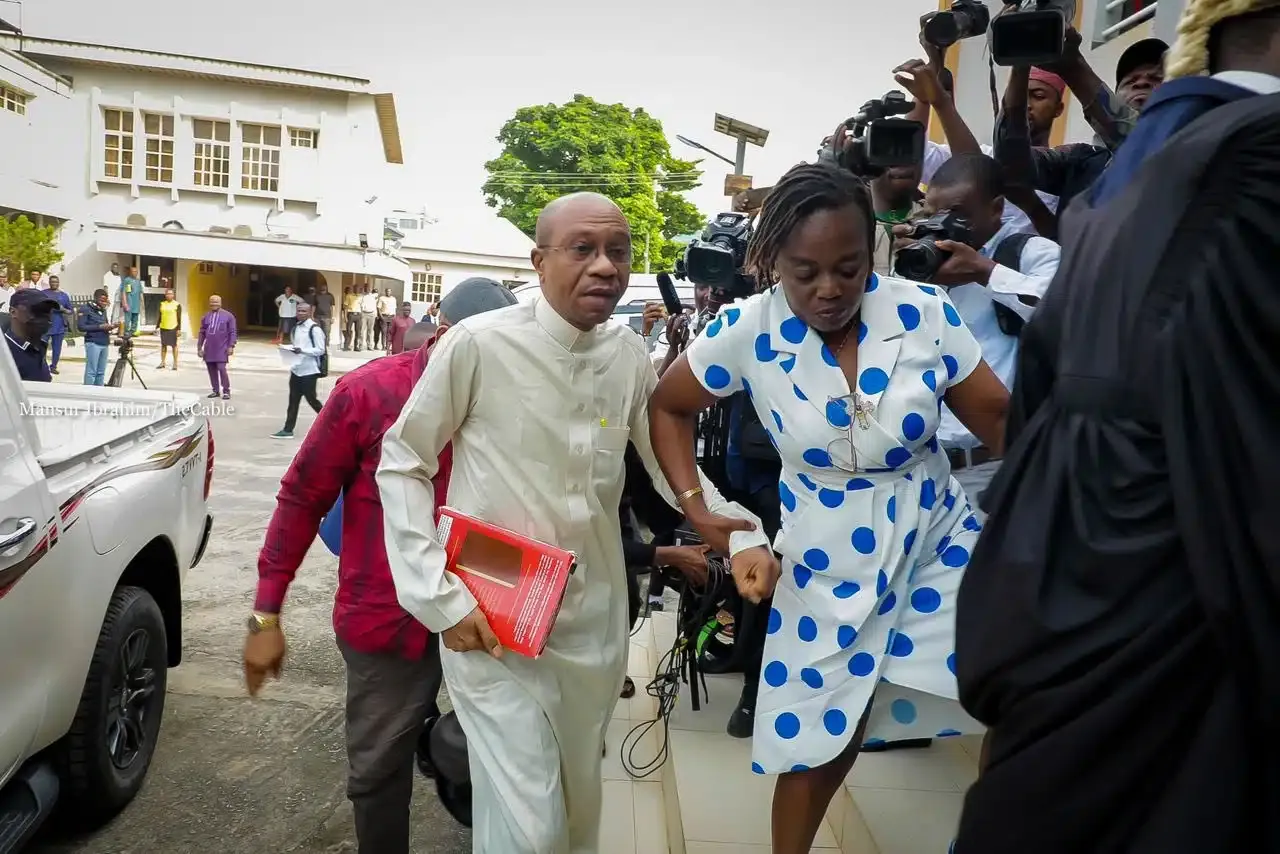
The Federal Government will on Thursday arraign suspended Central Bank of Nigeria (CBN) Governor, Godwin Emefiele, and his associates for N6.9 billion procurement fraud at the Federal Capital Territory (FCT) High Court in Abuja. Emefiele will be arraigned alongside a female CBN employee, Sa’adatu Yaro and her company, April1616 Investment Limited on 20 charges of procurement fraud, conspiracy and conferring corrupt advantages on his associates. The embattled apex bank chief, who has been in detention since he was suspended from office on June 9, 2023, was accused of conferring corrupt advantages on Yaro, a director in April 1616 Investment Ltd. The offence is contrary to Section 19 of the Corrupt Practices and Other Related Offences Act 2000. The section read, “Any public officer who uses his office or position to gratify or confer any corrupt or unfair advantage upon himself or any relation or associate of the public officer or any other public officer shall be guilty of an offence and shall on conviction be liable to imprisonment for five years without an option of fine.’’ In the charges signed by the Director of Public Prosecutions, Federal Ministry of Justice, Mohammed Abubakar; Deputy Director, Public Prosecution, Mrs Nkiru Jones-Nebo and eight other ministry officials, the three accused persons were alleged to have bought a fleet of over 98 exotic vehicles and armoured buses valued at about N6.9bn. Some of the vehicles bought between 2018 and 2020 included 84 Toyota Hilux vehicles, 10 armoured Mercedes Benz buses, three Toyota Landcruisers and one Toyota Avalon car. Count one read, “That you, Godwin Ifeanyi Emefiele, male, adult, sometime in 2018 within the jurisdiction of this honourable court did use your position as Governor of the Central Bank of Nigeria to confer a corrupt advantage on Sa’adatu Ramallan Yaro, a staff member of the Central Bank of Nigeria by awarding a contract for the supply of 37 (Nos.) Toyota Hilux Vehicles at the cost of N854,700,000 only to April 1616 Investment Ltd, a company in which she is a director and thereby committed an offence. “Statement of the offence: Conferring corrupt advantage contrary to section 19 of the Corrupt Practices and Other Related Offences Act 2000.’’ The Federal Government further accused Emefiele of conspiracy to confer corrupt advantage on the second defendant contrary to sections 26 (c) and 19 of the Corrupt Practices and Other Related Offences Act 2000 and punishable under Section 19 of the same Act. “That you, Godwin Ifeanyi Emefiele, male, adult, Sa’adatu Ramallan Yaro, female, adult, and April 1616 Investment Ltd, sometime in 2019 within the jurisdiction of this Honourable Court did conspire amongst yourselves to use the office of Mr. Godwin Ifeanyi Emefiele as Governor of the Central Bank of Nigeria to confer a corrupt advantage on Sa’adatu Ramallan Yaro, a staff of the Central Bank of Nigeria by awarding a contract for the supply of 1 (No.) Toyota Landcruiser V8 at the cost of N73,800,000 only to April 1616 Investment Ltd,” the charge stated. Emefiele was said to have also conferred a corrupt advantage on Yaro by awarding a contract for the supply of one Toyota Avalon at the cost of N99.9m to her company, April1616 Investment Ltd., in 2019. The suspended governor was also accused of awarding a contract for the supply of another Toyota Landcruiser V8 for N77.050m to the third defendant in 2018. The ex-CBN governor was said to have conspired with Yaro to confer corrupt advantages on the CBN staffer by awarding to her a contract for the supply of two Toyota Hilux Shell specification vehicles at the cost of N44.2m sometime in 2020. Emefiele was further alleged to have awarded another contract to Yaro and her firm for the purchase of one Toyota Landcruiser VXR valued at N96m in 2020. Yaro was similarly accused of fraudulent acquisition of property for getting a contract from the CBN for the supply of 47 Toyota Hilux vehicles at the cost of N1,085, 700,000 and thereby committed a punishable offence. Other counts read, “That you, Sa’adatu Rammala Yaro, female, adult, sometime in 2018 within the jurisdiction of this honourable court while being employed at the CBN knowingly held directly a private interest as director in April1616 Investment Ltd., in a contract awarded to the said company, for the supply of 47 Toyota Hilux vehicles at the cost of N1,085, 700,000 and thereby committed an offence.’’ Count 11, “That you, Sa’adatu Rammala Yaro, female, adult, sometime in 2018 within the jurisdiction of this honourable court while being employed at the CBN knowingly held directly a private interest as director in April1616 Investment Ltd., in a contract awarded to the said company, emanating from the CBN where you are employed, for the supply of 10 Mercedes Benz armoured buses at the cost of N2,222, 500,00 and thereby committed an offence.’’ Listed as witnesses against the defendants were the CBN Director of Procurement, Stanley Alvan; CBN Head of Procurement, Mike Agboro, Tahir Jafar, David Usman and “any other witnesses to be supplied later in the additional proof of evidence.’’