Tinubu Constitutes Boards of NADF, Bank of Agriculture, and UBEC

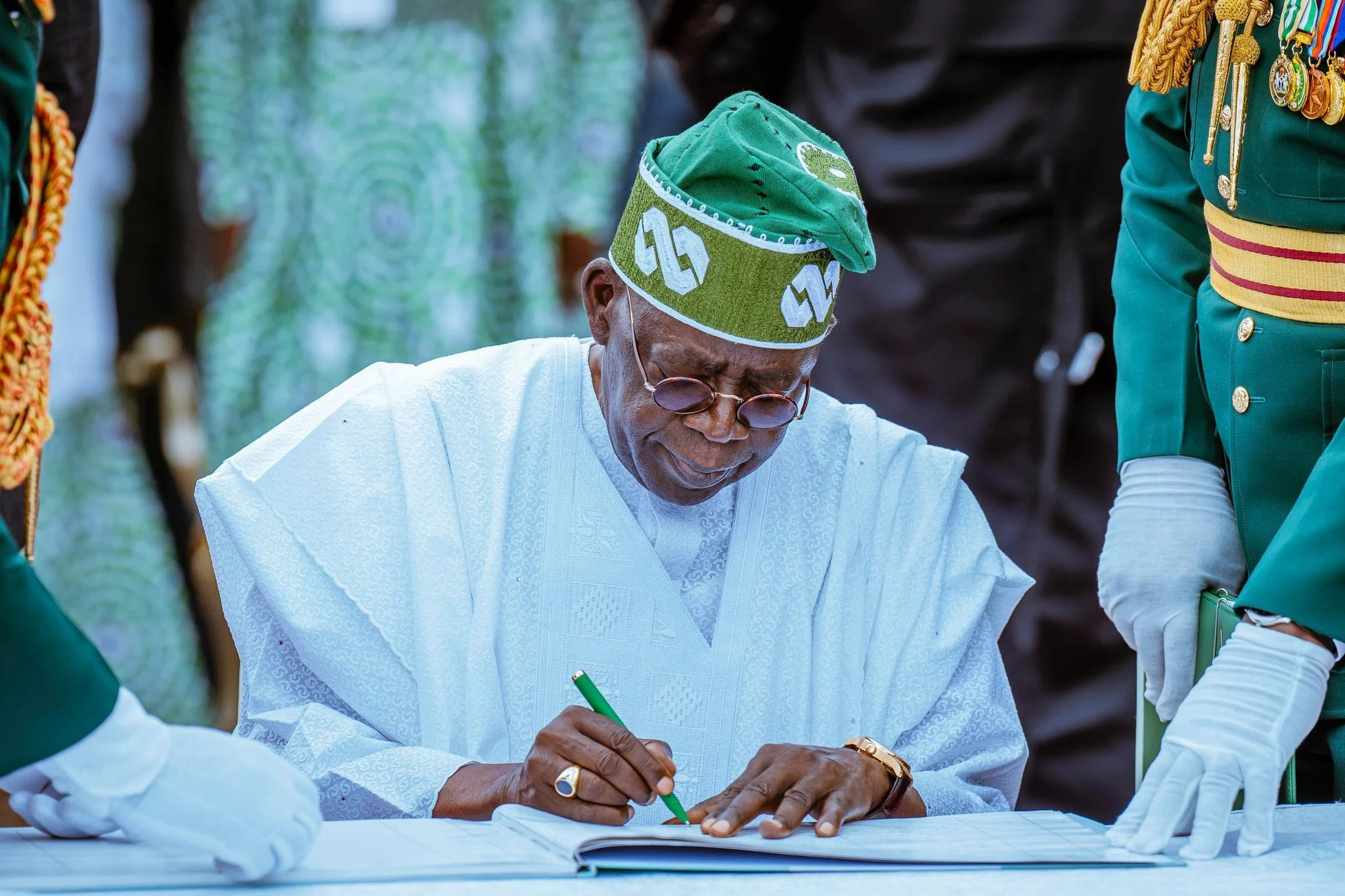
President Bola Ahmed Tinubu has approved the constitution of the governing boards of the National Agricultural Development Fund (NADF), the Bank of Agriculture (BOA), and the Universal Basic Education Commission (UBEC). The announcement was contained in a statement by Bayo Onanuga, Special Adviser to the President on Information and Strategy. At the UBEC, Senator Umaru Tanko Al-Makura, earlier appointed in July, will continue to serve as chairman of the board. Other members include Uchendu Ikechi Mbaegbulem (South East), Gift Ngo (South South), Mrs. Ibiwunmi Akinnola (South West), Dr. Meiro Mandara (North East), Dr. Abdu Imam Saulawa (North West), and Professor Paul Ibukun-Olu Bolorunduro (North Central).Each member will serve a four-year term in the first instance. For the Bank of Agriculture (BOA), President Tinubu confirmed the appointments of Muhammad Babangida as chairman and Ayo Sotinrin as managing director. He also approved the appointments of three executive directors and five non-executive directors representing Nigeria’s six geo-political zones. The executive directors are:• Fatima Garba (Sokoto) — Executive Director, Corporate Services• Ka’amuna Ibrahim Khadi (Borno) — Executive Director, Risk Management and Strategy• Hakeem Oluwatosin Salami (Kwara) — Executive Director, Operations The non-executive directors include Aminu Malami Mohammed (North East), Charles Amuchienwa (South East), Oladejo Odunuga (South West), Rabiu Idris Funtua (North West), and Kochi Donald Iorgyer (North Central). In the National Agricultural Development Fund (NADF), the President reaffirmed the appointment of Muhammad Abu Ibrahim as Executive Secretary and CEO, while constituting a new board to support the agency’s mission of expanding access to affordable agricultural finance. Mallam Bello Maccido, pioneer chairman of FBNQuest Merchant Bank Limited and a veteran of over 30 years in financial services, will chair the NADF board, representing the North West. Other members include:• Dr. Nelson Henry Essien (Akwa Ibom, South South)• Amina Ahmed Habib (Jigawa, North West)• Engr. Akinyinka Olufela Akinnola (Ondo, South West)• Hassan Tanimu Musa Usman (Borno, North East)• Lufer Samson Orkar (Benue, North Central)• Felix Achibiri (Imo, South East). Achibiri is the Group Director of Genesis Energy Holdings and Chairman/CEO of DFC Holdings Limited. The new boards are expected to strengthen institutional performance, deepen accountability, and enhance national development outcomes in education, agriculture, and rural financing.

President Tinubu’s Multi-layered Communication Team: A genius contraption or Disaster in the making: Only Time Will Tell

Wale Alonge, Dadeland, Miami, US-based Nigerian writer and political commentator.

When President Tinubu started his first day in Aso Rock with the bold or what many would consider a bone-headed political Kamikaze move of removing oil subsidy, and then proceeded with his excruciatingly painful economic and structural reform agenda, he made a decision that has put his presidency on an irreversible trajectory that will either seal his place as the transformational leader Nigeria has waited for or a catastrophic disaster. He locked himself into that irreversible trajectory, when unlike all his predecessors, he took what many have considered the Nigeria equivalent of the kiss of death by withdrawing the oil subsidy and floating the currency.Nigerians have taken it as their citizenship right and as the only benefit accruable to them from the corruption-ridden national oil reserve, access to cheap oil. To take that away from them was like taking away a child’s only Christmas toy. Since the Arab oil embargo fueled oil boom of 1973 when the god of crude oil smiled on Nigeria with massive inflow of petrodollar which unfortunately the country’s young president General Gowon knew not what to do with it, Nigerians have measured the health of their economy by the value of their heavily subsidized and overvalued local currency even though it was not backed by any measurable productivity to justify its valuation. We all now talked with great nostalgia of the era when our Naira exchanged for twice the dollar as if it were the apogee of economic genius, when in fact it led to the kind of insane conspicuous consumption which saw Nigerians clogging Heathrow airport runway with our useless imports. We spent money like a drunken sailor who just won a lottery jackpot. While it was obvious to everyone that artificially juicing and propping our currency was hemorrhaging life out of our economy, yet no president until Bola Tinubu had the courage to withdraw the addictive heroin from the dying drug addict. Floating the Naira exchange rate and in the process pauperizing the citizen was therefore another third rail of Nigerian politics that President Tinubu was courageous enough to touch. To do one was bad enough, but to do both, that is remove the oil subsidy, and at the same time float the currency was a political equivalent of jumping off the cliff of Mount Kilimanjaro without a parachute. It is for that precise reason that every Nigerian president for decades has promised to remove the oil subsidy but have chickened out even as everyone knew it was the bitter pill Nigerians had to swallow to stop the insane plunder of our commonwealth but a small but powerful oil mafia. This explains why President Tinubu has become one of the most divisive political figures in Nigeria history, who is virulently hated and despised by his detractors, and beloved by his loyalists and those who believe in him. With President Tinubu you either hate or love him. Many have compared him to blood thirsty Abacha while others have lost their minds to the point of equating him to genocidal Hitler. Whether you like or hate President Tinubu and yes, we may argue whether or not his reform policy could have been better deployed, or whether he could have taken more time to properly put in place palliative measures to ameliorate its excruciatingly painful impact, however, no rational or objective analyst will deny that President Tinubu deserves the presidential medal of courage for putting the country’s future above his political calculus. If anyone has wondered why I have been unwavering and unapologetic in my support for the President, that exactly is the reason, his political courage to do the unpopular and to risk his political career if that was the price. I have never met the President nor anyone in his circle, however, I believe in his reform policy as the necessary painful therapy our country needs. Our country desperately needed the very painful reform that President Tinubu has taken on if we were to have any chance to dig our country out of the economic grave it was in. A grave many past presidents have dug deeper and deeper to the point of no return. PLEASE READ: TINUBU SUBMITS INEC REC NOMINEES TO SENATE As a member of the baby boomer generation who enjoyed the stupendous prosperity of the heady days of the oil boom of the 1970s, when a college degree was a ticket to the middle class, I believe the last act of our generation, was to make this one last sacrifice to patch up this country whose huge potential we frittered away, to give the next generation a fighting chance of salvaging a livable country from the mess we have made of it. Regrettably, members of the same baby boomer generation who bear much culpability for the mess our country is in, are also the most vociferous in opposing President Tinubu’s reform agenda to salvage it. So, readers might ask, what is the connection between the presidential communication architecture and his economic reform agenda? A lot. One of the major mistakes President Tinubu made which has done so much damage to his bold economic reform agenda was his failure to have a presidential communication team in place at its launch, that was up to the challenge of selling it especially since they knew it was going to impose so much excruciating pain on the citizens. That mistake has turned out to be a costly error for this presidency especially in a fast-moving social media era where bad news travel at the speed of light, shaping perceptions along its path. Social media with its information overload has unfortunately made us less contemplative and more susceptible to perception manipulation which are often hard to shake off. It is easy to get the policy right and yet lose it all with a poor communication infrastructure. That has been the Achilles heel of this presidency as it has embarked on some of the toughest, excruciatingly painful but much needed economic reform agenda. It was

Still on the Guardian Newspaper Editorial Board faux pas

Wale Alonge, Dadeland, Miami, US-based Nigerian writer and political commentator.

The Guardian Editorial Board’s recent article on President Tinubu’s excruciatingly painful economic reform policies and the call for military intervention and the response by the presidency sent shockwave through the polity. The Guardian is the icon of Nigeria print journalism. Mr. Bayo Onanuga, the spokesman for the presidency is undoubtedly one of the most respected in the journalistic business. Hence, beyond the merits of the argument for or against the journalistic propriety of the Guardian’s article in question, let me sincerely thank Mr. Bayo Onanuga for reminding us all of the lost great tradition of excellence in penmanship, the economy of word, analytical logicism, and the succinctness that once characterized the best of journalism in our country. Sadly, today that tradition has all but become a rarity. Some of the best in the business now routinely feed us long, unwieldy, incoherent, incomprehensible, emotion-laden, illogical, mumbo jumbo maze of word salad that is a torturous to go through. We are routinely fed with long articles that go on and on with Yoruba folklores, long tales, simile, metaphor, personification, hyperbole, irony, alliteration, onomatopoeia, and puns that are best left for comedic drama performances than journalism. I have often wondered whether today’s journalists including our brothers in the Tribune are compensated based on their word counts as opposed to the logic and journalistic excellence of their posts. What is mind-numbing, bewildering and frustrating is that both the Tribune and Guardian were once the flagship of excellence in journalism that many of grew up to know. Many of us develop a love for writing, from reading mesmerizingly beautiful prose in the Guardian, and the Tribune. Sadly, the same cannot be said today, of these great journalism icons for inspiring the next generation. Now to Mr. Bayo Onanuga’s rebuttal to the Guardian article. He is totally on point that the Guardian could have made the points it intended to make in the article, that is the misery and suffering being imposed on the populace by the policies of the Tinubu’s regime without leading with the call for military intervention. Even a first year student in journalism school knows that no part of an article receives more critical attention than the headline. That the headline/title is the most important part that conveys in few attention catching phrase, the intent of the article. The Guardian editorial board knew what it was doing when it chose the headline “Calls for military intervention: misery, harsh policies driving Nigerian military desperate choices”. It was nothing but a tacit acquiescence to the propaganda by a fringe population particularly in the north, who are advocating for military intervention as a way to regain what they perceive as their stolen birthright to rule the country in perpetuity no matter how incompetently and disastrously they have done so for decades. In the age of social media of X-Twitter, Instagram and the associated information overload, which has shrunk our attention span to nanoseconds, headlines have taken on much more importance than at any time. Most readers now routinely scan through news headlines without reading the body of the article. It is therefore the height of journalistic malpractice for the Guardian to lead with military take-over headline despite its tepid denunciation of military take-over. Yes, our country is going through arguably the most excruciatingly painful span of economic hardship and suffering in a generation, however, no objective analyst will pin the entire culpability for it on the less than 18 months old regime of President Tinubu. More importantly no rational thinking person, especially anyone who understands that the origin of our national disaster and dysfunction, including the apocalyptic Biafra war in which Nigerians turned deadly weapon against one another, could be traced to the military intervention in our nascent experiment with democratic governance during the first republic. Yes, our experience with democracy since 1999 has fallen woefully short of our expectations and has in fact left many of us despondent. Nonetheless, it is criminally irresponsible for any journalist, especially from an iconic flagship like the Guardian to even be remotely associated with advocating or justifying military intervention. What is so troubling is that this is not an isolated event. We have witnessed many highly respected journalists including and especially many highly influential Yoruba opinion writers, who have sought to normalize and whitewash the reprehensible, blood curling, ignominious murderous Abacha regime by equating the Tinubu presidency with that regime. We have highly placed Yoruba who have dropped the name of Hitler in the same sentence describing the Tinubu regime. We all must condemn in the strongest term this attempt by influential journalists from the Southwest to normalize evil and justify military intervention. The worse democratic government is better than the most benevolent military juntas. The antidote to a bad democratic government is not to sell our suffrage for a pot of military porridge, but to seek a change thorough the electoral process. President Tinubu was explicitly upfront with the electorate about what he would do if they gave him the presidency. He told everyone of us that he would remove the criminal fuel subsidy, and float the currency. He also alerted the citizens that his policy prescriptions would impose excruciating pain to the citizens, albeit temporarily, with a promise of a big pay-off at the end of the pain. The president went a step further doing what many political consultants would consider a kiss of death, by telling the people not to vote for him should his reform policies fail to deliver on its promise.Yet, less than two years to his presidency some irresponsible journalists are already joining the wacko crowd mostly from the north, to slyly advocate for military intervention by speaking from both sides of the mouth. That is totally unacceptable. It is journalism at its worst form. It must be roundly and unequivocally condemned by everyone.

On protracted overseas stay: Tinubu can go anywere he desires – Presidency

President Bola Ahmed Tinubu’s recent travels from the UK to France have sparked public reactions, especially given Nigeria’s current economic situation. After spending nine days in London, Tinubu is now heading to France for undisclosed engagements. Many Nigerians have voiced concerns on social media about his continued absence from the country. Responding to the criticism, the President’s Special Adviser on Information and Strategy, Bayo Onanuga, reacted that Tinubu has the right to travel for personal reasons and official business, as his two-week leave allows him the freedom to move as he chooses. Onanuga in a post in his X handle wrote: “President Tinubu is on leave for two weeks. He is not restricted to the UK.“It is his private time. He can go anywhere he so desires.“He is still observing his leave.”

Tinubu Makes 7 New Appointments  

President Bola Ahmed Tinubu has approved the appointment of seven executive directors for the Nigerian Television Authority (NTA).   This was made known in a statement released on Friday and signed by the President’s Special Adviser on Information and Strategy, Bayo Onanuga.   They are:   1. Ayo Adewuyi — Reappointed Executive Director, News.   2. Bar. Ibrahim Aliyu — Executive Director, Special Duties – Legal Practitioner   3. Malam Muhammed Fatuhu Mustapha — Executive Director, Administration and Training   4. Mrs Apinke Effiong — Executive Director, Finance. An expert in financial marketing with treasury, management accounting and reporting skills.   5. Mrs Tari Taylaur– Executive Director, Programme. An audio/visual creator, producer and showrunner.   6. Mr Sadique Musa Omeiza – Executive Director, Engineering   7. Mrs Oluwakemi Fashina – Executive Director, Marketing. An integrated marketing communications professional and chartered marketer  

Coca-Cola Company announced plans to invest $1 billion in Nigeria over the next five years.

President Tinubu’s spokesperson, Bayo Onanuga made the claim in a statement released after Coca-Cola met with President Tinubu.   The statement reads: “President Bola Tinubu has reiterated his administration’s commitment to creating a robust financial system and a business-friendly economy that will attract more foreign direct investments.   “The President made the commitment on Thursday in Abuja, as the Coca-Cola Company announced plans to invest $1 billion in Nigeria over the next five years.   “The announcement was made at a meeting between the President and the global leadership team of Coca-Cola Company, led by Mr John Murphy, its president and chief financial officer, and the Chairman of Nigerian Bottling Company, Ambassador Segun Apata.   “President Tinubu commended Coca-Cola for its long-standing partnership with Nigeria and for promoting investment opportunities that have employed over 3000 people across nine production facilities.   ”We are business-friendly, and as I said at my inauguration, we must create an environment of easy-in and easy-out for businesses.   ”We are building a financial system where you can invest, re-invest, and repatriate all your dividends. I have a firm belief in that,” he said.   “President Tinubu told the delegation that private sector partnerships, which sustain investments, are central to his government’s far-reaching reforms to improve the business environment.   “He pledged that the government would continue partnering with Coca-Cola to expand investments in Nigeria and address environmental issues, including climate change.   ”The size of this country is enormous in Africa, and the consumption capacity of Nigeria is expanding daily,” President Tinubu added while commending the company for scaling up its skill development and community initiatives as part of its corporate social responsibility.   Presenting an overview of Coca-Cola’s business in Nigeria, Murphy noted that the company generates N320 billion annually through nearly 300,000 customers and contributes almost N90 billion in revenue to the Nigerian government.   ”We are very proud of the growth of the business over a long period and its impact on the daily lives of many Nigerians.   ”Beyond the financial impacts, we are also very committed to supporting the communities, and over the last number of years, we’ve had a special focus on several areas in the world of sustainability, water packaging and others, ” he said.   Mr Zoran Bogdanovic, CEO of Coca-Cola Hellenic Bottling Company, explained that the company’s confidence in Nigerian government policies had encouraged it to make the $1 billion investment pledge.   ”Mr President, in your inaugural address, we were very pleased to hear of your invitation for foreign investors to invest and your assurance that foreign businesses can repatriate dividends and profits.   ”That assurance gives us the confidence to continue our investments. Since 2013, we have invested $ 1.5 billion in Nigeria in capacity expansion, transformation of our supply chain infrastructure capabilities, training and development.   ”I am very pleased to announce that, with a predictable and enabling environment in place, we plan to invest an additional $1 billion over the next five years.   ”We believe Nigeria’s potential is tremendous, and we are committed to working with the government to realise this potential.”  

Atiku’s Ex-aide, Daniel Bwala To Become Tinubu’s New Spokesperson

Without any last minute changes, an ex-aide of PDP Presidential candidate, Abubakar Atiku, in the person of Daniel Bwala will be announced as the new spokesperson of President Bola Ahmed Tinubu. This is coming barely a week after Ajuri Ngalale went on an indefinite leave of absence due to ‘family health issues’ which indicated either a resignation or dismissal from his job as the President’s spokesperson. According to sources privy to this information, President Tinubu will announce the appointment of Daniel Bwala in the next one or two weeks after he returns to Nigeria. Although Daniel Bwala worked with PDP in the last election, he has since switched camp to the All Progressive Congress and has been seen with President Tinubu in Nigeria and overseas. The source made it known that Bwala’s job for Atiku was an agreement that was bound to expire after the court case. Recall that Bwala was with All Progressive Congress (APC) before he joined PDP during the election campaign period. Meanwhile, many are of the opinion that Bayo Onanuga would be the best fit for the position since he has been actively working in that capacity. Although Bayo Onanuga would not be a bad option for Tinubu, considering the fact that he has been close to be president for decades and has successfully operated PM News as a media company but the source revealed that President Tinubu isn’t interested in having Onanuga occupy the vacant position of his spokesperson because he is Yoruba. It is worthy of note that President Tinubu has been accused of neglecting other tribes in his appointment apart from people who are Yorubas just like him. This is the reason Bayo Onanuga would not be selected to fill the position of a spokesperson. According to the source, the appointment is a done-deal for Daniel Bwala as agreement has been made between the President and the former PDP chieftain. It was revealed that in a situation where Bwala doesn’t eventually become the spokesperson, he will be duly compensated with a higher position.

LG Autonomy: Presidency Attacks Peter Obi For Not Commenting On Supreme Court Ruling 

By Doris Isreal Ijeoma Presidential aide, Bayo Onanuga has slammed the 2023 Labour Party (LP) presidential candidate, Peter Obi, over his silence since the Supreme Court gave its ruling granting financial autonomy to Local government areas. Speaking via his account on Friday Night, Onanuga claimed that Obi’s silence shows he is only quick to tweet unverified news about President Bola Tinubu and Nigeria. He insisted that a good opposition must be sincere enough to praise his political opponent when he carries out a great deed. Onanuga urged the former Anambra governor to break his silence and acknowledge Tinubu’s efforts in making Nigeria great. He wrote, “Why is Peter Obi silent? “More than 36 hours after the Supreme Court gave a landmark ruling, granting financial autonomy to Nigeria’s 774 local councils, Mr. Peter Obi, the defeated Labour Party candidate, has yet to utter a word on the epochal judgment. His silence confirms the belief that he is always quick to tweet unverified news about the Tinubu administration or our country. “A good opposition statesman must be candid enough to applaud his political opponent when he has done some great deed. The Tinubu administration has succeeded in giving life back to our emasculated councils, using the instrumentality of the law. Even Atiku Abubakar has grudgingly admitted this. But Peter has been silent. He should break his silence and acknowledge that President Tinubu is making a great Nigeria possible.’’

Presidency Reacts To Supreme Court Ruling On Local Government Autonomy

The presidency has reacted to Thursday’s victory against 36 state governors at the Supreme Court on local government autonomy. The Supreme Court ruled that all federal allocations for local government councils should be paid directly into their accounts. In Nigeria, most states operate a joint account with local governments, Justice Emmanuel Agim, who led a seven-member panel of justices, said local government allocation should be paid directly to a separate account belonging to each local government. The federal government through the Attorney-General and Minister of Justice, Lateef Fagbemi (SAN) approached the Supreme Court, in a suit, marked SC/CV/343/2024, and sought that 36 governors of the federation grant full autonomy to the 774 local governments. Giving details of federal government’s prayer in the suit, Special Adviser to President Tinubu on Information and Strategy, Bayo Onanuga, on his X handle on Thursday, wrote, “The details of the Supreme Court ruling giving 774 local councils financial autonomy “The Supreme Court ruled on Thursday that all federal funds for local government councils should be paid directly into their accounts. “Justice Emmanuel Agim, who led a seven-member panel of justices, delivered the judgment in a suit filed by the federal government against the 36 state governors. “According to the judgment, henceforth, no more payments of local government area allocations will be made to state government accounts. The court also prohibited the governors from receiving, tampering with, or withholding funds meant for local governments. “Furthermore, the court barred the governors from dissolving democratically elected officials for local governments and deemed such actions a breach of the 1999 Constitution. “The federal government had approached the Supreme Court with a suit seeking to compel the governors of the 36 federating states to grant full autonomy to local governments in their domains. The suit, marked SC/CV/343/2024, was filed by the Attorney-General of the Federation and Minister of Justice, Lateef Fagbemi (SAN), on behalf of the Federal Government. “The Federal Government accused the state governors of gross misconduct and abuse of power in its suit, which was based on 27 grounds. In the originating summons, the FG prayed the Supreme Court to make an order stating that funds standing to the credit of local governments from the Federation Account should be paid directly to the local governments rather than through the state governments. “The justice minister also requested an order restraining governors, their agents, and privies from receiving, spending, or tampering with funds released from the Federation Account for the benefit of local governments when no democratically elected local government system is in place in the states. “Finally, the Federal Government sought an order stopping governors from constituting caretaker committees to run the affairs of local governments, contrary to the constitutionally recognized and guaranteed democratic system.”