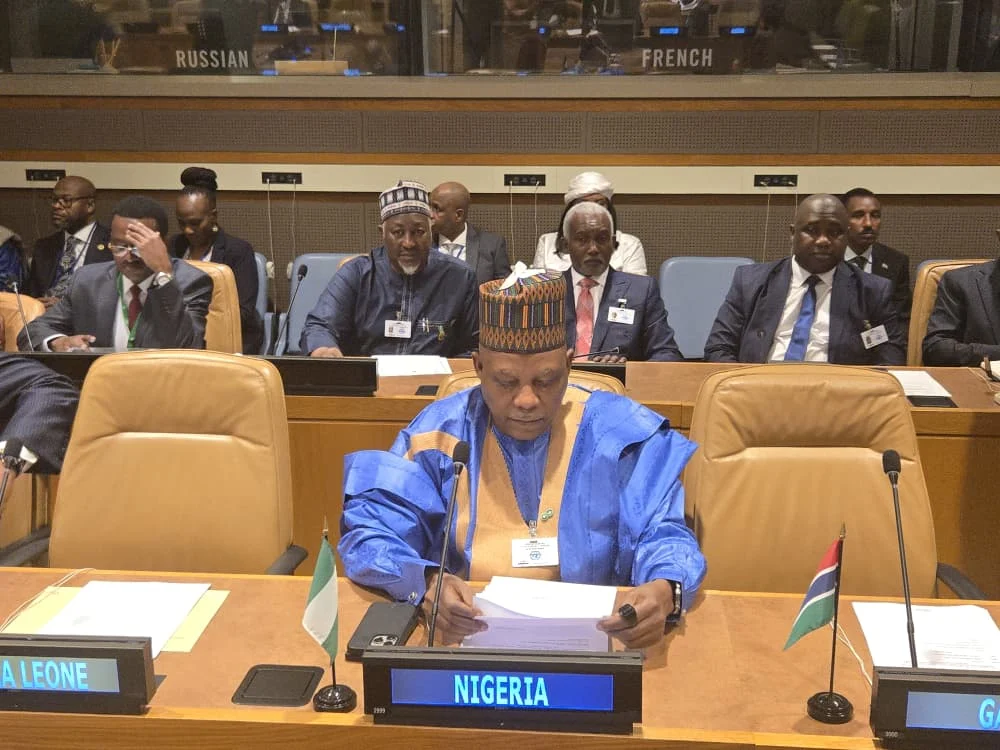
Tinubu Urges Bold UN, Financial Reforms at UNGA80

President Bola Ahmed Tinubu has called for sweeping reforms to restore the credibility of the United Nations and global financial systems, urging world leaders to adapt institutions to present-day realities. Speaking through Vice-President Kashim Shettima at the 80th United Nations General Assembly (UNGA80) in New York, Tinubu said the world could not afford “the luxury of inaction” in the face of conflicts, climate change, debt crises, and widening inequality. “The United Nations will recover its relevance only when it reflects the world as it is, not as it was,” Tinubu declared, arguing that Nigeria deserves a permanent seat on the UN Security Council. He noted that while Nigeria was a colony of 20 million when the UN was founded in 1945, it is now a sovereign state of more than 236 million, projected to be the world’s third most populous country. He outlined four priorities for change which includes: a) Security Council Reform: that is it’s expansion to reflect current global realities, including Nigeria’s representation. b) Debt Relief and Fair Financing: as a new binding mechanism for sovereign debt management, “an International Court of Justice for money.” c) Resource Equity: by ensuring mineral-rich countries to benefit directly from their resources through local processing and jobs, and; d) Closing the digital divide as a global initiative to expand technology access, declaring that “A.I. must stand for ‘Africa Included.’” Reaffirming Nigeria’s commitment to peace, Tinubu highlighted the country’s participation in 51 of 60 UN peacekeeping operations since 1960. He also backed a two-state solution in Palestine, saying the right to life “should not be trapped in the corridors of endless debate.” On regional security, he warned against terrorism and extremism, describing them as threats that prey on division and undermine human dignity. Tinubu further described climate change as a pressing security concern tied to migration, instability, and inequality, urging the UN to channel climate funds into education, resilient housing, and community development. Referencing Nigeria’s ongoing economic reforms, including subsidy removals and currency adjustments, Tinubu acknowledged the hardship but said they were necessary steps to unlock growth and attract investment. He pointed to the inaugural West Africa Economic Summit held in Abuja as proof of Africa’s potential when innovation and investment intersect. Warning against growing disillusionment with multilateralism, Tinubu said: “We must make real change, change that works, and change that is seen to work. If we fail, the direction of travel is already predictable.” He closed with a reminder of shared responsibility: “For none of us is safe until all of us are safe.”
Shettima knocks Badenoch for Nigeria Comment

“She is entitled to her own opinions; she has even every right to remove the Kemi from her name, but that does not underscore the fact that the greatest black nation on earth is the nation called Nigeria.” The Nigerian Vice President, Kashim Shettima however thinks that considering her exalted position as the leader of the UK Conservative Party, Ms. Badenoch shall have been more measured in her comments and not be so disrespectful to Nigeria. Badenoch, who has Nigerian heritage, recently advocated for stricter immigration measures, citing concerns over the strain on public services and societal balance. Speaking at the Annual Migration Dialogue in Abuja, Shettima addressed her stance, acknowledging her success while rejecting her portrayal of Nigeria. He noted Nigeria’s global significance, emphasizing its growing population and influence. ALSO READ: Filling Stations Reduce Fuel Price As Dangote, Marketers Strike Deal Badenoch’s previous remarks about her childhood in Nigeria have also drawn attention. She described facing corruption and hardship before migrating to the UK, where she pursued better opportunities. While her narrative highlights challenges in Nigeria, Shettima countered by defending the nation’s resilience and potential. He said: “Kemi Badenoch, is the leader of the British Labour or Conservative Party. We are proud of her in spite of her efforts at denigrating her nation of origin. “She is entitled to her own opinions; she has even every right to remove the Kemi from her name, but that does not underscore the fact that the greatest black nation on earth is the nation called Nigeria. “One out of every three, four black men is a Nigerian and by 2050, Nigeria will support the United States, will be the third most populous nation on earth.” It must be noted however, that Ms. Badenoch is not the first highly placed Nigerian yo make such uncomplimentary remark about the country. Shettima’s principal, President Bola Tinubu is also recorded to have made a remark in the past that he did not believe in one Nigeria.
Senator Kashim Shettima upscales Nigeria’s Human Capital Development Programme

Vice President Kashim Shettima upscales Nigeria’s Human Capital Development (HCD) agenda with the launch of the second phase of the critical development strategy, November 1, Abuja. He inaugurated the second phase, christened as HCD 2.0, during a meeting of the Human Capital Development Programme Steering Committee at the Presidential Villa in Abuja. The launch marks a renewed commitment to enhancing healthcare, education, and economic inclusion across Nigeria, building upon efforts initiated in 2018. Vice President Shettima acknowledged the progress made since the initial HCD 1.0 strategy, which laid essential groundwork to improve Nigeria’s global human capital rankings. Recognizing critical gaps in health, education, and employment, HCD 1.0 united national and state-level stakeholders in a shared goal to strengthen Nigeria’s health and education sectors by 2030. “Today, we are not only assessing our journey but setting a new path with HCD 2.0,” Shettima stated, describing the initiative as more than a program, but rather a “national commitment” aimed at creating a healthier, more educated, and inclusive Nigeria. HCD 2.0 introduces an expanded focus on equitable healthcare access, including digital health solutions, innovative financing, and climate-resilient practices to ensure all Nigerians receive essential services. Another key aspect of HCD 2.0 is bridging the digital divide and advancing financial inclusion, with measures to promote online banking, digital payment systems, and fintech solutions, allowing broader participation in the economy. Shettima emphasized that HCD 2.0’s success relies on support from federal and state leaders, private sector partners, and civil society, urging all stakeholders to embrace this shared vision for a sustainable future.
Human Capital Development: Vice President Shettima Launches HCD 2.0 Strategy

Enam Obiosio In a gathering that underscored Nigeria’s commitment to human capital transformation, Vice President Kashim Shettima recently addressed members of the Steering Committee of the Human Capital Development (HCD) Programme at the State House, Abuja. The event marked the launch of HCD 2.0, a comprehensive strategy aimed at advancing health, education, and economic inclusion for every Nigerian. He emphasized that HCD 2.0 is not merely an initiative but a national commitment to foster a healthier, more educated, and inclusive society. “This day is more than a milestone; it is the beginning of a new phase,” the Vice President declared, highlighting the significance of the new strategy. “We have laid a strong foundation, and now, we officially launch the second phase of the Human Capital Development strategy—HCD 2.0.” This next phase, Vice President Shettima noted, represents a strengthened blueprint and a vision for Nigeria’s future that addresses the evolving challenges in healthcare, education, and economic inclusivity. Vice President Shettima recounted the journey leading up to this moment. In 2018, Nigeria faced a stark reality when its global ranking in human capital development revealed significant deficits in health, education, and employment. To counter these challenges, the Nigerian government introduced HCD 1.0, establishing foundational structures and rallying stakeholders from across the nation in pursuit of a unified goal: a healthy, educated, and productive Nigeria by 2030. The HCD 2.0, however, is designed to build upon this groundwork by adapting to the rapidly shifting global landscape. The strategy seeks to establish an equitable healthcare system, promote inclusive education, and ensure financial accessibility. “Our aim is to ensure that no Nigerian is left behind as we move toward a more inclusive, sustainable society,” he said. One of the core pillars of HCD 2.0 is creating a modern, equitable healthcare system accessible to all Nigerians, regardless of their location or economic circumstances. Vice President Shettima also ighlighted the introduction of digital health platforms, innovative financing, and climate-resilient practices as essential components of this improved healthcare model. “We envision a system that reaches every Nigerian,” he affirmed. Education remains another key focus. He emphasized that HCD 2.0 aims to foster a functional education system with a strong emphasis on digital literacy, gender equity, and financial accessibility. By prioritizing Science, Technology, Engineering, and Mathematics (STEM) education, technical and vocational training, and practical skills, the government is preparing Nigerians for a world increasingly driven by technology and green industries. With the rise of digital economies, HCD 2.0 seeks to bridge Nigeria’s digital divide and boost financial inclusion nationwide. Through fintech solutions, online banking, and digital payment systems, the government is creating pathways for every Nigerian to actively participate in the economy. “Our approach encompasses cross-cutting themes that are essential to the long-term impact of this programme,” Vice President Shettima remarked, emphasizing the interconnected nature of health, education, and economic inclusion. A critical component of HCD 2.0 is its broad governance framework, designed to foster collaboration between federal and state leaders, private sector partners, civil society, and development agencies. He affirmed that the Steering Committee, chaired by himself and including prominent public and private sector leaders, would oversee the implementation and ensure the efficient rollout of the strategy. Vice President Shettima lauded the contributions of the Core Working Group, the Private Sector Partners Group, and the National Champions Forum—a coalition including traditional rulers, youth ambassadors, and advocates for human capital development. Together, these groups will monitor progress, inspire engagement, and work tirelessly to deliver measurable results. As Nigeria inaugurates HCD 2.0, the Vice President set forth ambitious yet attainable targets. By 2030, Nigeria aims to rank among the top 80 countries on the Human Capital Index, reaching a score of 0.6. “These metrics represent more than just numbers; they signify real change in the lives of our people,” he said, pointing to improved healthcare access, enhanced educational outcomes, increased employment opportunities, and a more resilient society. Vice President Shettima’s speech was also a call to action for all Nigerians. He urged policymakers, community leaders, and citizens to recognize the stakes and rally behind the HCD 2.0 initiative. “This is our moment to shape the Nigeria we envision,” he concluded, extending a vision of a Nigeria that stands strong, united, and prepared to meet future challenges. As Nigeria embarks on this transformative journey, the HCD 2.0 strategy promises to bring the country closer to a future where every citizen can thrive in a society that values health, education, and economic inclusion. With this initiative, Nigeria reaffirms its commitment to nurturing the potential of its people and securing a legacy of progress and opportunity for future generations.
NEC Directs Waterways and Dams Audit to Tackle Flooding

One of the forward looking decisions taken at the recent 145th meeting of the National Economic Council (NEC) was the order for the audit of all inland waterways. At the meeting presided by the Vice President, Senator Kashim Shettima the federal ministry of water resources and sanitation was instructed to carry out an in-depth assessment of Nigeria’s waterways and dams to manage the challenges posed by frequent floods. This directive, following a NEC meeting led by Vice President Kashim Shettima, reflects the council’s concern over widespread flood damage. Anambra State Governor, Chukwuma Soludo, shared details from the NEC meeting, where members reviewed recent updates from the water resources minister, Joseph Utsev, on ongoing federal interventions. With many regions, especially in the South-East and South-South, heavily impacted by floods, NEC harped on the need to consider these areas in dam construction plans to help manage water flow and act as barriers on main highways near the River Niger. The council also urged state governors who have yet to submit flood management reports to complete this process promptly. A call was made for enhanced emergency response coordination between states and federal authorities, which includes a possible infrastructure resilience plan within the Green Climate Fund to boost national flood response efforts. The devastation from recent floods has been extensive, affecting about 34 states, 217 local governments, and displacing over 740,000 residents. READ ALSO: DEVELOPING INLAND WATERWAYS TRANSPORTATION
Call for new presidential jet for VP Shettima, “Insensitive” – Peter Obi

Labour Party presidential candidate in the 2023 elections, Peter Obi, has criticized a call for a new jet for Nigeria’s Vice President, Kashim Shettima, calling it “insensitive” amidst the country’s economic struggles. The former Anambra state governor stated that Nigeria’s challenges, such as extreme poverty, unreliable power grid, and failing businesses, should be the priority of the country’s leaders and not luxury. He urged leaders to focus on essential trips and prioritize selfless service to uplift Nigeria’s development and welfare. “We are today among one of the eleven worst-governed African nations in the last 10 years. “We are also among the 20 most hungry nations in the world, with our people facing worsening mass poverty, extreme hunger and starvation. “Our nation remains the poverty capital of the world, with our per capita income crashing further from $1700 in 2023 to $1109 this year. Are these not the issues that should be prioritized by committed leaders?” Obi queried. Using Indonesia as an example, Obi stated: “It was not until 2014 that Indonesia, with sustainable economic growth of over 6% annually for the past 10 years, adding about 50% to both her GDP and GDP per capita, decide to buy a Presidential jet, used by both the President and Vice President. “The Vice President travels mostly in the country’s national airline, Garuda Indonesia. And since we have recently undeservedly bought one, it should be used on essential, inevitable trips of the President and Vice President. “I appeal to the President, Vice President, and our public office holders that our present precarious situation calls only for minimal and highly contributory inevitable travels. “It is time to sit down and find solutions to our litany of challenges for the wellbeing of the people and the development of our country. Nigeria will rise again if the leadership can commit to selfless service.”