Food insecurity: Cardoso urges Edun to reconstitute ACGSF Board

The Central Bank of Nigeria (CBN) has urged the Minister of Finance and Coordinating Minister of the Economy, Yomi Edun to urgently reconstitute the board of the Agricultural Credit Guaranty Scheme Fund (ACGSF). The CBN governor issued the communication in a letter dated March 6, 2025 with reference no. CSD/DIR/CON/DCS/023/021. In the letter, the CBN governor also urged the minister to take necessary steps required to retool the Fund in order to intervene in the agricultural value chain. “The absence of a Board has led to delays in policy formulation, approval of key strategic initiatives and the general oversight required it operates optimally in supporting agricultural financing in Nigeria,” the governor stressed. To fill this void, the the apex bank encouraged the ministry to pay up the balance of N28,199,196,000 being its equity stake in the recapitalised share base of N50billion. The Fund is owned 60 percent by the Federal Ministry of Finance (FMF) and 40 percent by the CBN. Out of its allotted share of N30billion, the FMF has paid up N1,800,804,000, leaving a balance of N28,199,196,000. Second, the apex bank also urged the Minister of Finance to expedite the process by appointing individuals to fill up vacancies in the board of the Fund. By provisions of the ACGSF (amended) Act 2019, the FMF is to appoint four directors to the board of the Fund. The Ministry of Finance is to appoint the Chairman of the Fund. The ministry is also to appoint the representative of the Nigerian farmers. Others are the Representative of the Ministry of Finance and representative of the Federal Ministry of Agriculture. The CBN governor explained in the letter that the ACGSF was established via Decree No. 20 of 1977 (now an Act), with the sole mandate to provide guarantee to agricultural loans. The Fund has been without a board since the dissolution of Boards of Agencies of government at the inception of the Tinubu Presidency in May 2023. The CBN regretted that the absence of a board has resulted in “delays in policy formulation, approval of key strategic initiatives and the general oversight required it operates optimally in supporting agricultural financing in Nigeria.”

Naira Depreciates Further, Losing N5 on Monday

As Nigeria’s inflationary trend remains upbeat, lending rate prohibitive, and production tanks, the woes of the Naira persisted, exchanging, N1,665/$1 at the parallel market. The new rate represents a slight five naira fall from N1,660 that it traded at the weekend. This new trend marks another round of depreciation in the unofficial market, reflecting ongoing pressures on the Nigerian currency. In contrast, the official foreign exchange market saw a minor improvement for the Naira, appreciating slightly to N1,534.56 per dollar, up from N1,535 per dollar on Friday. This represents a modest gain of 44 kobo, according to data released by the Central Bank of Nigeria (CBN). The decision of the Federal Government to withdraw subsidy on Petrol and float the naira orchestrated a major headwind that continues to destabilise the Nigerian economic system. Unfortunately, while government officials admonish the suffering mass of Nigerians to be patient, to embark on very ostentatious lifestyles that spur the youth to protest.

1000 CBN Staff Resigned Voluntarily – CBN

In December 2024, around 1000 staff members of the Central Bank of Nigeria (CBN) voluntarily left their positions, as confirmed by Governor Olayemi Cardoso.  Contrary to claims that the departures were forced, the CBN emphasized that the exits were initiated by the staff themselves. During a recent hearing by the House of Representatives Committee, Bala Bello, the CBN’s Deputy Director of Corporate Services, clarified that the decision to leave was part of a restructuring process aimed at improving operational efficiency.  The voluntary exits allowed the bank to realign its workforce to better meet its current needs, especially in light of the global shift toward digitization. READ ALSO: CBN TO SACK 1,000 WORKERS, OFFERS N50BN INCENTIVE PACKAGE The programme was not a response to internal pressure but rather an opportunity for staff members who had reached a career plateau to pursue other ventures.  Some individuals leaving the bank have plans to start their own financial institutions.  The process was opened to all levels, a first in the bank’s history, and those who chose to stay continue their roles without coercion. READ ALSO: Nigeria Inflation Rate Surges Higher, Hits 34.6% The CBN also addressed concerns about the N50 billion in severance benefits for the departing employees, stressing that these payments were part of the regular process for voluntary departures.  The bank has previously carried out similar exercises, though this was the first time the initiative was extended to such a large group. The House committee has pledged to conduct a thorough investigation into the matter. It would be recalled however, that late in 2024, the Central Bank of Nigeria had offered a N50billion incentive targeted at 1000 staff of all cadres. Insider sources revealed however that those targeted were given deadlines to take the offer or get whatever comes their way, meaning they could be sacked.

Reps Push for Urgent Action on Cash Scarcity  

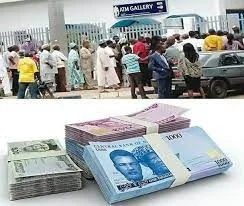
Even as analysts wonder if this was some way of combating spiraling inflation by cutting currency in circulation, the national assembly has urged the Central Bank of Nigeria to take urgent steps to curtail biting cash scarcity. To be precise, the House of Representatives, yesterday called on the apex bank to take swift action to alleviate the growing economic burden on citizens.   During a plenary session, lawmakers emphasized the disruptive effects of the crisis, which has hindered access to funds for daily transactions, leaving many Nigerians stranded.  PLEASE READ: Shettima Knocks Badenoch for Nigeria Comment Rural communities, particularly reliant on cash transactions, have been hardest hit, as they lack alternatives like digital payments.   The current situation stems from a 2022 CBN directive limiting cash withdrawals to N500,000 for individuals and N5 million for corporate entities.  Despite this policy, banks reportedly cap withdrawals at much lower amounts or fail to disburse cash entirely. Meanwhile, Point of Sale (POS) operators seem to have unrestricted access to cash, often reselling it at inflated rates.   Lawmakers voiced concerns about the disconnect between commercial banks and POS agents and called for immediate intervention to prevent the situation from escalating, especially with the festive season approaching.   To address the issue, the House has tasked its Committee on Banking Regulations with investigating the cash shortage and reporting back within a week, while directing the CBN to resolve the scarcity urgently.

Our central bank governor is angry. Really?

Ugo Onuoha is a Nigerian journalist and columnist who writes FINGERPRINTS, a commentary on governance, power and social justice in Nigeria.

OLAYEMI Cardoso is the governor of the Central Bank of Nigeria (CBN). I was made to understand that he came to the job with intimidating credentials. Some of his traducers will dispute this by saying that his hands-on banking experience is thin and that he was essentially a once-upon-a-time chairman of an international bank with only one branch. And that one branch shared a building with the bank’s headquarters somewhere in Victoria Island in Lagos. I think the name of that institution is City Bank. It has to be acknowledged though that it was, still is, a global brand. But Cardoso’s experience, whether thin or thick, did not fetch him the top CBN job. What did it for him was his connection to Nigeria’s president, Alhaji Bola Ahmed Tinubu. He had worked for Tinubu in the president’s previous incarnation as the governor of Lagos state between 1999-2007. Cardoso is not alone in this regard. Virtually everybody who is anybody and who is occupying any significant position in this regime has been a ‘boy’ or acolyte of the president. Cardoso as the CBN governor has done a few other things since he was installed to succeed the former hack who occupied that office. Godwin Emefiele was a disaster who in addition to economic management ineptitude and administrative failings diminished the office of the CBN governor almost beyond redemption. Emefiele, it was, who as a sitting CBN governor made a grab for the presidency of Nigeria. He threw his hat into the ring in the contest for the presidential ticket of the All Progressives Congress (APC) political party. He was a card-carrying though closet member of the ruling party. The man who reappointed him to office for a second term, former president, Maj.-Gen Muhammadu Buhari, said much later that Emefiele did not break any law. Buhari, who turned out to be Nigeria’s affliction, may yet be right but in which sane clime would a serving central bank helmsman dive in such a reckless manner into the murky waters of partisan politics and walk away scot-free. Well, he has not walked away unscatted though he appears to be facing political persecution from Tinubu who appears to feel that the ex-CBN governor threw huddles on his way to Aso Rock Villa through the sudden currency recoloration in the heat of the 2023 campaigns. PLEASE READ: CBN to Sack 1000 Workers, Offers N50bn as Incentive Package Expectedly, Cardoso had his hands full in terms of house cleaning when he assumed office. In addition, he had a couple of petty bills to pay including the backlog of unremitted foreign currency revenues of international airlines. Apart from minor distractions such as the above and occasional claims of accretion to the country’s foreign reserves (up to $40bn now from about $36bn though no mention is ever made of any portion of the sum that may be encumbered), the new sheriff in the apex bank has preoccupied himself solely with raising interest rates. For Cardoso, mindless raising of interest rates with its deleterious effects on other areas of the economy is the only tool in his box to rein in galloping inflation which now stands at over 33% (food inflation is actually about 40%}, and arrest the rapid and precipitous decline in the value of the Naira. The current street value of the Naira is $1/N1,740. For the 2024 national budget the federal government projected that $1USD would exchange for N800. The projection was off target. Even the economically illiterate knew then that the benchmark was a non-starter. The $1/N1,400 provided for in the 2025 budget may still fall through the cracks. In spite of Cardoso’s best efforts in digging in neither inflation nor exchange rate stability has been achieved. And he has been on these for one and a half years. Just like the chief executive officer of the Nigerian National Petroleum Company Limited (NNPCL), Mele Kyari, and the completion of refineries’ turnaround maintenance, Cardoso has missed all the targets he had set for himself on inflation reduction and Naira stability. For a distraction, the CBN governor has turned his attention to populism. Christmas and New Year celebrations are around the corner. Under Emefiele the experience of Nigerians during the festive season in 2023 was both horrible and horrific. To be sure the trauma started from October of that year. Nigerian banks virtually froze the bank accounts of ordinary folks and created a situation where it was easier for a camel to pass through the eye of a needle than for Citizen Ugochi to withdraw any cash from her bank account. In frustration some Nigerians visited their anger at automated teller machines (ATMs) and destroyed a couple of them. Others laid siege to bank premises and held workers hostage. Indeed some bank staff had to use a ladder to scale the fence to escape from the angry mob. We also witnessed situations where customers who managed to force their way into banking halls but could not be availed with desperately needed cash resorted to stripping themselves stark naked as a mark of protest. Of course, the videos of naked bodies with exposed genitalia went viral. The acute cash hoarding by the CBN in connivance with money deposit banks eased up a little soon after the February/March 2023 general elections. But the problem was not addressed in a systematic and deliberate manner. It has lingered on. Getting cash out from the bank accounts of ordinary folks has remained a nightmare for about two years, either from over the counter or from the ATM. PEASE READ: Tax Reform Bills: Tinubu Shuns National Consensus for Radical Policy Proposals Last weekend at the Chartered Institute of Bankers Annual Dinner, Cardoso told Nigerians, probably over mouth full of delicacies, that we should report to the CBN any difficulties in withdrawing cash from bank branches or from ATMs. This must have come as a shock to many ordinary folks because this has been their experience since before Cardoso assumed office. That statement from

CBN to Sack 1,000 Workers, Offers N50bn Incentive Package

Even though 17 directors whose appointments were recently terminated are still in court, the Central Bank of Nigeria (CBN) has initiated an Early Exit Package to eliminate 1,000 employees. Sources close to the apex bank reveal that targeted staff members were given up to December 31, 2024, to either take the offer or grapple with whatever comes their way. The voluntary Early Exit Package (EEP) will cost the bank over N50 billion.   A circular released by the CBN announced that the EEP application is open to staff across all levels, except those with less than a year of service. READ ALSO: CBN Moves to Replace Sacked Directors  The exit date is fixed for December 31, 2024.  Employees opting for the package will receive financial compensation based on their remaining years in service, with additional benefits such as financial planning support and extended healthcare.   As of now, 860 employees have applied for the program, fueling concerns among staff about the impact of the downsizing.  The initiative follows the disengagement of 17 directors earlier this year, whose positions remain vacant.  As of now, the Yemi Cardoso-led bank has not given any clear reason for this purge other than to say that the program presents an opportunity for employees to explore new career paths.   This development occurs at a very crunchy time when many Nigerians are grappling with harsh economic realities precipitated by difficult economic reform policies by the Federal Government. READ ALSO: Layoffs as CBN Sacks NIRSAL MD, other Executive Directors

CBN addresses foreign exchange market pressures

CBN Mulls New Recapitalisation For Banks

By Doris Isreal Ijeoma The Central Bank of Nigeria (CBN) has announced recent fluctuations in the foreign exchange market are largely driven by corporate demand and seasonal summer uptick.  This was disclosed in a statement by CBN on Friday, July 19. The statement reads:”The Central Bank of Nigeria (CBN) wishes to inform the general public that recent movements in the foreign exchange market are driven largely by demand pressure from corporate entities and the expected seasonal uptick during the summer period. “The CBN, therefore, wishes to assure the general public that it has commenced a regular sale of foreign exchange through Authorized Dealer Banks and licensed Bureaux De Change (BDCs) to improve supply in the foreign exchange market in line with its price stability mandate and its commitment to ensure a well-functioning and liquid market. “Over the next few weeks, the CBN will continue to support various segments of the official markets with liquidity. In line with the above, the CBN on Thursday, July 18 and Friday, July 19, 2024, sold a total sum of US$106,500,000.00 (One Hundred and Six Million and Five Hundred Thousand US Dollars Only) to 29 (Twenty-Nine) Authorized Dealer banks between an exchange rate range of N1,498.00/US$1 to N1,530.00/US$1. In addition, it bought US$9,500,000 (Nine Million and Five Hundred Thousand Dollars) from 4 (Four) Authorized Dealer banks at rates between N1,510.00/US$1 and N1,550.00/US$1. The value date for all the transactions is July 19, 2024. “Additionally, the CBN will continue closely monitoring compliance with existing trading rules and regulations by authorized dealer banks to promote ethical conduct and support the drive to achieve stability in the foreign exchange market. Therefore, the general public is advised to direct their foreign exchange demand to their banks and BDC operators in accordance with prevailing market regulations.”

NNPCL, CBN, and Others Assure Nigerians of Imminent Economic Recovery …Nigeria to Become Net Exporter of Petroleum by December

Senate Probes 'One Chance' Victim's Tragic Death, Maitama Hospital Negligence

Critical stakeholders in Nigeria’s economy, including the Nigerian National Petroleum Company Limited (NNPCL) and the Central Bank of Nigeria (CBN), have assured citizens that the nation’s ailing economy is on the path to recovery. This assurance was given during an interactive session held on Monday with joint committees of the National Assembly on Finance. The session, attended by key figures such as the Ministers of Finance, Mr. Wale Edun, Budget and National Planning, Senator Atiku Bagudu, Minister of State Petroleum, Senator Heineken Lokpobiri, NNPCL’s Group Executive Officer, Mela Kyari, and CBN Governor, Mr. Yemi Cardoso, focused on strategies to revitalize the economy. In his presentation, Mela Kyari, Group Executive Officer of NNPCL, informed the committee that Nigeria is set to become a net exporter of petroleum by December. He cited the upcoming commencement of production at the Port Harcourt refinery in early August, followed by the Warri refinery, and the Kaduna refinery by December. Kyari also revealed that Nigeria’s oil production is expected to reach 2 million barrels per day soon, as all necessary measures have been implemented. “Mr. Chairman and members of the Joint Committee, the NNPCL and the oil and gas industry are pivotal in transforming our economic situation. We have seen growth in our oil and gas production due to actions taken by the President and our commitment to enhancing production activities,” Kyari stated. Kyari also highlighted the potential contributions of the Dangote refinery and other smaller producers, expressing confidence that Nigeria will be a net exporter of petroleum products by the end of the year. The CBN Governor Yemi Cardoso, represented by Deputy Governor for Economic Policy Muhammad Sani Abdullahi, addressed the challenges of rising inflation, foreign exchange rate fluctuations, and food inflation. He indicated that these issues are expected to improve soon, based on emerging economic indicators. Also, the Minister of Budget and National Planning, Atiku Bagudu, mentioned that the 2024 budget is already in implementation. He also noted ongoing negotiations with labor leaders on the minimum wage to prevent further economic disruptions. In his response, Senator Sani Musa, Chairman of the Committee, appealed to Nigerians to remain patient as the government works tirelessly to stabilize the economy. “Our interactive session with you, the managers of the economy, is about fostering economic growth and ensuring that our policies benefit Nigerians. The National Assembly is committed to addressing the economic challenges and supporting the President’s efforts to bring stability,” Senator Musa remarked. The Lawmaker also acknowledged the difficulties faced by the economy in recent years and emphasized the need for gradual improvements, urging Nigerians to persevere and support the current administration. “The indicators show that the economy is on the mend. Although inflation remains a challenge, progress is being made, and with time, the situation will improve,” he concluded.

Cardoso Pledges Conducive Atmosphere For Foreign Investments

Cardoso Pledges Conducive Atmosphere For Foreign Investments

Following his confirmation as the Governor of the Central Bank of Nigeria (CBN), Mr. Olayemi Cardoso has said that the CBN will do all within its statutory functions to address identified distortions and ensure a conducive atmosphere for different categories of investors.  He gave the assurance in his office on Thursday, when a group of investors paid him a courtesy visit, noting that under his leadership, the new management team at the Bank will do its best to tackle the impediments to liquidity in the foreign exchange market in Nigeria. While disclosing plans to formally unveil his agenda for the monetary and financial sector in the days ahead, Mr. Cardoso stressed the importance of credibility and transparency in implementing the Bank’s monetary policy. To achieve this, he said the Bank would focus on strengthening its data-gathering system to ensure that only verifiable data will be relied upon for evidence-based decisions. According to him, the CBN would also adhere to rules that are known, acceptable and transparent for the conduct of monetary policy. Speaking further on liquidity management, he said his team had a short-term goal of addressing structural issues within the financial system that gave rise to the liquidity challenge in the first instance.  On the relationship between the monetary and fiscal authorities, the new CBN Governor said there would continue to be consensus between both authorities to harmonise their positions on the interest rate and inflation. He, however, said the Bank would remain open to different views in its push for greater transparency. Meanwhile, Mr. Cardoso said the Bank would only provide strategic policy support to critical sectors of the economy while allowing experts to take charge of such critical sectors, given that the expertise lies within other relevant agencies.  In their remarks, the investors, led by Mrs. Ireti Samuel-Ogbu, said they were at the CBN to discuss ways of strengthening collaboration to boost foreign investment in Nigeria. The group also emphasised issues around the Bank’s independence and the need to grow the country’s foreign exchange reserve, among other issues.

Senate Confirms Olayemi Cardoso As CBN Governor

Cardoso Pledges Conducive Atmosphere For Foreign Investments

In a significant development, the Senate has officially confirmed the appointment of Dr. Olayemi Cardoso as the Governor of the Central Bank of Nigeria (CBN). This confirmation comes after thorough screening and evaluation on Tuesday, during which Cardoso’s qualifications and suitability for the role were thoroughly examined. Dr. Cardoso’s confirmation also marks the approval of four nominees for the positions of Deputy Governors at the CBN. These appointments collectively signify a crucial step in shaping the direction of the apex bank’s operations over the next five years. It’s worth noting that Dr. Cardoso had assumed the role of Acting CBN Governor last week, pending his formal screening and subsequent confirmation by the Senate. This confirmation solidifies his position as the head of the CBN and underscores his mandate to lead the nation’s central banking institution. In addition to the CBN appointments, the Senate has set a date for the screening of two additional ministerial nominees, a move proposed by President Bola Tinubu. Dr. Jamila Ibrahim and Ayodele Olawande have been appointed as the Minister of Youths and Minister of State for Youths, respectively, by Tinubu during the National Assembly’s break. Their upcoming screening which will take place on Tuesday, October 3, 2023, will further reshape the composition of the federal cabinet.