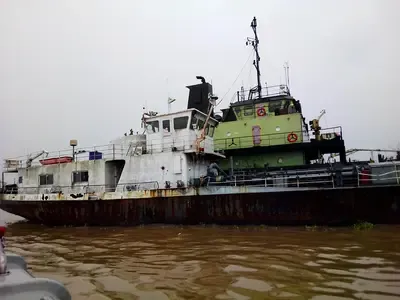
Oil Theft: Navy Hands Barge, TUG Over To EFCC

The Nigerian Navy Ship (NNS) DELTA has handed over the impounded TUG MV STEPH 1 and Barge SIMI to the officials of the Economic and Financial Crimes Commission (EFCC). The arrested vessels, laden with product suspected to be stolen Automotive Gasoline Oil (AGO), were handed over to the anti-graft agency on Wednesday at the NNS DELTA Jetty. Commander88 Samuel Musa, the Base Operations Officer (BOO) of NNS DELTA released the vessels to the EFCC on behalf of the Commander, NNS DELTA, Commodore Chindo Yahaya. Addressing newsmen, Yahaya said that Barge SIMI was impounded with about 120,000 litres of product suspected to be AGO at Workson Jetty, Edjeba, on the NPA Expressway in Warri South. He said that TUG MV STEPH 1 was arrested at KFT Yard, Edjeba on the NPA Expressway while discharging suspected AGO into some rubber tanks. The commander said that the two vessels were arrested on July 6. “On July 6, 2023, NNS DELTA arrested Barge SIMI, laden with about 120,000 litres of product suspected to be AGO at Workson Jetty, Edjeba on the NPA Expressway. “The barge was without necessary documents and approvals. “Preliminary investigation revealed that the product is an accumulation of Remnants On Board (ROB) from various vessels. “Accordingly, Barge SIMI is hereby handed over to the EFCC for detailed investigation and further necessary action. “Similarly, On July 6, 2023, NNS DELTA also arrested TUG MV STEPH I at KFT Yard, Edjeba on the NPA Expressway in Warri,” he said. Yahaya said that TUG MV STEPH 1 was caught discharging product without necessary documentation, and approvals adding that it was consequently detained and taken to NNS DELTA. “Accordingly, TUG MV STEPH 1 is hereby handed over to the EFCC for detailed investigation and further necessary action,” he said. Yahaya said that the NNS DELTA was poised to rid-off its area of illegal activities or operations. He warned those who indulged in such illegalities to desist forthwith. Mr Gomina Suru, Assistant Cdr. EFCC Two, Benin Zonal Command led officials of the anti-graft agency to receive the vessels on behalf of the Commission. “I am directed by the EFCC Two, Benin Zonal Command to take over the TUG and Barge from the NNS DELTA for the furtherance of investigation.” Officials of the Nigerian Midstream and Downstream Petroleum Regulatory Authority (NMDPRA) were on ground to collect samples of the product.
Crude Oil Theft: Military Destroying Vessels To Conceal Evidence — Ned Nwoko

Senator Ned Nwoko, the Vice Chairman of the Senate Committee on Environment, has raised concerns about the military‘s practice of destroying vessels apprehended for carrying illegal goods or stolen crude oil, suggesting it is an attempt to conceal evidence. Speaking in Abuja, he emphasized that the destruction of potential evidence in these cases makes little sense, unless there is complicity and compromise among those responsible for preventing such crimes. Senator Nwoko expressed his frustration with the apparent illogicality of the situation, stating, “What is the point? It does not make any sense. You know, if somebody is found in possession of stolen goods, do you say, oh, the way to deal with this is to destroy it? No. You take it from them, you document it, you preserve it, you charge the culprits. And then you produce that in evidence against them in court and then ultimately return that product to the owner.” As a member of the Senate Committee on Upstream Petroleum, Senator Nwoko raised the possibility that the military’s actions may be driven by compromises within their ranks. He explained, “Well, I think the military are complicit. You know the reason they do this, because some of them might have compromised. They have been bought over because to load this kind of commodity vessels – the crude – it takes weeks sometimes because of the size of the vessels, it takes time.” He further suggested that multiple parties may be involved in crude oil theft, including oil companies, producing companies, NNPC officials, the police, and more. Notably, Senator Nwoko observed a common pattern among personnel in joint task forces, where their rapid accumulation of wealth raises suspicions of complicity in these criminal activities.
ERA/FOEN Decries Shell’s Slow Response To multiply Spills In Bayelsa

The Environmental Rights Action/ Friends of the Earth Nigeria (ERA/FoEN) has expressed dismay at Shell Petroleum Development Company (SPDC) slow response to multiple crude oil spills in the Diebu Creek in Peremabiri community in Southern Ijaw Local Government Area of Bayelsa State. ERA/FoEN in a statement by the Communication Officer, Elvira Jordan on Sunday, said its position came in the light of a field visit by ERA/FoEN team led by Programme Manager Niger Delta Resource Center, Comrade Alagoa Morris. The NGO had visited the community with a team of journalists following a save-a-soul call from the community over multiple spills along the Diebu creek. Prior to the visit, the community had informed ERA/FoEN that Shell said a Joint Investigation Team (JIT) was to visit the site of the spill but failed to keep show-up, including the very date ERA/FoEN visited. After two unkempt JIV, the JIV only took place a day after the field visit by ERA/FoEN with Shell sponsored news statements that attributed one of the spills to equipment failure and the other tagged inconclusive. Speaking to the team, the youth president of the community, Benjamin Ebinibo expressed his dissatisfaction over the conduct of Shell and their response to spill issues. According to him, the people of Peremabiri are not known for sabotaging crude oil pipelines and so the leak must have been from faulty Shell equipment. Describing the plight of the women of the community, the Assistant Women Leader of Peremabiri, Favour Morganlamented that the recurring spills in their community, and how it has destroyed their environment and collapsed fishing and farming activities, which is their primary source of livelihood. On his part, the CDC Chairman of the community, Basil Young narrated the ordeal of the people of Peremabiri, citing issues ranging fromneglect suffered by the community as host community in terms of absence of basic amenities to negative impacts of the current oil spill incidents. Reacting to the spill incident, the Executive Director of ERA/FoEN, Chima Williams said “we have it on record thatthe promise by Shell to visit the Spill site for JIV on 10th and 11th October, 2023 did not happen. Rather, we were duly informed that the JIV took place a day after the field visit by the ERA/FoEN led team; on the 12th October.” According to him, “going to sites and communities of interest with the media by ERA/FoEN is a deliberate strategy to enable stakeholders to come face to face with victims of incidents and get information from primary sources.” Williams further stated that while booming crude oil to prevent spreading on the surface of water is commendable, such actions do not prevent the soluble elements of crude oil to have chemical reaction within the marine ecosystem, adding that this is why effective and prompt clean up should follow booming of crude oil in any marine ecosystem. He called on Shell to take immediate action to clean up and restore the environment around Peremabiri community, and admonished NOSDRA and the Bayelsa State Ministry of Environment to follow up on spill incidents and ensure clean up and compensation matters are affected within a reasonable time frame.
We’ll continue to support fight against oil theft -Chevron

Oil major, Chevron Nigeria Limited, has said that it would not relent in the continued support of the fight against oil theft and pipeline vandalism in the Niger delta region. General Manager, Policy, Government and Public Affairs of Chevron, Esimaje Brikinn, in a statement on Saturday insisted that over the years, it has been in the vanguard of the fight to curb oil theft and pipeline vandalism in the oil rich region. CNL is the operator of the joint venture between the Nigerian National Petroleum Company Limited (NNPCL/CNL JV). According to Esimaje, to therefore blame the company for incidences of oil theft and pipeline vandalism is not only untrue but also without basis. “Chevron Nigeria Limited is aware of a report in one of the online media platforms blaming international oil companies (IOCs), communities and other stakeholders for the oil theft that has hindered the growth of the oil industry. “Chevron and another IOC were specifically mentioned in the report allegedly attributed to the Chairman of the House of Representatives ad hoc committee set up to investigate crude oil theft. “CNL refutes this assertion as it is untrue, incorrect, and made without any basis. CNL reiterates its commitment to supporting the collaborative efforts to prevent oil theft and pipeline vandalism in its area of operation. “CNL affirms illegal bunkering and oil theft in the Niger Delta region has negatively impacted CNL’s operation and has devastating effects on the nation’s economy and the environment in the Niger Delta region. CNL continues to monitor the environment in its areas of operations and report any suspected illegal activity and breaches to the relevant Government Security Forces and regulatory agencies. “CNL has helped in reducing pipeline vandalism and oil theft in the Niger Delta region by collaborating with communities around the areas of the company’s operations to set up the Community Pipeline and Facilities Surveillance Programme (CPFSP) in 2005. Through the CPFSP, CNL continues to tackle the challenge of oil theft and pipeline vandalism and engage the community youth in pipeline surveillance to reduce oil theft in CNL’s area of operation. CNL also deploys security surveillance equipment and other technologies in addition to physical water-borne patrols by the CPFSP and the government security forces,” the company said. He noted that CNL’s commitment to working with government agencies and others to prevent oil theft and its impact on the environment was recently commended by the Special Investigation Panel on Oil Theft/Losses in Nigeria set up by the Federal Government during their visit to CNL’s operations. “CNL is committed to the highest ethical standards and business principles. CNL operates as a responsible company and conducts its business in full compliance with the law and in a socially and environmentally responsible manner. CNL will continue to work with the Nigerian government towards the development of the oil and gas industry and the Nigerian economy generally,” he added.
Crude production plunges to 1.22mbpd in Q2 2023 -Report

Hope for increased crude oil production deemed with second quarter figures plunging to 1.22 million barrel per day (mbpd), Nigeria’s statistics bureau, has said. The decrease is coming in spite of the restoration of fragile peace in the Nigeria Delta region; the second quarter of 2023 recorded an average daily oil production of 1.22 million barrels per day (mbpd). This according to the Nigerian Bureau of Statistics (NBS) was much lower than the daily average production of 1.43mbpd recorded in the same quarter of 2022 by 0.22mbpd and lower than the first quarter of 2023 production volume of 1.51 mbpd by 0.29mbpd. The real growth of the oil sector was 13.43 per cent (year-on-year) in the second quarter of 2023, indicating a decrease of 1.66 per cent points relative to the rate recorded in the corresponding quarter of 2022 (-11.77 per cent). Growth also decreased by 9.22 per cent points when compared to the first quarter of 2023 which was –4.21 per cent. On a quarter-on-quarter basis, the oil sector recorded a growth rate of -14.12 per cent in the second quarter of 2023 and contributed 5.34 per cent to the total real Gross Domestic Product (GDP) in the second quarter of 2023, down from the figure recorded in the corresponding period of 2022 and down from the preceding quarter, where it contributed 6.33 per cent and 6.21 per cent respectively. The statistics bureau further said the non-oil sector grew by 3.58 per cent in real terms during the reference quarter (Q2 2023). This rate was lower by 1.19 per cent points compared to the rate recorded in the same quarter of 2022 and 0.81 per cent.
Iran to boost oil production by 3.4mbpd

The Islamic republic expects to boost production to 3.4 MMbpd by the end of summer, according to Oil Minister Javad Owji. That would put output near Iran’s capacity limit of 3.8 MMbpd. According to Bloomberg, Iran has already boosted production by about 50 per cent over the past two years, according to comments Owji made to the Iranian parliament’s energy committee reported by the ministry’s news service, Shana. Owji’s remarks come amid diplomatic efforts between the U.S. and Iran that have raised speculation about whether aspects of the nuclear deal abandoned by former President Donald Trump in 2018 could be revived. The two nations recently reached agreements that would see captive Americans released and some frozen Islamic republic funds freed for transfer. Further talks could set the stage for Iran to boost its already surging oil exports. The nation shipped 2.2 MMbpd of crude and condensates during the first 20 days of August, with monthly exports poised to reach the highest this year, according to TankerTrackers.com Inc., which provides data on oil cargo shipments, Bloomberg said. At the same time, the country’s boom in oil sales, most of which are flowing to China, has complicated efforts by OPEC to support oil prices, with Iranian barrels partially countering recent output cuts agreed by Saudi Arabia and Russia. That’s weighed on oil prices, with global benchmark Brent crude trading below $85 a barrel. The revival in Iran’s output has coincided with the nation reaching a preliminary accord with regional adversary Saudi Arabia in April, as well as the latest US diplomatic talks. The Persian Gulf state that was once the second-largest producer in the Organization of Petroleum Exporting Countries saw its energy industry starved of investment under successive rounds of sanctions, while its crude exports were throttled under Trump’s policy of maximum pressure. While Iranian exports are very hard to track — with vessels turning off satellite tracking systems to mask their routes — the data TankerTrackers indicates that Iran is drawing crude out of land-based storage tanks. The country processes roughly 1.8 MMbbl of crude at domestic refineries each day.
Revive idle wells to meet revenue shortfall, expert urges FG

Industry expert, Dr Victor Ekpenyong has urged the Federal Government to revive idle oil wells to boost oil production in order to meet revenue shortfalls. Ekpenyong, who is the Chief Executive of Kenyon International West Africa Limited, said this during an interactive session with journalists in Yenagoa, Bayelsa State. Kenyon International is a Well Control Services firm. Ekpenyong noted that vandalism and oil theft have hampered the country’s oil production and kept the nation from harnessing its full production capacity. He explained that oil production was being limited by breach of pipelines that evacuate crude from oilfields to export terminals. He noted that with the rebound of the Forcados Export Terminal which has been out of service, there will be an increase of export capacity by at least 350,000 barrels per day (bpd) when scheduled repairs on the export trunkline is completed in the next one week. Ekpenyong commended the Nigerian National Petroleum Company Limited (NNPCL) for ongoing repairs on major oil export pipelines, noting that upon conclusion of repair schedules, export capacity would rise significantly. He said that there was the need to revive idle assets to boost oil production to meet the Organisation of Petroleum Exporting Countries (OPEC) quota of 1.8 million bpd quota for Nigeria. Ekpenyong noted that there was existing production capacity to meet the shortfall in production from a little over one million bpd current output. “Reports available from NNPCL have it that repairs on Trans Forcados Export Trunkline is almost concluded and the Forcados Export Terminal will be up again and it has capacity to handle up to 400,000 bpd of oil export. “The sections of the Trans Niger Delta Pipeline (TNP), which feed the Bonny Crude Export Terminal, are also scheduled to be ready as well, so we need to revamp the idle wells to produce enough to meet our OPEC quota and earn more revenue,” Ekpenyong said. He noted that the country is yet to produce more and leverage the supply cuts occasioned by the Russian-Ukrainian crisis which has pushed up international crude oil prices. He noted that proposed divestment by the government from oil assets in non producing oil reserves would provide opportunities for investors to enter into partnerships with the government to increase oil production. “The efforts being made by the government to increase local refining is very massive. I learnt that the rehabilitation work at the Port Harcourt refinery has gone far for the President to promise that the plant will be back in December. “There is also ongoing work in Warri Refinery and these will increase local production of refined petroleum products and reduce imports and subsequent pressure on the naira at the foreign exchange market,” Ekpenyong said. He said that NNPCL remained the dominant importer of refined petroleum products saying the $3 billion facility being put in place by the government would enable more private sector players to augment the supply deficit.
Nigeria crude exports to rise as Shell Forcados resumes operations

Nigeria’s contribution to the Organisation of Petroleum Exporting Countries (OPEC) is expected to increase with the resumption of the Forcados grade of crude oil Sunday. The resumption is coming roughly a month after loadings of the medium sweet grade were suspended because of a potential leak at the export terminal. Sources had told Reuters that exports of the grade, which was scheduled to ship 220,000 barrels per day (bpd) in July, were halted on the evening of July 12 after workers saw fumes near a single buoy mooring where oil was being loaded onto a vessel. A single buoy mooring is essentially a floating loading facility that allows large tankers to moor offshore to discharge cargoes. Shell confirmed that injections into the terminal had been curtailed after the report, though no force majeure was declared. The Shell said the cause of the suspension would be determined by a joint investigation between company and community representatives in tandem with government agencies. The suspension of Forcados loadings contributed to Nigeria becoming the second-biggest contributor to the drop in OPEC crude oil output in July, a Reuters survey showed. This follows observation by the Nigerian Upstream Petroleum Regulatory Commission, NUPRC that the country’s crude oil production dropped by 12.56 per cent in July to 1.29 million barrels daily from 1.48 million barrels daily in June. According to the NUPRC, one of the reasons for the decline was the temporary shutdown of the Forcados terminal, which Shell, the operator, said in mid-July on suspicions of a leak. The Forcados sees loadings of an average of 220,000 barrels daily but on July 12 workers in the area saw fumes near a vessel that was being loaded with crude. The repairs work on the terminal was expected to be completed by the end of the first week of August but as of the middle of this week, Forcados remained shutdown. Earlier this year, the Commission warned that Nigeria is producing one million bpd of crude less than it has the capacity to produce. The agency cited a lack of investments, a shortage of funding sources because of the energy transition, and insecurity among the factors driving the situation. “Currently, Nigeria has the technical allowable capacity to produce about 2.5 million barrels of oil per day. However, arising from the highlighted challenges, our current production hovers around 1.5 million barrels of oil and condensate per day,” the chief executive of the body said in May. To remedy matters, Nigeria earlier this month announced the pending launch of a roadshow to pitch upstream investments in the country. “Whereas the global imperatives for energy transition is clear and justified, the need for Africa’s energy security, economic development and prosperity cannot be overemphasised,” the Nigerian regulator, which is organizing the roadshow, said. According to a senior Petroleum Ministry official, Nigeria is looking to boost its oil production to 1.7 million barrels daily by November this year.
Current oil output unlikely to change as OPEC meets Friday

The Organization of Petroleum Exporting Countries (OPEC) is not likely going to make any changes to the current oil output policy as tighter supplies and resilient demand drive an oil price rally. Ministers from the OPEC and allies led by Russia, known as OPEC+, meet on August 4 and the panel, called the Joint Ministerial Monitoring Committee, can call for a full OPEC meeting if warranted. Oil has rallied to a three-month high this week above $85 a barrel for Brent crude, as tighter supply and rising demand outweigh concern that interest rate hikes and stubborn inflation could hit economic growth.The Six OPEC+ sources said the Committee would probably not make any changes to existing policy during Friday’s online meeting as one of them cited the rising oil price as a reason to take no action.The OPEC and the Saudi Energy Ministry did not immediately respond to requests for comment on Tuesday.In the latest comments from an OPEC member about the market, the energy minister for the United Arab Emirates told Reuters on July 21 that current OPEC+ actions were sufficient for now and the group was “only a phone call away” if any further steps are needed. The UAE minister sits on the JMMC, which is chaired by Saudi Energy Minister Prince Abdulaziz bin Salman. Still, a surprise cannot be ruled out. The Saudi minister in July said OPEC+ would “continue the effort at surprising markets”. In April, several OPEC+ members announced cuts just ahead of a JMMC meeting that was expected to take no action. At its last policy meeting in June, OPEC+ agreed on a broad deal to limit supply into 2024 and Saudi Arabia pledged a voluntary production cut for July that it has since extended to include August. Analysts told Reuters last week they expected Saudi Arabia to extend the voluntary cut for another month to include September. National Australia Bank said in a report on Tuesday that it expected the Saudis to announce an extension of their voluntary cut at the committee meeting on Friday.