Misapplication Of Discretion In Judicial Proceedings In Nigeria

By Douglas Ogbankwa Esq. Justices, Judges, Magistrates and Presidents of Area and District Customary Courts in Nigeria are very powerful. What they say and write is the Law, which you must obey. The latitude and discretion however given to My Lords, Their Worships and Their Honours are however too wide and sometimes unfettered. This could give room for abuse and perversion of Justice. It was Lord Atkins that said ‘Power corrupts and absolute power corrupts absolutely!’. The following are some practices and procedures in the Justice Delivery System in Nigeria, which require guidelines to ensure a uniformity of the Application of the Law and Discretion in the Nigeria Legal System. Same is currently now being abused and misapplied by some. 1.Ex Parte Orders or Interim Injunctions: Ex Parte Orders or Interim Injunctions are orders that are made for the time being, usually to provide succour for a person in an urgent situation, in a way that if you do not do so, the res-subject matter will be destroyed. This Procedure is being abused by some Nigerian Judges, Magistrates and Court Presidents, who some times determine the main issues in a matter at the Ex Parte Stage. There are no guidelines for the issuance or refusal of Ex Parte Orders. Judicial Officers usually hide under the hazy and nondescript concept of the word “Discretion”, to do what ever they wish, even if some times such is not allowed by Law. My Noble Lord, The Chief Justice of Nigeria (CJN), must as a matter of urgency provide a Practice Direction to establish the compass of how to and how not to grant Ex Parte Injunctions. This should be like the one that was given that stopped conflicting Judgments of Courts. This is very important to delimit the ambit of the Law on this subject and make the granting and refusal of Interim Injunctions ascertainable. It will also stop the current practice of some parties going about looking for Interim Injunctions. There should be pointers to the grant or refusal of same, pointing to the names of the parties, whether they are juristic persons, the jurisdiction of the Court to hear and determine the main matter before the determination of an Interim Injunction, whether there is real urgency, which must be established and not by mere deposition in an affidavit of urgency. For example, the Judge will ask the question, “What will go wrong in the event that the order party is put on Notice?” Will the heavens fall? The current practice of any thing goes in the grant or refusal of Interim Injunction is one of the reasons for the perceived disdain with which the Legal Profession is viewed in Nigeria today. The Narrative among the public is not palatable. While I concede that Judges do not give their Verdicts based on Public Perceptions, the Judiciary should however realise that the general public are the customers of our Judicial System and like a good Customer Care Service , it is important we get the feedbacks from the public, to know how we can improve our services .We must not operate among people that live on earth and act as if we live in planet Mars. There must be a symetry of purpose between the Law and the Society. 2.The need for sentencing guidelines: The Concept of Sentencing is a creation of Statute and Case Law. If the Body of Laws says you can give an option of fine, why should a Judicial or Presiding Officer Order otherwise? The needless imprisonment of Citizens is one of the reasons our Prisons are congested. There should be a uniform Sentencing Guideline issued to all Judicial and Presiding Officers, which My Lords, Their Worships and Their Honours should subscribe to and apply to the Letter. A Matter with the same facts and circumstances should not be determined in a different manner. This will obviate the abuse of Sentencing Powers of Judicial and Presiding Officers to preclude them to be too excessive or too mild in exercising their sentencing powers. 3.Granting of bail The Granting of Bail by Judicial and Presiding Officers even require more streamlining as it the most abused of the discretionary powers of Judicial and Presiding Officers. Bail is no longer entirely at the discretion of Court. The Administration of Criminal Justice Law Act and Laws of different States have indicated Matters in which a Judicial and Presiding Officer must grant bail. So ,it is no longer a privilege to the Defendant for such Matters indicated in the Administrative of Criminal Justice Act (ACJA) and the Administration of Criminal Justice Law (ACJLs), but a right, for which they could even seek redress ,if denied Bail. To this end, to ensure that the Law is followed in symmetry l, Guidelines should be issued stating all the Offences and conditions therein for Bail, which should follow the Statute creating the Offence and should not be too excessive or too mild. This is to avoid allegations of bias, malice and ensure Judicial Powers are exercised, with out affection or ill will. 4.Election petitions Election Petition Cases though sui generis, appear mysterious and esoteric in the way and Manner that two Election Petition Cases for example, in the same State, in two Constituencies, will be determined differently by the same Panel, with the facts and applicable authorities being the identical, evaluated differently to reach a different conclusion. This is completely unacceptable! Election Petition Cases are even more grave, because they deal with the destiny of the Local Governments, States and Country. To this end, I recommend that only retired Justices and Judges of the applicable Courts are used for Election Petition Matters and Appeals. This will also ensure that cases in the Courts do not suffer owing to the absence of Justices and Judges that conduct Election Tribunal Cases and Election Appeal cases respectively. There should also be penalties for Members of a Tribunals and Appeal Panels who fail, neglect and/ or refuse to follow Judicial Precedents set by higher Courts of Records and their own Court,
Lamido’s N712m Money Laundering Case: HEDA hails EFCC’s appeal

Anti-corrupt group, Human and Environmental Development Agenda (HEDA Resource Centre) has commended the Economic and Financial Crimes Commission (EFCC) on its appeal of the recent judgment of the Court of Appeal, Abuja judicial division. The Court discharged the former Governor of Jigawa State, Alh. Sule Lamido and his two sons, Aminu and Mustapha Lamido of corruption and money laundering charges on the grounds that the prosecution had filed the charge at the wrong judicial division of the Federal High Court. Earlier, the EFCC had charged the former Governor and his two sons with money laundering offenses at the Abuja judicial division. After presenting six witnesses, the anti-graft agency closed its case, and the defendants subsequently filed a no-case submission. However, Justice Ojukwu of the Federal High Court dismissed the no-case submission, ruling that the defendants had a case to answer. Dissatisfied with the ruling, the defendants decided to appeal to the Court of Appeal. A panel of three jurists, led by Hon. Justice Adamu Waziri, reviewed the case and concluded that the money laundering charge should have been filed in Jigawa State, where the alleged offenses were committed. Based on this finding, the Court of Appeal discharged the defendants. In response to the judgment, HEDA Resource Centre’s Chairman, Olanrewaju Suraju, expressed concerns, citing a precedent set by the Supreme Court in the case of Dele Belgore. In the Belgore case, the Supreme Court also overturned a no-case submission ruling by the Federal High Court. However, unlike the Lamido case, the Supreme Court ordered the case to be re-filed and prosecuted in the appropriate judicial division, which was Kwara State. Suraju also highlighted another relevant case, that of Senator Orji Uzor Kalu & Ors, wherein the Supreme Court overturned the judgment of the Federal High Court due to jurisdictional issues. In that case, the Supreme Court ordered a re-trial of the defendants, instead of discharging them. He stressed that an appellant whose appeal is based on an application or an interlocutory appeal, and not on the final judgment of the trial court, should not be discharged by the appellate court. Such discharges could set a wrong precedent, suggesting that technical errors may lead to acquittal. Suraju therefore called on the EFCC, as the prosecutor, to pursue further appeal at the Supreme Court. He emphasized that Nigerians cannot afford a precedent that fails to ensure consequences for money laundering, corruption, and misappropriation of public funds. The EFCC’s response and the potential implications of further appeal will be closely watched, as the case involves high-profile individuals and raises important questions about the judicial process surrounding corruption cases in Nigeria.
Supreme Court Justice, Chima Centus Nweze dies @64

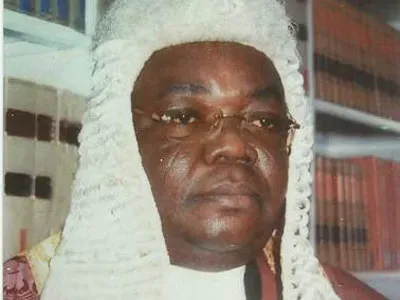
Supreme Court Justice Chima Centus Nweze has passed on. He died on Sunday at the age of 64. Festus Akande, the Director of Information at the Supreme Court, confirmed the news to NIGERIAN ANCHOR, whilst adding that and an official press statement will be released soon. Justice Nweze gained prominence for his dissenting judgment in 2020, which declared Emeka Ihedioha of the Peoples Democratic Party (PDP) as the rightful winner of the 2019 Governorship election in Imo State. This decision triggered extensive debates and divided opinions among legal experts and the public. In another significant moment of his judicial career, Justice Nweze, in a three-against-two split decision, declared Ahmad Lawan, then Senate President, as the authentic candidate of the All Progressives Congress (APC) for Yobe North Senatorial District during the 25 February general election. These rulings underscored the profound impact of his decisions on the political landscape. Born on September 25, 1958, in Obollo, Udenu Local Government Area of Enugu State, Justice Chima Centus Nweze had a long and distinguished career within the Nigerian legal system. In 2014, former President Goodluck Jonathan’s administration approved his appointment to the Supreme Court upon the recommendation of the National Judicial Council (NJC). Justice Nweze’s demise leaves a significant void in the legal community. He was renowned for his thoughtful and meticulous approach to cases, earning respect among peers and legal scholars alike. As the nation mourns the loss of this accomplished jurist, his legacy of upholding justice and the rule of law will undoubtedly endure in Nigeria’s legal history.