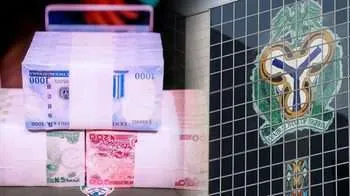
Naira Depreciates To N827.83/$1 At Official Market

The naira again declined against the US dollar at the official market on Thursday, exchanging for N827.83 to one U.S dollar after a slight appreciation on Wednesday which saw the local currency exchanging at N818.99/$1. This is still a slight gain when compared to the N850.22 it recorded on Tuesday. However, the naira closed flat at the parallel forex market where forex is sold unofficially, the exchange rate closed at N1140/$1 as against the same N1140/$1 it quoted on Wednesday, representing 0.00 per cent, while peer-to-peer traders quoted around N1127.01/$1. The intraday high recorded was N1100/$1, while the intraday low was N751.00/$1, representing a wide spread of N348.78/$1. Similarly, the naira also fell to the Euro, exchanging at N1,175/€1 at the parallel market, while it goes for N898.44/€1 at the official market. Also the pound sterling goes for N1,370 and N1029.7441 at the parallel and official market respectively. According to data obtained from the official NAFEM window, forex turnover at the close of the trading on Wednesday was $173.51 million, representing a 20.87 per cent increase compared to the previous day. The local currency struggle at the foreign exchange market is coming on the heels of rising inflation in the country which saw the inflation rate jump to 27.33 per cent in October 2023 as prices of foodstuff continued to increase in the aftermath of the removal of fuel subsidy by the President Bola Tinubu administration. This was according to the October 2023 Consumer Price Index (CPI) and Inflation Report released by the National Bureau of Statistics (NBS) on Wednesday. The CPI, which measures the changes in the prices of goods and services, rose from 26.72 per cent to 27.33 per cent showing an increase of 0.61 per cent points. “In October 2023, the headline inflation rate increased to 27.33 per cent relative to the September 2023 headline inflation rate which was 26.72 per cent,” the report partly read. “Looking at the movement, the October 2023 headline inflation rate showed an increase of 0.61 per cent points when compared to the September 2023 headline inflation rate. “Furthermore, on a year-on-year basis, the headline inflation rate was 6.24 per cent points higher compared to the rate recorded in October 2022, which was (21.09 per cent). “This shows that the headline inflation rate (year-on-year basis) increased in October 2023 when compared to the same month in the preceding year (October 2022).”
No Plans To Re-Denominate Naira, Says CBN

The Central Bank of Nigeria (CBN) has insisted that it has no plans to re-denominate the Naira, saying such reports are misleading. According to a statement by the Director, Corporate Communications of the Apex Bank Dr. Isa AbdulMumin, he wondered why a narrative that had been refuted by the Bank continues to gain traction. “The attention of the Central Bank of Nigeria (CBN) has been drawn to the wide circulation of a text message suggesting that the Bank plans to redenominate the country’s legal tender, the Naira, with effect from January 2024. “We are concerned that this narrative, which we had refuted before now, appears to be gaining traction with several debates on the implication of such a policy for the Nigerian economy. “We wish to reiterate that the contents of the message are misleading,” it said. The Apex Bank noted that the “authors of the message, in their mischief, modified text eked from an old policy move by a previous CBN Governor in 2007 to make it appear recent. “For the avoidance of doubt, there is currently no plan by the Bank to restructure and redenominate the naira as it considers reforms”, according to laid down procedures in line with the provisions of the CBN Act, 2007. The regulator advised Nigerians to ignore the news report, “as it is speculative and calculated to cause panic in the polity.”
Despite Slight Appreciation, Naira Still Weak – Report

In spite of the slight appreciation of the Naira at the weekend, the World Bank has listed Nigeria’s local currency as being among the worst-performing currencies in Sub-Saharan African in the first ten months of 2023. According to figures obtained from Aboki forex, the naira was bought and sold for 1,140/$ and 1,150/$1 at the weekend on the parallel section of the foreign exchange market as against the 1,310/$ on Thursday. Over the past two weeks, the Naira has been hitting new lows, as it sold as low as N1300/$ at the black market, and N848/$ at the official market. However, within the past few days, the currency has been on an upward swing, as it appreciated to N789.84/$ on Friday. But in a report by the World Bank the Nigerian Naira has posted a year-to-date depreciation of about 40 per cent, making it the weakest currency in Sub-Saharan Africa, alongside the Angolan Kwanza. Other currencies with significant losses include the South Sudanese pound which has depreciated by about 33 per cent YTD, the Burundian Franc which has depreciated by 27 per cent YTD, the Congolese Franc (18 per cent), Kenyan Shilling (16 per cent), Zambian Kwacha (12 per cent), Ghanaian Cedis (12 per cent), and Rwandan Franc (11 per cent). In the report, it highlighted that between March 2020 and June 2023, there was a widening disparity between the parallel market exchange rate and the official exchange rate. The disparity widened to as much as 80 per cent in November 2022 and dropped to 60 per cent in June 2023. The prioritization of strategic sectors and the imposed price ceilings and trade restrictions pushed transactions to the parallel market, which started to account for a large share of the foreign exchange transactions in the country, including for remittances, tourism, and exports of non-oil products. After the unification and liberalization of the exchange rates in June 2023, the NAFEX rate converged to the parallel one, closing the gap. However, resistance toward the increasing pressure on the Nigerian naira coupled with limited supply of FX at the official window has led to the reemergence of the parallel market premium. Figures obtained from the Central Bank of Nigeria on movement of foreign reserves showed that the country’s external reserves recorded $76.82m accretion in one week, after it moved up from $33.249bn on October 19, 2023 to $33.326bn as of the end of October 26, 2023. It had earlier lost $841.75m in three months after it fell from $34.07bn as of July 7, 2023, to $33.23bn as of October 5, 2023. Meanwhile, an economist and Chief Executive Officer, Centre for the Promotion of Private Enterprise, Dr Muda Yusuf, attributed the naira appreciation to the Supreme Court judgment that brought finality to the litigation around the presidential election. He said the judgment removed uncertainty in the economy. “The pronouncement that the President made about efforts to boost the liquidity in the forex market may have also affected the level of confidence and influenced expectations because if people have expectations that liquidity will improve and the naira will appreciate, they would quickly begin to offload the dollars they have at a lower rate. “We need to seize the opportunity to push down the demand for foreign goods. We must reduce the demand for the dollars. We can have the naira appreciate better.”
Has Mission To Save The Naira Begun?

The government may have begun the resuscitation of the Naira as it recently lifted the suspension restricting 43 items from its official forex platform, Investors’, and Exporters’ window. The restriction which became effective as announced by the Central Bank of Nigeria in 2015 originally had 41 products, but later had two other items added. The Governor of the Bank, Mr. Olayemi Cardoso, announced the lift last Thursday among other policy initiatives he promised to unveil to halt the downward slide of the Naira against other currencies, particularly the America Dollar and British Pounds Sterling. The uncontrolled freefalling of the local currency, occasioned by the decision of the government to harmonize the exchange rate due to arbitrage, and racketeering in the parallel market of the forex subsector made the decision inevitable. The Governor gave a hint of this reversal among other reforms he promised during his screening by the Nigeria Upper legislature. This restriction affected products like rice, margarine, palm oil, palm oil products, dairy products, poultry, tomatoes, wheelbarrows, cosmetics, steel products, including toothpicks to mention but few. The objective of the lift according to the Circular released by the Bank is to boost liquidity in the foreign exchange market, promising to intervene from time to time to ensure that importers of these items have free and unhindered access to forex from the official window. The CBN Act 2007 stipulates that Naira is the only acceptable legal tender in the country, but the emerging trend in irrationality is the dollarization of the economy. The non-regulation of the dollar by the government as it is the case in some countries, particularly African countries, has increased the appetite and demand for the currency, preferring it as a store of value, over and above the local currency to perpetrate rent-seeking and arbitrage. The importers of the restricted items have had to approach the parallel market to source for the dollar, invariably creating a chaotic pressure on the Naira. This atmosphere apparently took a toll on the Naira. Obnoxiously, in Lagos, Abuja and Port Harcourt, landlords, hoteliers, and proprietors of schools started charging and demanding payments in dollars and pounds sterling. Equally, attitudes of some politicians and operators in the economy, particularly, the parallel market operators have not helped the fate of the currency. The usage of foreign currencies during electioneering campaigns impacted heavily on the Naira. It was an inexcusable national security offence, punishable by law. Also, Nigerians’ huge appetite for foreign imported goods is offensive, exporting jobs to other nations, thereby depleting the scarce national foreign reserves. More so, Nigeria’s backward integration intention has not been matched with action. Factories have closed and more are closing with its attendant job losses. Poverty reigns unchecked in the country, youth unemployment at almost 40 percent, creating despondency and Ja’pa syndrome. Brain drain phenomenon is fast depleting the economy of its egg heads, and professionals are emigrating in droves in search of greener pastures. It is noteworthy and pleasing that the administration of President Tinubu has opted to arrest the drift, injecting fresh brains in key organs of government saddled with the responsibility of creating jobs and wealth. The CBN latest circular announcing this decision, TED/FEM/FPC/GEN01/010 stated that “importers of all 43 items previously restricted by the 2015 circular, and its addendums are now allowed to purchase foreign exchange from the official Investors and Exporters’ forex window. Prior to this decision, key stakeholders in the economy, the Manufacturers Association of Nigeria, Lagos Chamber of Commerce and Industries, Airline Operators Association of Nigeria among others had called for a review of the policy to allow for transparency in the subsector. What the CBN has done in the opinion of some concerned Nigerians is that the Bank has now decided to tow the process of policy normalization in tandem with the present administration’s philosophy. The suspended restriction is considered an anathema to extant trade policy. This is because the restricted items were not under any prohibition. That singular action they opined caused the distortion and chaos not only in the forex subsector, but the economy at large. This latest responsive action from the CBN Governor has been variously commended by sector stakeholders, but warned the Bank against suppressive tendencies, particularly, outside the I&E window. A seasoned Financial/Business publisher, Mr. Ewache Ajefu, commended Mr. Cardoso for taking the bull by the horn. He, however, urged the fiscal authority to also review existing laws impeding economic growth, and come up with friendly policies that will encourage and boost local production and wealth creation. He urged policy formulation, coordination, and collaboration, devoid of rancor, witnessed during the immediate past administration between the monetary and fiscal authorities. He also welcomed the decision of the Governor to “pull back” the CBN from its developmental financing activities witnessed during the immediate past governor of the Bank. He urged Mr. Cardoso to live up to his words to streamline the relationship between the Bank and government. He suggested a more mutual and beneficial relationship, respecting each other’s mandate, but should endeavor to always play limited advisory role that is supportive of economic growth and development. Mr. Adisa Olatilewa, an agricultural entrepreneur, also welcomed the suspension of the restriction. He lamented how his businesses suffered while the restriction lasted. He advised current managers of the nation’s bank to restrict themselves to the mandate of the Bank, and shy away from direct involvement in fiscal development financing initiatives. He said his experience, and many others like him, during the last administration of President Buhari was distasteful. He wants the CBN as the banker to the government, and its advisor, to play the roles as constitutionally ascribed on policy measures, regulations, and programmes that will support economic development and welfare of Nigerians. He also wants the government to liaise with the CBN on measures to be taken to arrest the intractable inflation which in his opinion may jump to 26 percent if urgent measures are not taken. If the government works with the CBN, and the CBN is sincere