Nigerian Ambassador To Morocco, Nuhu Bamalli Dies @42

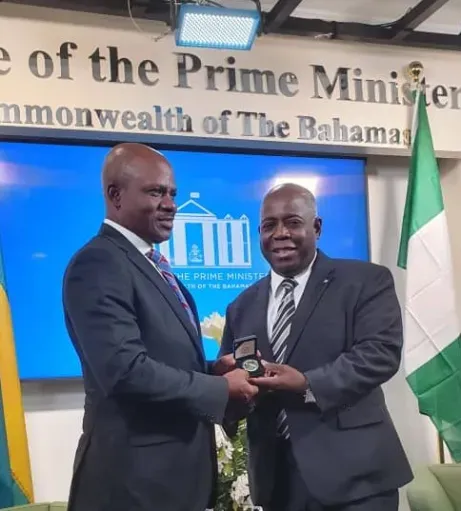
Nigeria’s Ambassador to Morocco, Alhaji Mansur Nuhu Bamalli, who also held the title of Magajin Garin Zazzau and was a Prince of the Zazzau Emirate in Kaduna State, has passed away at the age of 42. Alhaji Mansur Nuhu Bamalli was the younger brother of the current Emir of Zazzau, Ambassador Nuhu Bamalli. According to a statement from the Media and Publicity officer of the Zazzau Emirate Council, Ambassador Bamalli breathed his last at a private hospital in Lagos while on his way to Morocco. The statement noted that details about funeral arrangements would be provided at a later time. Ambassador Mansur Nuhu Bamalli is survived by his wife and two children. His appointment as Nigeria’s Ambassador to Morocco came in 2022, under the administration of former President Muhammadu Buhari. Prior to this role, he had served as a deputy director at the Ministry of Foreign Affairs.
Tinubu Calls For Strengthening Of Nigeria-EU Relations

President Bola Tinubu has called for the strengthening of cross-sectoral partnership between Nigeria and the European Union (EU) based on the principles of democracy, rule of law, and freedom. Chief Ajuri Ngelale, Special Adviser to the President on Media and Publicity, who disclosed this said Tinubu stated this when he received a delegation of the EU, led by Ms Jutta Urpilainen, EU Commissioner in charge of International Partnerships. The President welcomed the signing of eight financing agreements between Nigeria and the EU, under the “EU Global Gateway in Nigeria,” at a separate event earlier in Abuja. “Democracy is not an easy process, but we must fight for democracy and struggle for it to win at all times,” the President said. Tinubu stressed the importance of economic cooperation with the EU in the areas of digital education, traditional energy, renewable energy, and broadband access. He told the visiting delegation that Nigeria’s economy was going through several long-lasting reforms to render it capable of pulling millions of Nigerians out of poverty. “We have a young and vibrant population, and we are determined to succeed. If we succeed, democracy succeeds. If we succeed, freedom succeeds. “We need all of our partners’ hands on deck to sail together. We look forward to strengthening our partnerships,” he said. In her remarks, Urpilainen commended Nigeria for playing a pivotal role as a key partner of the EU, not only in politics and economics, but also in shaping the social landscape across the African continent. The EU Commissioner explained that over the past four years, the EU has been working to transform the nature of its relationship with Africa by shifting away from the traditional donor-recipient dynamic. She said that the EU seeks to establish an equal and mutually beneficial partnership through the “Global Gateway” investment programme as a flagship example. She noted that this strategy, agreed at the AU-EU Summit in Brussels last year, sets a goal of 300 billion Euros in investments, with 150 billion Euros allocated to Africa. She thanked Tinubu for the important role Nigeria played in supplying key energy products during its standoff with Russia in recent times. The EU Commissioner noted that the oil and gas partnership can be expanded, while adding that the “Global Gateway” strategy was designed to expedite the green and digital transformations in EU partner countries, with Nigeria standing as one of its most strategic. “We are investing in critical infrastructure such as energy, transportation, and digital infrastructure, as well as in human capital, education, and research,” she said. Other members of the EU delegation include Ms Samuela Isopi, Ambassador of the European Union to Nigeria and ECOWAS and Ms Rita Laranjinha, Managing Director of the Africa and European External Action Service (EEAS). Others are Ms Lora Borissova, Africa Advisor, Cabinet of EU; and Ms Maria Pilar Palmero Vaquero, Head of Unit for Western Africa, Directorate-General International Partnerships (DG INTPA).
Nigeria’s Equity Market Sheds N140bn

Trading on the floor of Nigerian Exchange ((NGX)) on Thursday closed negative, shedding N140 billion following losses recorded by Nigerian Breweries, Stanbic IBTC and other companies which impacted negatively on the market. Market capitalisation of listed equities declined by 0.38 per cent to N36.864 trillion from N37.004 trillion reported the previous day. The NGX All Share Index also depreciated by 254.43 basis points to 67098.80 points from 66353.23 points traded on Wednesday. Learn Africa led gainers table in percentage terms with 10 per cent to N3.30 per share, Daar Communication followed with 9.52 per cent to close at N0.23 per share, UPDC gained 8.00 per cent to close at N1.35 per share, Thomas Way added 6.80 per cent to N3.30 per unit, SUNU Assurance gained 6.67 per cent to close at N1.12 per share. Mcnichols recorded the highest loss, dropping by 8.82 per cent to close at N0.62 per share, Omatek trailed with a loss of 8.70 per cent to close at N0.42 per unit, Stanbic IBTC down by 8.49 per cent to close at N69.55 per unit, Ikeja Hotel declined by 6.98 per cent to close at N2.93 per unit. Volume of trades during the day declined by 98.873 million, representing 24.87 per cent as investors traded 298.687 million shares valued at N4.483 billion in 5453 deals against 397.970 million shares worth N4.699 billion traded in 6165 deals. Transactions in the shares of United Bank for Africa led market activities with 56.287 million shares valued at N1.053 billion, Fidelity Bank followed with account of 33.882 million shares worth N282.308 million, AccessCorp traded 22.173 million shares cost N364.027 million, Transnational Corporation of Nigeria exchanged 21.823 million shares valued at N135.261 million, Ellah Lakes sold a total of 20.195 million shares valued at N81.726 million.
FG To Advance HIV/AIDS Response — Minister

The Coordinating Minister of Health and Social Welfare, Prof. Muhammed Pate, on Wednesday affirmed the Federal Government’s commitment to advancing the HIV response in Nigeria during a performance review meeting hosted by the U.S. Centre for Disease Control (CDC) in Abuja. The third Biannual Performance Review and Stakeholder Engagement meeting aimed to share experiences, successes, and lessons with funders and CDC/PEPFAR partners in Nigeria. Represented by Dr. Anyaike Chukwuma, the Director of Public Health at the Federal Ministry of Health (FMoH), Pate emphasized the progress made in combating HIV and acknowledged the crucial support provided by the U.S. CDC and the U.S. Government. He highlighted achievements, challenges, and plans in the fight against HIV, underscoring the importance of sustainable financing, improved governance, and enhanced healthcare outcomes. Pate explained that the government’s agenda and collaborative efforts with stakeholders aimed to ensure a resilient and sustainable healthcare system in the country. Key interventions included the Basic Healthcare Provision Fund (BHCPF) and the National Health Insurance Act. He also mentioned restructuring the National Health Insurance Scheme (NHIS) into the National Health Insurance Authority (NHIA) to strengthen the healthcare system. The U.S. Chargé d’Affaires, Mr. David Greene, praised Nigeria’s efforts toward achieving the UNAIDS 95-95-95 goals. He highlighted the operation of key population-led One Stop Shops and innovation hubs for adolescents and youth. Greene expressed pride in partnering with Nigeria and the potential of an integrated health service delivery platform. Dr. Gambo Aliyu, the Director-General of the National Agency for the Control of AIDS (NACA), emphasized the impact of the U.S. President’s Emergency Plan For AIDS Relief (PEPFAR) in combating HIV/AIDS. He stressed the need for continued progress and sustainability, transitioning from an emergency response to managing HIV as an endemic global situation. Aliyu underscored the importance of collective responsibility, engagement, and discussions for achieving HIV epidemic control in Nigeria beyond 2030.
Nigeria’s Domestic Equity Market Gains N16bn

In the Nigerian Exchange, trading activity witnessed continued growth, resulting in a market capitalization increase of N16 billion. The total market capitalization of listed equities grew by 0.04%, reaching N37.004 trillion compared to the previous day’s N36.988 trillion. The NGX All Share Index (ASI) also showed an uptick, rising to 67353.23 points from 67326.12 points on the previous trading day. Top gainers on the equity market include Guinea Insurance, leading the gainers table with a 9.09% increase to N0.24 per share, followed by Eterna Plc with a 6.86% gain, closing at N14.80 per share. Unity Bank added 5.49%, closing at N0.96 per share, Jaiz Bank with a 5.26% increase to N1.60 per unit, and Omatek with a 4.55% gain, closing at N0.46 per share. On the flip side, CWG recorded the highest loss, dropping by 10% to close at N8.55 per share, followed by RTBriscoe with an 8.77% loss to close at N0.55 per unit. AfriPrudential fell by 7.14%, closing at N6.50 per unit, and FTNCocoa dipped by 6.29% to close at N1.64 per share. Neimeth International Pharmaceutical was down by 6.06% to N1.55 per share. The total volume of transactions increased by 19.59 basis points, representing a 5.18% rise, with investors trading 397.560 million shares valued at N4.699 billion in 6,165 deals. This is compared to 377.970 million shares worth N5.169 billion traded in 6,729 deals. Wema Bank was the most traded stock by volume, with 88.986 million shares valued at N418.147 million. AccessCorp followed with 35.606 million shares at N59.848 million, United Bank for Africa traded 35.171 million shares at N659.134 million, Fidelity Bank exchanged 33.405 million shares valued at N279.512 million, and GTCO Plc traded 23.421 million shares at N82.848 million.
NGF Backs State Of Emergency In Education

The Nigeria Governors’ Forum (NGF) has expressed support for a call of a state of emergency in the education sector. Speaking at the National Conference on the Learning Crisis in Nigeria in Abuja on Wednesday, the Chairman, NGF, Governor Abdulrazaq Abdulrahman of Kwara, said resources must be provided for sustainable and promising education. The conference, organised by the Federal Ministry of Education in collaboration with United Nations Children’s Fund, has the theme: “Scaling Foundational Literacy and Numeracy in Nigeria.” Represented by the Vice Chairman of NGF, Governor Seyi Makinde of Oyo State, Abdulrahman said education is in crisis and a state of emergency should be declared in the sector. He stressed the need to remove all barriers such as gender, poverty, location, disabilities, language and ethnicity, that could hinder children from accessing foundational literacy and numeracy. “We must follow UNESCO standard for education system that is progressive and sustainable, Governors at the various states must commit above 15 per cent above of our budget to education. “I support the call for state of emergency but it must be backed by actions, the resources must be provided and we must look at issues that have mitigated against achieving that sustainable growth. “It is one thing to declare a state of emergency but it’s another thing to put all the resources and elements that will allow us to achieve it. “So, I support putting the resources in place to allow us move fast at it. Our education is in crisis and a state of emergency should be declared in all the sector. We need solid roadmap and I believe it is a collective involvement,” he said. Meanwhile, the Minister of State for Education, Dr Yusuf Sununu, said learning crisis had been a challenge the education sector is faced with which needs urgent solution. “The consequences of learning crisis are far-reaching and profound as we risk widening the already significant education gap, perpetuating a cycle of poverty, illiteracy, diseases and stifling innovation and progress. “Education is the cornerstone of societal progress and individual empowerment, yet the challenges we currently confront demand our immediate attention, dedication, and action. “In recent years, Nigeria has been grappling with a severe learning crisis that hinders our youth from achieving their fullest potential. “A significant portion of our school-aged population, especially those in underserved communities, face barriers to access quality education. “The factors contributing to this crisis are multifaceted and include inadequate infrastructure, teacher shortage, unequal distribution of resources, outdated curricula, and socio-economic disparities,” he said. Sununu said the country must rise to protect the potential and aspiration of the youths, saying they are the greatest asset and hope for a prosperous future. He expressed the political will of President Bola Tinubu to raise education budgetary allocation from 8 per cent to 25 per cent in the next few years. He said the gesture would be a major breakthrough in addressing the learning crisis issues. In the same vein, UNICEF Representative in Nigeria, Cristian Munduate, said the conference was from outcomes of UN General Assembly in September where countries were urged to accelerate progress on Sustainable Development Goal 4. Munduate said this is to regain ground lost during the COVID-19 pandemic that saw unprecedented school closures globally. “For Nigeria, convening a conference on the learning crisis is opportune as government defines its priorities for the education sector in the new Ministerial Strategic Plan (MSP). “Just as Nigeria has galvanised significant support around the out-of-school problem, so too must it give attention to the learning crisis that is in fact fueling the out-of-school problem in Nigeria. “Three out of four children in basic education in Nigeria cannot read with meaning or solve simple maths problems. “When children fail to learn to read in the early years, they fail to read to learn in the subsequent years. Failure to learn begins to alienate children from the curriculum and their peers. “This contributes to the staggering drop out rates each year between the first and last year of primary school,” she said. She, therefore, called for serious attention to the learning crisis saying learning is not just important for education outcomes, it is key to finding a higher paying job, for achieving better health outcomes and for navigating community and social life. Also, the Chief Education, UNICEF Nigeria, Saadha Panday-Soobrayan, said the learning crisis in Nigeria begins in early childhood education, saying only half of the children are developmentally on track in early childhood. She said that learning gaps persist across the life course and most severe in the north part of the country. According to her, by the end of grade nine, only 74 per cent of pupils demonstrate foundational literacy and 69 pee cent foundational numeracy. She, therefore, said that all hands must be on deck to finding a lasting solution to the country’s learning crisis.
Obi Beat Tinubu In 2023 Presidential Election, Babachir Lawal Insists

A former Secretary to the Government of the Federation (SGF), Dr David Babachir Lawal said in Abuja on Tuesday that the presidential candidate of the Labour Party, (LP) Peter Gregory Obi won the February 25 presidential election and not Bola Ahmed Tinubu as declared by the Independent National Electoral Commission (INEC). According to Babachir, available factual data as aggregated from several independent sources indicated that Obi got the majority votes while Atiku came second in the election, adding that Bola Tinubu came a distant third in the number of votes scored. In a statement he issued on Tuesday, Babachir Lawal said “I have resisted the temptation to engage in the contemporary political discourse since the May, 2023 election faux pas. “I did this for two reasons; the first being that as an active player in the drama, I needed time to analyse and digest the data that led to the outcome(s) so I could arrive at an informed decision; the second, being that the rainy season had just set in and it was necessary that I focused my attention on my farms which are the mainstay of my livelihood. “The current topical issues for political discourse and inquiry are whether or not Bola Tinubu won the presidential election and/or that he was apriori qualified to participate in the election given his murky bio data as is now being publicly unveiled daily in an avalanche. “My answer to the first inquiry is that regardless of whatever INEC or Appeal Court said or did, Bola did not win the election. “Right from the start of the campaigns, Bola new knew he was not going to win the election in a free and fair contest so he decided to go by all means. “Available factual data as aggregated from several independent sources indicate that Obi got the majority votes while Atiku came second. Bola came a distant third in the number of votes scored. “My answer to the second inquiry is that given the now unfolding deluge of uncomplimentary information about who or what he actually is, ordinarily, sound ethics and morality should have convinced him to voluntarily excuse himself from participation in the election. “But this, notwithstanding, I believe he still has time and opportunity to save himself this public humiliation and embarrassment to his person, both locally and internationally by resigning so that he can give more attention to his health. “After all, no one knows about the truism of these severely embarrassing and humiliating exposures about his person than the man himself. “Leadership is all about integrity; sound pedigree, trustworthiness and the ability to unite and instil hope and confidence in the people one seeks to lead. In these qualities, most Nigerians are in total agreement that Bola has them in very very short supply indeed. “But now, six months down the line, the chicken has come home to roost as Nigerians have come to the realization that we have not got what we deserved politically. “Confusion and despondency are now all over the nation as no one trusts the government to do what it says it will do. No one trusts the leader; and no one trusts appointees who are appointed as rewards for their roles in the election or who had in the past helped him in his life. “Bola the President and his group are now in government and are in full control of Nigeria’s vast resources and opportunities. They are enjoying their offices while Nigerians languish in insecurity, poverty and hopelessness. “During the campaign, Bola mouthed some platitudes about competence; but we are so far yet to see it reflected in his political appointments. It seems more like he is rewarding people who supported him to get the Presidency at all cost. “This band of appointees that Bola is assembling into his government don’t care about Nigeria at all. “Fuel prices will continue to gallop upwards until only they can afford it; the Naira will continue to race downhill in a free-fall until only they can afford anything in the market; insecurity will continue its escalation until every community in the nation is consumed by it”, he said.
Telcos Mull Legal Action Against Banks Over N130bn USSD Debt

The Association of Licensed Telecoms Operators of Nigeria (ALTON), has said that it may take legal action against banks in order to recover their unpaid N130 billion Unstructured Supplementary Service Data (USSD). The National Chairman of the telecom operators’ umbrella group (ALTON), Engr. Gbenga Adebayo, said ALTON has decided to take the option of legal battle as the last resort, after several failed attempts to amicably resolve the indebtedness matter. He explained the issue of unpaid USSD debt was part of the association’s submission to the new Minister of Communications, Innovation and Digital Economy, Dr. Bosun Tijani, when the ALTON’s team paid a courtesy visit to him last week in Abuja According to him, the minister expressed his concern over the lingering issue of unpaid USSD debt and advised telecom operators to have an independent Think-Tank that would look at the issues surrounding telecoms operations in Nigeria and develop empirical data that would best explain the economic implications of the challenges. The ALTON President said: “The issue of USSD debt was discussed with the Minister, and he was quite concerned and worried that the matter has lingered for too long unresolved. “Since the matter has dragged for too long, the best bet is to withdraw the USSD service from the banks and challenge them to pay for the accumulated debt that has reached N130 billion as at September this year. To get this done, we are contemplating at going to court to resolve the matter. “The issue has lingered for too long and debt accumulated, and I think it’s time to go to court to address the issue. We are thinking so because every effort made by telcos and the government to make the banks pay their debt, has not yielded positive result. It has been like taking two steps forward and taking one step backward”, Adebayo added. He said telecom operators have a commercial service agreement with the banks several to provide them with the USSD service that would enable seamless financial transactions like money transfers through the mobile phones, lamenting that despite the agreement, the banks have refused to obey the terms of the agreement, which had provisions for third party intervention, that include legal action. “The agreement permits parties to go to anywhere, including law court to resolve issues. So instead of the continuous meetings that have not yielded results, we are contemplating taking the next line of action, which is to go to court,” he said.
Tragic Road Accident Involves FG Civil Servants En Route IPPIS Registration

A group of 20 federal civil servants, who were en route from Maiduguri, Borno State, to Abuja for a mandatory verification exercise related to the Integrated Personnel and Payroll Information System (IPPIS) registration, were involved in a tragic road accident in Gombe on Tuesday. While the specific details of the accident remain unclear as of the time of this report, it was confirmed that one person lost their life in this unfortunate incident. The accident took place during their journey from Maiduguri to the nation’s capital. The Nigerian Government recently issued a directive requiring all civil servants and employees from core ministries to participate in the ongoing IPPIS registration to ensure the accurate capture of their details. This directive impacted approximately 17,000 federal civil servants from various regions of the country who had to travel to Abuja for registration. A surviving civil servant, deeply distressed by the situation, shared, “Tragically, one of our colleagues lost their life on the way from Maiduguri to Abuja for the mandatory IPPIS registration. The accident occurred in Gombe. This is a truly heartbreaking situation, and I will provide further updates as we receive more information.” The affected civil servants have been grappling with delayed salary payments, adding to their concerns and challenges during this registration process.
Economy, Social Issues Top Agenda As Tinubu Presides Over 2nd FEC Meeting

The Federal Executive Council meeting is scheduled for today, Monday. Ajuri Ngelale, the Special Adviser to the President on Media and Publicity, announced this to State House Correspondents. President Bola Tinubu will chair the meeting, with the attendance of the Secretary to the Government of the Federation, Chief of Staff to the President, and various Ministers. Other high-ranking government officials, such as the Head of Service of the Federation and Special Advisers, will also be present. Ngelale highlighted that this second edition of the meeting during this administration will address matters related to the president’s approvals concerning economic and social issues. The inaugural meeting took place in August, where new ministers received their initial briefings on their roles and responsibilities in the Renewed Hope Agenda. The Federal Executive Council (FEC) is a constitutional institution where government policies are deliberated and endorsed by Ministers. The President serves as the Chairman, while the Vice President serves as the Vice Chairman.