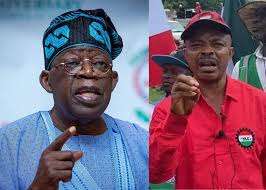
NLC Strike: FG insists on N60K Minimum Wage Offer

That the organized labour has given Monday, June 3rd as commencement date for an indefinite strike to protest the failure of government to approve a new national minimum wage agreeable to them is no longer news. What is trending is that the FG has adduced 14 reasons why it can not approve the figure proposed by labour. Here are 14 reasons the FG gave for a N60,000 minimum wage: N35,000 wage award for all treasury-paid federal workers. N100 billion for the procurement of CNG-fuelled buses and CNG conversion kits. N125 billion conditional grant and financial inclusion to MSMEs. N25,000 each to be shared to 15 million households for 3 months. N185 billion palliatives (loans to States) to cushion the effects of fuel subsidy removal. N200 billion to support the cultivation of hectares of land to boost food production. N75 billion to strengthen the manufacturing sector. N1 trillion for student loans for higher education. Release of 42,000 metric tons of grains from strategic reserves. Purchase and onward distribution of 60,000 metric tons of Rice from the rice millers association. Recent salary increase of 25-35 per cent on all consolidated salary structures for federal workers. 90% subsidy on health costs for Federal Civil Servants registered on NHIS. Light rail commissioned in Abuja to relieve transportation cost until the end of the year. Lagos State had already commenced the same initiative with their blue and red lines. In addition to the freedom of civil servants to engage in agriculture, the federal government has approved the inclusion of ICT services as an alternate source of income. The government added N3, 000 to its initial offer of N57, 000 proposed last week, taking the total figure to N60, 000 while labour lowered its demand by removing N3, 000 from the N497, 000 it proposed last week. The tripartite committee has been locked in talks over a new minimum wage since the committee was inaugurated in January this year. To fast track the negotiation process, the NLC and TUC on May Day gave the committee until the end of the month to wrap up talks on a new national minimum wage. That ultimatum expired on Friday night without an agreement. During the meeting, the government defended their offer of N60,000.00 per month.
FG Reacts As Labour Begins Indefinite Nationwide Strike

The Federal Government has appealed to Organised Labour to reconsider its decision to embark on an indefinite strike from Monday, June 3, 2024. The Nigeria Labour Congress president, Joe Ajaero yesterday announced that the industrial action which would begin by Monday midnight is in protest against the government’s refusal to raise the proposed minimum wage from N60,000. Reacting to the development, Minister of Information and National Orientation, Idris Mohammed in an interview with Punch stated that the interest of the masses should be the top priority of Organised Labour, saying strike was not the solution to the ongoing negotiation for a new minimum wage for workers. His words: “The government is pleading with Labour to reconsider its position. The FG has already made an offer of N60,000, and whatever the government does is in the interest of Nigerians. “We won’t like to do something that will throw the country into another problem. “Even as we do that, we are pleading with Labour. They are partners in this project called ‘Nigeria’ and we expect them to join hands with the FG as it strives to look for solutions that will take Nigeria to the desired prosperity. “Our message is that of an appeal and the need for Labour to see reason with the government. That was even the basis for setting up the tripartite committee that was made up of Organised Labour, the sub-nationals and the FG. This was because the government just didn’t want to make unilateral decisions. In any case, the position on the wage regime is not a one-sided thing. “We expect that they will see reason with the government. That is why we are calling on them to show understanding by not embarking on the strike because we don’t want that at this point. A strike is not the solution to our problem. We are continuing our negotiation with them. The minister and other stakeholders are still talking to them and we believe that we will find a common ground,” he stated.
National Assembly to Consider Bill Proposing Nigeria’s Return To Regional Government

In a landmark move, the National Assembly is speculated to be planning for a debate and, most likely, pass into into law before October 1, 2024, a bill proposing a return to regional government. Part of the draft bill circulating on social media, seen by SaharaReporters is titled: “A Bill for an Act to Substitute the Annexure to Decree 24 of 1999 with a New Governance Model for the Federal Republic of Nigeria.” Although the identities of the sponsors of the bill were yet to be ascertained, the Bill, when passed, would be cited as the Constitution of the Federal Republic of Nigeria New Governance Model for Nigeria Act 2024. The sponsors of the Bill explained that the current Constitution of the Federal Republic of Nigeria 1999 (as Amended) is not “autochthonous” as it does not evolve from the deliberations and consensus of the Nigerian people. According to the advocates, the constitution amendment would be subject to a “yes or no” vote in a referendum by the people of the Federal Republic of Nigeria. The sponsors of the Bill explained that the current Constitution of the Federal Republic of Nigeria 1999 (as Amended) is not “autochthonous” as it does not evolve from the deliberations and consensus of the Nigerian people. According to the advocates, the constitutional amendment would be subject to a “yes or no” vote in a referendum by the people of the Federal Republic of Nigeria. Part of the draft Bill seen by SaharaReporters on Friday partly read: “PART I – Preliminaries: WHEREAS Nigeria, its Peoples and Government have been governed under Decree 24 of 1999 that was handed down by the then Military Government without the express consent of the people despite the preamble of “We the people.” “WHEREAS the said Constitution of the Federal Republic of Nigeria 1999 (as Amended) is not autochthonous as it does not evolve from the deliberations and consensus of the Nigerian People. “WHEREAS the Peoples of Nigeria now desire and effectively demand for a change to a Constitution based on Federal/Regional System of Government. “WHEREAS the Federal and Regional governments are to operate within the provisions of this Constitution, it is within the discretion of the ethnic blocs within the States that constitutes a given region to aggregate or disaggregate as Provinces, Divisions and Districts, while being in control of their affairs without let or hindrance at whatever level of governance. “Whereas the 1999 Constitution as amended is a schedule of a military decree now deemed to be an Act of the National Assembly for which the National Assembly have the powers to amend and/or abrogate as expedient. Whereas the National Assembly where so necessary and expedient can invoke the doctrine of necessity to resolve any point of law for the good governance of the country Nigeria.” On PART 11 – Substitution Clause, the drafters proposed that the National Assembly shall invoke its inherent powers to expunge the schedule attached to decree 24 of 1999 often referred to as 1999 Constitution as amended from the decree, which “is now deemed to be an Act of the National Assembly to which the National Assembly have the powers to so do and replace same with a new governance model for Nigeria effective not later than October 1, 2024.” “This amendment is subject to a yes or no vote in a Referendum by the people of the Federal Republic of Nigeria,” it proposed. On governance structure under PART III – Stipulations for Federal Administration, the sponsors proposed that: “(1) Nigeria shall be a Federation comprising of Regional Territories and a Federal Capital Territory and shall be a Republic to be known by the name of the Federal Republic of Nigeria. “(2) The territorial jurisdiction of Nigeria shall comprise the territory of the Regional members of the Federation and its bound.
FG, Labour To Resume Talks Friday On Minimum Wage

President Bola Tinubu-led government, on Wednesday, reached out to the Organised Labour consisting the Nigeria Labour Congress (NLC) and Trade Union Congress (TUC) for the continuation of minimum wage negotiations. According to Punch, a source familiar with the matter disclosed the development in Abuja. The source noted that Labour would honour the invitation. The source said, “A letter has been addressed to Labour by the committee chairman and signed by the NSIWC chairman. The meeting is scheduled for Friday. “Of course, Labour will attend. If they present a better offer on Friday we will accept it.” Recall that the minimum wage committee, on Tuesday, adjourned indefinitely after talks between the Federal Government and Organised Labour broke down. During the meeting labour rejected the Federal Government’s ₦60,000 fresh proposal, up from the earlier ₦57,000 offer. At the meeting, labour also lowered its demand by removing ₦3,000 from the ₦497,000 it proposed last week, pegging the new proposal at ₦494,000. To fast-track the negotiation process, NLC and TUC on May Day gave the committee till the end of the month to wrap up talks on a new national minimum wage. The ultimatum will expire on Friday night.
FG Withdraws Terrorism Charges Against Miyetti Allah President

The President of Miyetti Allah Kautal Kore, Alhaji Bello Bodejo became a free man on Wednesday after the Federal Government withdrew alleged terrorism charges filed against him. The charges against Bodejo were withdrawn by the office of the Attorney-General of the Federation (AGF) on resumption of the trial on Wednesday. Upon resuming hearing, the lawyer to the AGF, Aderonke Imana, moved an oral application for the withdrawal of the three-count charge The lawyer said the application was under Section 108 of the Administration of Criminal Justice Act (ACJA), 2015. She said the request was further predicated on the power of the AGF under Section 174 of the 1999 Constitution (as amended). “Consequently, the Honourable Attorney-General of the Federation has instructed me to withdraw this charge against the defendant in the interest of justice. “That is our humble application my lord,” she said. Bodejo’s team of lawyers, including Johnson Usman, SAN, but led by Ahmed Raji, SAN, did not oppose the application. The senior lawyer thanked the AGF, Lateef Fagbemi, SAN, for his “magnanimous gesture.” “We urge your lordship to discharge the accused person under the sections refers to by the prosecutor,” Raji said. Justice Inyang Ekwo, in a short ruling, thereafter discharged Bodejo. Ruling, Justice Ekwo said though the matter was slated for commencement of trial, however, the prosecution applied to withdraw the charge citing relevant sections of the law. “The court is hereby moved to consider the application for the discharge of the defendant. “Consequently, an order is hereby made discharging the defendant. That is the order of this court,” the judge declared. Bodejo was arrested on the alleged raising up an armed militia in detriment of the nation’s unity.
Tinubu’s anniversary: FG begins N75,000 cash payment to 75 million Nigerians

The Federal Government announced on Tuesday the reinstatement of the suspended social investment programme, aimed at providing direct payments to 75 million Nigerians across 50 million households. This initiative is intended to alleviate the hardships faced by citizens, particularly vulnerable groups, as disclosed during a ministerial sectoral briefing marking President Bola Tinubu’s first year in office. Wale Edun, the Minister of Finance and Coordinating Minister of the Economy, revealed that the cash transfer programme had undergone significant overhauls to address and mitigate fraud. This announcement follows the suspension of all National Social Investment Programme Agency (NSIPA) activities by President Tinubu on January 12 for a six-week period, due to alleged mismanagement. Concurrently, Betta Edu, the Minister of Humanitarian Affairs and Poverty Alleviation, was suspended on January 8. The intervention programmes affected by this suspension included N-Power, the conditional cash transfer scheme, the government enterprise and empowerment programme, and the home-grown school feeding initiative. On March 13, the House of Representatives urged the federal government to resume these social investment initiatives. To revamp the programme, President Tinubu established a Special Presidential Panel, led by Edun, to conduct an intensive review and audit of the existing financial frameworks and policy guidelines of the social investment programmes. Providing an update on the committee’s progress, Edun emphasised the government’s commitment to providing relief for poor Nigerians. “I am duty-bound to give you an overview of the strategy, policies, and implementation of Mr President’s reform programme,” Edun said. “Immediately upon assuming office, Mr President launched macroeconomic reforms to restore stability to the Nigerian economy, including subsidy reforms and foreign exchange market reforms. “These reforms caused a spike in costs for individuals and businesses, but Mr President is committed to counterbalancing the negative effects with interventions across the social spectrum.” Edun outlined the government’s restarted social investment programme, which includes direct payments to 75 million Nigerians in 50 million households. He also mentioned improvements in access to credit, with ₦1 billion allocated to consumer credit and grants of ₦50,000 being provided to 1 million nanoindustries.
FG Reacts As Labour Rejects N60K Minimum Wage Offer

The Federal Government has appealed to the organised labour to be considerate and accept the proposed N60K minimum wage offer. Minister of State for Labour and Employment, Mrs Nkeiruka Onyejeocha made the appeal in a statement signed by Mr Olajide Oshundun, Director of Press and Public Relations in the ministry on Wednesday in Abuja. The organized labour on Tuesday rejected the N60,000 proposed by the Tripartite Committee. They also reduced their demand from N500,000 to N494,000. Giving reasons for not accepting the N60K proposal, the Labour said: “How can we agree on N60,000- an amount that cannot buy a bag of rice to serve as national minimum wage. Let’s assume that you are buying a loaf of bread for your family at N2,000 every day and that is what you and your family want to be eating for one meal. “We have to be realistic in this country. When government increased the price of petrol, they asked labour to wait and demand for a living minimum wage and the government is going to provide a living a living wage for workers. But now, we are asking for a living wage and government is playing around it.” Reacting to the development, Onyejeocha said that the federal government had been consistent in taking steps to secure a fair and realistic wage for Nigeria workers. “We are committed to putting the people first and ensuring that our economic policies benefit all Nigerians, not just a select few. “The government remain dedicated to prioritizing the well-being of our citizens and its want to urge all relevant parties to demonstrate patriotism and understanding. “This is particularly during this critical period when the President, Bola Tinubu, is working diligently to revitalize the economy,”she said. “As a government, we recognise the importance of ensuring that our citizens receive a decent standard of living, and we are committed to making this a reality. “After hours of intense negotiations, labour leaders took a recess to consult with other key stakeholders and have pledged to return to the negotiating table for further discussion. “We welcome this development and are optimistic that our continued engagement will yield a positive outcome. “In light of the current economic conditions, we have made a concessionary move from N57,000 to N60,000. “This is the path that this government has chosen to pursue, and we will not deviate or stray from the course. “President Tinubu has been tireless in his efforts to revitalise the economy and improve the standard of living for all Nigerians. “His commitment to creating jobs, stimulating economic growth, and reducing poverty is genuine, and we appeal to all to support him in this endeavour. “As we move forward, we will continue to engage with organised labour and other stakeholders to ensure that our economic policies are inclusive and beneficial to all,” she added. Meanwhile, yesterday’s meeting ended in a deadlock as both parties failed to reach an agreement. The meeting was subsequently postponed indefinitely. The Labour had vowed that if the Federal Government failed to come up with a reasonable amount by May 31, then a nationwide strike will begin.
The Tinubu Presidency:Renewed Hope or Reincarnation of Controversy

Just as I reflected on a theme to anchor my thoughts on the first anniversary of the Tinubu Presidency, I received two electronic messages from the same source, expressing two diametrically opposed views on the same subject matter. What is even more perplexing is the fact that the two messages were official communications purporting to convey a message from the highest office in the land and signed off by two individuals that should have been speaking from the same script. The first message, an official communication from the office of the Special Adviser on Media and Publicity to the President, Mr. Ajuri Ngelale read: “STATE HOUSE PRESS STATEMENT IN COMMEMORATION OF MAY 29 AND THE FIRST ANNIVERSARY OF THE PRESIDENT TINUBU ADMINISTRATION In furtherance of his commitment to delivering good governance, President Bola Tinubu has embarked on the inauguration of strategic projects across the country. More transformative projects will be inaugurated by President Tinubu’s administration for the benefit of all Nigerians. In view of public commentary concerning the President delivering a speech before a Joint Sitting of the National Assembly tomorrow, May 29, 2024, it is important to state that this information is false and unauthorized as the Office of the President was not involved in the planning of the event.” This message was dated My 28, 2024. In the same breath, another communication from the presidency and signed by Mr. Bayo Onanuga, the Special Adviser on Information & Strategy to Mr. President was released, and it read: “STATE HOUSE PRESS STATEMENT PRESIDENT TINUBU TO ADDRESS JOINT SITTING OF NATIONAL ASSEMBLY TOMORROW President Bola Ahmed Tinubu will not make a broadcast to the nation on Wednesday to celebrate his first anniversary as the leader of Nigeria. Instead, the President will address a joint session of the National Assembly, which has lined up a programme to commemorate 25 years of the nation’s democratic journey at both the executive and legislative levels. President Tinubu’s speech will dwell on the achievements of his administration and Nigeria’s democracy since the military ceded power in 1999. Former Senate President, Senator David Mark, former speaker of the House of Representatives and now President Tinubu’s Chief of Staff, Rt. Hon. Femi Gbajabiamila are all lined up to address the parliament. Also lined up to speak is the former military ruler, General Abdulsalami Abubakar, who handed over power to civilian administration in 1999. At the end of the speeches, President Tinubu will commission the National Assembly Library and Resource Center, now to be known as Bola Ahmed Tinubu Building.” This one too, was dated May 28, 2024. While we await the stage appearance of President Tinubu, the lead character in this dramaturgy about heroic failures, I can hear some mischief makers murmuring déjà vu. Certainly. It is the reincarnation of controversy, which has become the hallmark of this president. Even more controversial is the record of performance of the first twelve months of the Tinubu presidency. From last May 29, twelve months ago, when on inauguration day, President Tinubu, looking forlorn but turbo-charged by the excitement of new office pronounced, “subsidy is gone” until this day, cheerleaders and advocates of his policy choices have mastered the art of double-speak. They often argue, ‘even though the policies shall visit pain and hardship on the people, the tough decisions have to be made for the good of the country.’ Yet, what we see are somersaults and policy reversals that reveal the poor quality of work that was put into these policies. From the withdrawal of subsidy on petrol to the merger of the forex windows through to recent withdrawal of subsidy on power, Nigerians have been served a menu of completely strange dishes that give them no option of choice. Unfortunately, this is coming after eight cruel years of nepotistic, corrupt and clueless reign of Gen Muhammad Buhari when virtually every index of misery took an upward swing. President Buhari represented the worst case of dashed hope since the return of civil rule in 1999. At ascendancy in 2015, he promised to wrestle corruption to a manageable level, grow the economy and tackle insecurity. Eight years after, he handed Nigeria to his successor and party mate, Bola Ahmed Tinubu as the poverty capital of the world where about 113million, out of a population of 200million, was classified as multidimensionally poor with out-of-school population brimming at 20.2million children. President Tinubu, during his numerous electioneering campaign stumps, promised to continue from where President Buhari stopped. It can be assumed that the import of that message was lost on many Nigerians until what some now say was a thoughtless “subsidy is gone” pronouncement. From inauguration day till date, it will seem like the President was determined to act like the young king Rehoboam who spoke roughly to his subjects and said in 1 Kings 12.11: “And now, whereas my father put a heavy yoke on you, I will add to your yoke; my father chastised you with whips, but I will chastise you with scourges!” What is however, very clear to a discerning Nigerians is the fact that as many compatriots lay prostrate and distraught due to the excruciating burden of “Tinubunomics” his alleged puppeteers, the Bretton Woods institutions, infamous deities of the market-driven economy, may celebrate President Tinubu’s zero-subsidy regimes and the foreign exchange liberalization; two policies that created the current storm in the economy. President Tinubu’s leadership mantra is christened, “Renewed Hope.” This contradicts sharply with the reality on ground as many Nigerians and their businesses have been crowded out of the emerging economic landscape. With the naira now a shadow of its old self, since it now exchanges for less than half of its value as at less than a year ago, while the rate of inflation has doubled and unemployment nearing 50 per cent, and with a cabinet that is an unwieldy crowd of round pegs fitted into square holes, it is most doubtful how President Tinubu can turn the corner and restore hope and life to many
FG approves first aviation school in Southeast

To address the dearth of manpower in the aviation sector, the Federal Government has approved the listing of Eastwing Aviation Training Institute under the National Board for Technical Education (NBTE). Having met the technical evaluation by the FG, the Institute can now commence the process of admission of students through the Joint Admission and Matriculation Board, JAMB, and the students, upon completion of their studies, will be awarded national diploma and high national diploma, respectively. Speaking on the approval, the founder and CEO of Eastwing Aviation, Dr. Christopher Edeh, urged youths to take advantage of the opportunity offered by the institution to achieve their dream of becoming pilots, aviation engineers, cabin crew or other functions found in the sector. He said: “What this approval means for our youths is that every one of them now has the opportunity to explore this field, even if it means just coming to us for advice. The institution would encourage and help build the dream because we do not want you to stay idle after graduating. “It has been my desire to give back to society considering what I have passed through from the day I joined the Nigerian Air Force. “Being the first aviation school in the South-East region means a lot to us. It means that I am getting closer to my dream and I have reached that stage where society can benefit from me.” Explaining the process of getting the institute certified, Edeh disclosed that he worked with former colleagues to realize the project. “Those who worked with me on this project were colleagues that we served together. They have been very supportive throughout this quest. It was purely a communal effort, what you would call ‘Wazobia’ and we are where we are today.” The Eastwing Aviation Institute also recently established a non-governmental organisation to encourage less privileged youths who are talented and who meet the basic requirements but are not able to financially pursue their dreams. According to the founder, “We are hopeful that the new dawn would encourage a huge turn up. Many people regard the aviation sector as rocket science; now we have brought it to their doorsteps. For interested candidates, there are many areas in this field they can fit in; go to airports, all you see are many people carrying luggage and we believe they can do more than that.” Speaking further, Dr Edeh recounted: “A good example is one of the security personnel I worked with who was talented and hardworking. I realised this and encouraged him to do more for himself seeing that he has potential. Today, he is an aircraft maintenance engineer in one of the airlines.”
Obasanjo proffers solutions to Nigeria’s economic woes

Former Nigeria President, Olusegun Obasanjo has told President Bola Ahmed Tinubu to ramp up activities around production and productivity to tackle Nigeria’s economic woes. Obasanjo disclosed this in a statement by his Media Aide, Kehinde Akinyemi, on Sunday, quoting the ex-president as having spoken at a Colloquium: “Nigeria’s Development: Navigating the Way Out of the Current Economic Crisis and Insecurity” delivered at the Paul Aje Colloquium (PAC) in Abuja. Obasanjo blamed fuel subsidy removal, the Harmonization of foreign exchange markets and dealing with a military coup in Niger for Nigeria’s economic hardship. However, as a solution, the former President said the government should focus on production, noting that there is no shortcut to economic progress. “The way forward is production and productivity, which belief and trust in government leadership will engender. No shortcut to economic progress but hard work and sweat. “The economy does not obey orders, not even military orders. I know that. If we get it right, we will begin to see the light beyond the tunnel in two years. It requires a change of characteristics, attributes and attitude by the leadership at all levels to gain the confidence and trust of investors who have alternatives,” he said. Recall that in June last year, Tinubu’s administration announced fuel subsidy removal and the Harmonization of Foreign exchange markets. In April, fuel pump price surged by 176.02 per cent on a year-on-year basis to N701.24 per litre compared to N255.06 last year. Similarly, the country’s Naira dropped to N1482.81 per dollar last Friday from N465.50 per dollar on June 14, 2023. This development has led to a surge in prices of goods and services, as headline and food inflation increased to 33.69 per cent and 40.53 per cent, respectively.