No work no pay, except in the NNPC refineries

By UGO ONUOHA PUBLIC intellectual and a commentator on national issues, Dr. Nnaemeka Obiaraeri, recently reportedly said that members of Petroleum and Natural Gas Senior Staff Association of Nigeria [PENGASSEN] and Nigeria Union of Petroleum and Natural Gas WORKERS [NUPENG], two key unions of oil workers in Nigeria consume about N120 billion in salaries, allowances, and wages every year. The two unions in various incarnations have been the dominant players in Nigeria’s oil industry for about 60 years, and especially since the commissioning of our first refinery in 1965 in Alesa, Eleme, near Port Harcourt, in Rivers state. This refinery, a joint venture between Shell and British Petroleum, was then known as Nigerian Petroleum Refining Corporation [NPRC]. It was initially built to process crude oil into products like gasoline and diesel. It had the capacity to process 38,000 barrels of crude oil per day. About 24 years later, in 1989, another refinery was founded by the federal government close to the first plant, the so-called second Port Harcourt refinery. Two more refineries were subsequently established by the government, one in Warri in today’s Delta state, and the other in Kaduna, Kaduna state. In theory, the four refineries have a combined capacity of 450,000 barrels. Dangote Refinery and Petro-chemical Company These four government – owned refineries were all that were of note that operated here until the ‘commissioning’ of the Dangote Refinery and Petrol-Chemical Company in 2023, long before it was completed. In reality, the refinery came on stream in January last year with the production of diesel and aviation fuel. The production of petrol followed eight months later, one year ago last month. At its commissioning, and up till now, the Dangote refinery is the largest single-train refinery in the world. But with its current capacity of 650,000 barrels per day, it is ranked as the seventh largest refinery globally. India’s Jamnagar Refinery sits atop the pile worldwide with an output capacity of 1.24 million barrels per day. We will return to the travails of the Dangote refinery shortly. RELATED STORIES: Non-Functioning Refineries In 2007, in the twilight of the administration of President Olusegun Obasanjo [1999-2007], Blue Star, a consortium led by the business man, Aliko Dangote, had bidded and and won majority shares in two of the four government-owned refineries in Port Harcourt and Warri. There was disquiet in the land with allegations of underhanded dealings and specious, self-serving arguments about national energy security. So when the successor administration of President Umaru Musa Yar’Adua took office that same year, it revoked the sale and refunded the Dangote consortium about $700million. It has to be said that before the consortium moved in, the refineries were at best epileptic in their operations, and at worst moribund. In fact, to all intents and purposes they were dead. They had become bottomless pits and a cesspool for the corrupt and unscrupulous government officials and their outside collaborators. The unions, PENGASSEN and NUPENG, and their fatcat leaders orchestrated the protests and strikes against the partial sale of the two refineries. The unions were not alone. There was a cabal in the background of those who import petroleum products into the country on behalf of the Nigerian National Petroleum Corporation [NNPC]. The deal was that they bring in the products and then make a claim on the government including payments for subsidies. It was a racket that bordered on daylight robbery. Many of the authorised persons and companies brought in zero petroleum products, and yet claimed humongous subsidy payments. There were cases of forged shipping documents and discharge of millions of phantom metric tons of petroleum products in ghost tank farms in Lagos, and elsewhere. And the ghost importers got payments. The racketeering was widespread, corrosive, and deadly. It stretched from individuals to corporations, to government agencies, to the ports, to the national legislature, and the presidency. It was a bazaar. The greater tragedy was that unsuspecting Nigerians were used as fodders to oppose the partial government divestment from the moribund refineries. For as long as it lasted, and it has not really ended, the four government refineries presented a story of the near hopelessness of this country. Some persons were employed in each of the refineries in Port Harcourt, Warri and Kaduna and retired in the same after 35 years or on attaining 60 years of age without doing any meaningful work, without really earning their pay. And in-between their employment and retirement, they attended trainings at home and abroad; were promoted as and when due; got pay raise; received hefty allowance; collaborated and connived with the petroleum products import cabal to fleece the country; and, then went home with hefty gratuities and pensions. To crown it all many of such people were not, ab initio, qualified for the jobs for which they were employed. They were beneficiaries of nepotism in recruitment into high-paying government agencies and parastatals such as the refineries, NNPCL, central bank, NIMASA, among others. If, according to Dr. Obiaraeri, about N120billion is expended annually on salaries, wages, and allowances of members of PENGASSEN and NUPENG, then it will be safe to assume that about N250bn was being used as overhead for the personnel of the moribund refineries. And if the refineries have not worked effectively and efficiently for about 30 years, and they indeed have not, it means that this country has been pouring N250bn on average down the drain every year for 30 years. Or N7,500,000,000,000 [N7.5trillion]. In which sane country does this happen, and be allowed to linger for about one generation?    Between $15-20bn may have been expended on repairing and recovering the moribund refineries in the last 30 years, to no avail. Of course, much of the money may have been stolen. It was not unusual to read bizarre stories about the stewardship of some leaders of the NNPC, owners and operators of the refineries. About $9million was once found in a steel cabinet in a nondescript house in Kaduna of one of NNPC’s former

Sani approves N72,000 minimum wage for Kaduna workers

Gov. Uba Sani of Kaduna State has approved a new minimum wage of N72,000 for civil servants in the state, with effect from November. Chief Press Secretary to the Governor, Malam Ibraheem Musa, made the disclosure in a statement issued in Kaduna on Thursday. Musa said that the approval of the new minimum wage was part of the Sani-led administration’s commitment to workers’ welfare. He also said that the move was aimed at improving the living conditions of the low-income, the vulnerable and the underserved communities. Musa highlighted the governor’s longstanding commitment to advancing workers’ rights, enhancing their welfare and supporting disadvantaged groups in the state. In addition to the new wage policy, he said that the governor would also launch a Free Transport Scheme for civil servants, introducing 100 CNG-powered buses to provide daily transportation to and from work. According to him, the scheme, designed to ease financial burdens and improve productivity, will be managed by a Joint Management Committee, comprising NLC and TUC representatives and the state government. Musa restated the present administration’s commitment to implementing policies that would uplift the less-privileged and make the state a model for social welfare programmes, with the support of the citizens.

TUC Pushes for Petrol Price Cut, Urges FG to Act

The Trade Union Congress (TUC) has called on the Federal Government to reduce petrol prices to the rates seen in June 2023.  This demand comes amidst rising fuel costs that have affected Nigerians since May when the rate surged from ₦184 to the current price of ₦998 per litre in Lagos. The Congress goes on to make a raft of suggestions which it reckons, when adopted by the Federal Government, would ameliorate the current hardship greeting the sudden increase in fuel pump price. avert the impending mallei The TUC proposed that foreign exchange be allocated to Dangote Refinery at a lower rate to make fuel more affordable. It also suggested sourcing refined petrol from other regions if current production cannot meet local demand. In addition, the TUC advocated for all marketers to be given licenses to lift petrol from the Dangote Refinery, ensuring availability and access to fuel across the country. “We want the price of the product to go below what it was before; not just reverse to what it was before but to go below,” said TUC President, Festus Osifo, at a press briefing in Abuja on Thursday. “We want the Federal Government to, through Nigerian Midstream and Downstream Petroleum Regulatory Authority (NMDPRA), give all marketers licenses to lift petrol from the Dangote Refinery. “The solution we are proposing if implemented will take us to the price we had as of June last year. “There is no government in the world that doesn’t intervene in its critical sector” and that the Federal Government “shouldn’t leave it (the oil sector) to the vagaries and gyration of our naira. “If it is not available, it is a problem. If, for example, the production from Dangote Refinery is less than 15 million litres per day, it is not sufficient. “So, while efforts are being made to ramp up production from Dangote Refinery, what we are demanding is that we should look for every other means as we are ramping up production, we should source for that difference and bring it in for a while until Dangote can get to that level where the production is sufficient to get to all nooks and crannies of Nigeria. For us, that is key because it will address the issue of availability,” the TUC boss stated.

Strike: ‘Why Labour Should Be Thankful To God That We Are Not In Military Regime’ – Presidency

The presidency has stated that in light of the recently lifted nationwide strike, organized labour should express gratitude that Nigeria is not under military rule. President Bola Tinubu’s Special Adviser on Information and Strategy, Bayo Onanuga, pointed out that the Nigerian Labour Congress (NLC) and Trade Union Congress (TUC) enjoy ample freedom owing to Nigeria’s civilian regime. Speaking on TVC, Onanuga criticized labour for shutting down airports and the national grid as part of their efforts to enforce the nationwide strike. Onanuga said: “Labour should view itself as a partner with the Federal Government, not as an adversary to the Federal Government. “Labour should be thankful to God that we are not in a military regime. We are in a civilian regime that allows for freedom of expression. “I think that labour overstepped their bounds by shutting down the national grid. At a time when we are complaining about the lack of power, I think that act is extreme. You’re not supposed to shut down the airports on everyone else. Joining the strike should be voluntary. “I will appeal to labour to be more responsible in their reaction. They cannot be asking for what they are asking for. It is unrealistic.” Recall that organized labour initiated a nationwide strike on Monday to push for an enhanced pay package. The organised labour is demanding ₦494,000 minimum wage as opposed to ₦60,000 proposed by the Federal Government. However, President Tinubu reaffirmed his commitment to a wage exceeding ₦60,000, with the TUC and the NLC stressing their willingness to adjust their ₦494,000 demand. Following an agreement between the Nigerian Government and labour to raise the minimum wage.

FG invites labour to meeting Tuesday

The Federal Government has through the National Salaries, Incomes and Wages Commission, invited the organised labour to a meeting on Tuesday over the ongoing nationwide strike. The Nigeria Labour Congress and the Trade Union Congress had on Sunday said the strike would go ahead on Monday as scheduled despite an appeal by the leadership of the National Assembly which held a mediation meeting between the unions and representatives of the Federal Government. The two unions and their organs commenced the strike on Monday which paralysed economic and government activities in different states of the federation. Ministries, departments, agencies and offices in critical sectors like the courts, government secretariats, airports, and schools were grounded. Many bank branches did not open although some in Lagos did not shut down. Labour went on strike because it could not accept the N60,000 minimum wage offered by the Federal Government.

Nationwide Strike to Go on: Negotiations Between NASS and Labour End in Deadlock

Efforts by the leadership of the National Assembly to mediate between the federal government and Labour unions hit a roadblock as the latter insists on continuing the strike. Despite last-minute discussions, the unions remained adamant in their demand for a ₦494,000 minimum wage while negotiations persist. In a bid to resolve the ongoing impasse between the federal government and Labour unions, the leadership of the National Assembly convened a meeting aimed at finding common ground. However, despite extensive deliberations, the parties failed to reach a consensus. Labour unions, represented by their leadership, reiterated their stance that the strike action must continue until their demands are met. Central to their demands is the insistence on a ₦494,000 minimum wage, which they argue is necessary to address the pressing needs of workers across various sectors. Meanwhile, the federal government has expressed its commitment to ongoing negotiations but maintains that any decision regarding the minimum wage must be approached with careful consideration of economic realities and sustainability. The deadlock in negotiations underscores the challenges faced by both parties in finding a balance between addressing the legitimate concerns of workers and ensuring the long-term viability of government policies. As the strike enters its next phase, the impact on essential services and the economy at large is expected to escalate, further underscoring the urgency for a resolution to be reached. With negotiations at an impasse and the strike set to continue, the onus is on both the federal government and Labour unions to redouble their efforts to find a mutually acceptable solution. The welfare of workers and the stability of the economy hang in the balance as stakeholders navigate this challenging period of labor relations.

Nigeria Police Seal NLC Office in Lagos Ahead of Planned Protest

In a move to thwart the Nigeria Labour Congress (NLC) planned nationwide protest against hunger and hardship, the Nigeria Police Force has sealed the NLC office in Lagos State.  The protest, scheduled for February 27 and 28, is aimed at address economic challenges faced by Nigerians. Hassan Taiwo, national coordinator of the Education Rights Campaign (ERC), shared an image on Monday morning revealing armed police personnel stationed in front of the NLC headquarters in the Yaba area of Lagos State.  Some individuals within the building remain uncertain about the unfolding developments. The NLC had issued a 14-day ultimatum to the Nigerian government regarding widespread hardship, leading to the organization of the protest.  Despite warnings from the Department of State Services (DSS) and the Attorney General of the Federation, Lateef Fagbemi (SAN), urging cancellation, the NLC remained steadfast in its decision. Accusing the government of planning to attack peaceful rallies and alleging involvement of certain groups in causing violence against protestors, the NLC President emphasized the right to peaceful protest.  The statement also expressed concerns about potential deployment of state-sponsored terror, highlighting the NLC’s determination to proceed with the protest despite government warnings and concerns from various quarters.

Day 2 Nationwide Strike: NLC Pickets Banks, Courts, Govt Offices

Just In: NLC, TUC Suspend Nationwide Strike

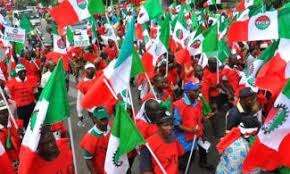
The nationwide strike declared by the Nigeria Labour Congress (NLC) and the Trade Union Congress (TUC) entered its second day with intensified actions across various states, including Kaduna, Rivers, Edo, Yobe, and others. Union officials, spearheading the strike, engaged in picketing activities targeting banks, courts, and government offices to press for compliance with their demands. In Kaduna, the enforcement team led by NLC Chairman Ayuba Suleiman took measures to ensure full compliance with the strike. Gates of the Kaduna State Secretariat, housing several ministries, were locked along the independence way. Similarly, all banks along the Yakubu-Gowon Way remained closed for regular business, except for Automated Teller Machine (ATM) services. Additionally, the National Union of Electricity Employees (NUEE) halted operations at the Transmission Company of Nigeria (TCN) power plant in Mando, while the Kaduna Electricity Distribution Company’s headquarters remained shut. Expressing contentment with the level of compliance, Suleiman reiterated the unions’ commitment to maintaining the strike until the government addresses their demands comprehensively. Moving to Rivers State, workers’ protest actions resulted in the closure of the Court of Appeal and several other offices on Moscow Road, Port Harcourt. Notably, facilities hosting agencies like the Nigerian National Petroleum Company Limited (NNPCL), housing the Nigerian Upstream Petroleum Regulatory Commission (NUPRC) and Nigerian Midstream and Downstream Petroleum Regulatory Authority (NMDPRA), were also locked down. Vehicles belonging to workers lined the roads, while operations remained suspended. In Edo State, Organised Labour leaders monitored compliance and disrupted the inaugural sitting of the Edo State Local Government Election Petition Tribunal, impacting activities at the NNPC Mega Filling Station on Sapele Road in Benin City. The strike also affected schools and banks in the region. However, in Yobe State, the strike experienced partial compliance as some government and private offices operated behind closed doors. In response, the NLC/TUC Task Force shut down offices that were not adhering to the indefinite strike in Damaturu, the state capital. NLC Chairman Muktar Tarbutu emphasized ongoing efforts to sensitize members for complete compliance with the national directives. The second day of the nationwide strike witnessed varying levels of impact across different regions, with intensified efforts by union officials to enforce compliance and escalate the strike’s influence until their demands are met. *Channelstv.com

Shelve Planned Strike, Tinubu, Sultan Beg NLC, TUC

Shelve Planned Strike, Tinubu, Sultan Beg NLC, TUC

President Bola Tinubu has appealed to the labour unions to give government more time to address the issues bedeviling the country. The Nigeria Labour Congress (NLC) and the Trade Union Congress (TUC) have fixed October 3rd to embark on an indefinite strike following the removal of fuel subsidy by the Federal Government and the attendant hardship it has brought on Nigerians. Tinubu, who was represented by the Deputy Senate President, Sen. Barau Jibrin, at a public lecture to mark Nigeria’s 63rd Independence Anniversary on Friday in Abuja, announced that the Federal Government is determined to address the socio-economic challenges facing Nigerians. Whilst urging them to sheathe their swords “in the interest of the masses”, Tinubu said his government was doing everything within its power to bring succour to Nigerians. “I want to emphasise as well that this government is new and the government is doing all within its powers to make sure it brings succour to the entire people of this country. “Government has already gone ahead to provide N500 billion to states to cushion the effects of subsidy removal. The President enjoined members of the unions to consider dialogue as the best way to resolve the issues. “The Sultan also talked about the issue of strike by the NLC. Please, on behalf of the President and the entire government, this is not the time for strike. It is too early. “Please let’s dialogue, let’s get together, let’s understand ourselves and let us look at the prevailing situation in the country,” he said.  Earlier in his remark, Alhaji Sa’ad Abubakar, the Sultan of Sokoto and President-General, Supreme Council for Islamic Affairs (NSCIA), had appealed to labour unions to shelve the nationwide strike slated to commence on Tuesday. Abubakar urged Labour not to embark on the industrial action but continue to dialouge with the Federal Government. He emphasised the need for dialogue to find solutions to the issues “instead of embarking on a strike”. “I am an advocate of dialogue because strikes don’t solve problems; they make them worse. Our leaders must tighten their belt, the common man is suffering. “I don’t think this government will just decide to make life bad for the people; as leaders and elders, we will always call on stakeholders not to embark on journeys that will make life worse for the common man. “I don’t think government can take it upon itself to make life unbearable for the common man, let’s give them chance and see what they can do,” he said. According to him, strike will add more problems to the existing economic situation. “If people are on strike, there wouldn’t be electricity, water, hospital and transportation system. “Please, let’s reach out to our brothers and sisters who are clamouring to go on strike. They should have a rethink,” Sultan appealed.

NLC’s planned protest, strike according to law –Falana

NLC’s planned protest, strike according to law –Falana

Human rights lawyer, Femi Falana has said the Nigeria Labour Congress and its affiliates can proceed on the August 2 strike and protest as planned, and that the exercise does not translate to any contempt of court. This is contained in a letter from the Falana Falana Chambers, solicitors to the NLC, by Sam Ogala, titled “Re- NLC in contemt of Court” and addressed to the Permanent Secretary/ Solicitor-General, Federal Ministry of Justice on July 28. According to the Senior Advocate of Nigeria, the decision of Nigerian workers to participate in peaceful rallies is for the interest of the masses and to protest the worsening economic crisis in the country. “You were reported to have accused the leaders of the Nigeria Labour Congress of treating the order of the National Industrial Court with contempt. “Contrary to your unwarranted allegation, the Nigeria Labour Congress does not intend to disobey the ex parte order of the National Industrial Court. “And to the effect that “the defendants/respondents are hereby restrained from embarking on the planned Industrial Action/or strike of any nature, pending the hearing and determination of the Motion on Notice dated June 5.” Falana added that the National Industrial Court or any other Court had not granted an order of interim, interlocutory or perpetual injunction restraining Nigerian workers from participating in peaceful rallies convened by the NLC. He argued that it was the constitutional right of Nigerian workers to protest peacefully and cannot by any stretch of imagination be classified as an industrial action or strike of any nature. “It is pertinent to draw your attention to the case of Inspector- General of Polic vs Nigeria People Party (2008) of where the Court 12 WRN 65, where the Court upheld the fundamental right of Nigerians to protest without police permit in the leading judgment of the Court, Justice Adekeye. “This includes the right to demonstrate, and the right to protest on matters of public concern are rights which are in the public interest and that which individuals must possess, and which they should exercise without impediment as long as no wrongful act is done. “If as speculated by law enforcement agents, that breach of the peace will occur, our criminal code has made adequate provisions for sanctions against breakdown of law and order. “So that the requirement of permit as a conditionality to holding meetings and rallies can no longer be justified in a democratic society.” He added that, finally, freedom of speech and freedom of assembly are part of democratic rights of every citizen of the country. “Our legislature must guard these rights jealously as they are part of the foundation upon which the government itself rests. “Having advised the NLC and its allies to conduct the rallies peacefully, you may wish to advise the Nigeria Police Force to comply with section 83(4) of the Police Establishment Act 2020. “Where a person or organisation notifies the police of his or its intention to hold a public meeting, rally or procession on a public highway or such meetings in a place where the public has access to. “The police officer responsible for the area where the meeting rally or procession will take place shall mobilise personnel to provide security to provide security cover for the meeting, rally or the procession,” he said. The National Industrial Court in Abuja on June 5, restrained the NLC and the Trade Union Congress, TUC, from embarking on their planned strike to protest the unilateral removal of fuel subsidy by the Federal Government. The court, in a ruling that was delivered by Justice O. Y. Anuwe, barred the two organizations from proceeding with the strike action, pending the determination of a suit that was brought before it by FG. The court held that the interim order, as well as the substantive suit, should be immediately served on both the NLC and the TUC, which were cited as defendants/respondents in the suit marked: NICN/ABJ/158/2023, even it fixed the matter for hearing on June 19. The court order followed an ex-parte application that FG filed through the Federal Ministry of Justice. FG’s lawyer, Mrs. Maimuna Lami Shiru, who moved the application, maintained that the proposed strike action was capable of disrupting economic activities, the health sector and the educational sector. FG further tendered Exhibits FGN 1, 2 and 3, which were notices from the NLC, TUC and the Nigerian Union of Journalists, NUJ, to their members, asking them to withdraw their services with effect from Wednesday, June 7. The court, in its ruling, held that it was empowered by section 7(b) of the NIC Act, 2006, with the exclusive jurisdiction in matters relating to the grant of any order to restrain any person or body from taking part in any strike, lockout or any industrial action. It held that sections 16 and 19(a) of the NIC Act 2006, also empowered it to grant urgent interim reliefs. The court held that the affidavit of urgency as well as the submission of FG’s lawyer revealed: “a scenario that may gravely affect the larger society and the well-being of the nation at large”. On July 27, the Federal Government said the planned strike by the NLC over the removal of fuel subsidy and its attendant hardship is in contempt of an order of the National Industrial Court. Solicitor-General of the Federation Beatrice Jeddy-Agba, in a statement on the issue, warned the NLC leadership to desist from threatening court orders with disdain. The NLC, on July 19, issued a notice to begin a nationwide strike on Aug. 2 to protest the removal of fuel subsidy amid an astronomical hike in the pump price of petrol resulting from the policy announced by President Bola Tinubu at his inauguration on May 29.