NGF Backs Direct Federation Account Oil Revenue Reforms

Nigeria Governors’ Forum meeting highlighting support for direct Federation Account oil revenue reforms.

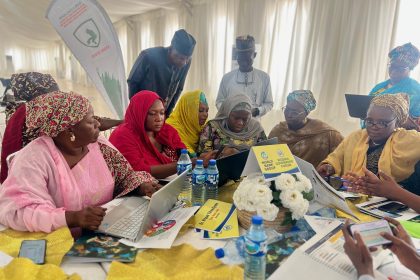
The Nigeria Governors’ Forum has thrown its weight behind Executive Order 9 signed by President Bola Ahmed Tinubu, describing direct remittance of oil and gas revenues into the Federation Account as essential for fiscal transparency, predictability, and constitutional alignment across federal, state, and local governments.

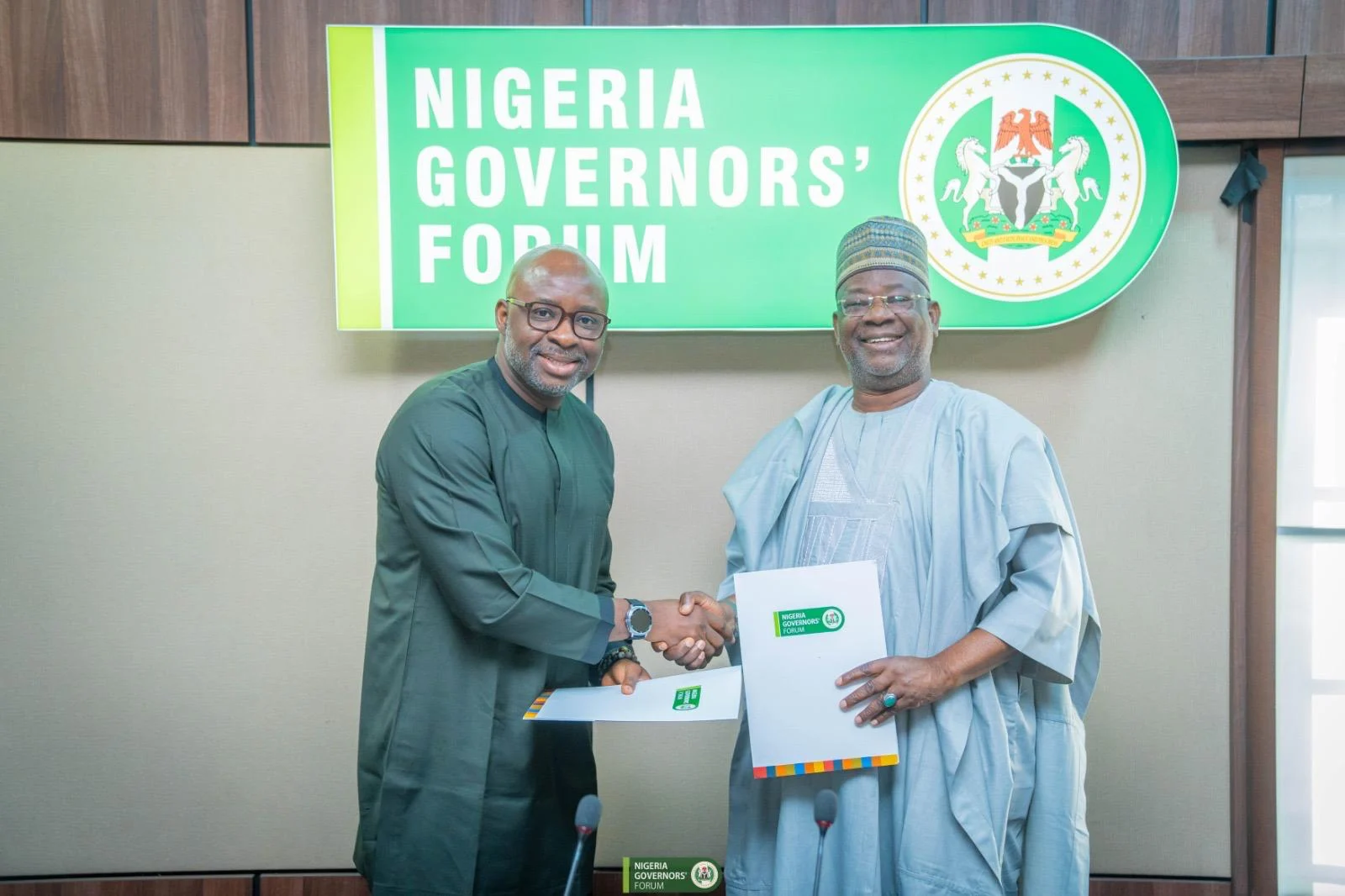
NGF, HiiL Seal Partnership to Advance People-Centred Justice in Nigeria

The Nigeria Governors’ Forum (NGF) has entered into a formal partnership with the Hague Institute for Innovation of Law (HiiL) to deepen justice sector reforms and promote people-centred justice across Nigeria’s 36 states. The partnership was sealed through the signing of a Memorandum of Understanding (MoU) at the NGF Secretariat in Abuja, marking a shift from years of engagement between both institutions to a more structured and long-term collaboration focused on measurable outcomes for citizens. Speaking at the event, the Director-General of the NGF, Dr. Abdulateef Shittu, said the agreement builds on an existing relationship shaped by sustained, evidence-based dialogue on justice reform. He described the collaboration as timely, given ongoing challenges around access to justice, affordability, and public trust in justice institutions. According to Shittu, a key milestone in the NGF–HiiL relationship was the launch of the Justice Needs and Satisfaction in Nigeria 2023 Report, which he said has provided policymakers and justice sector stakeholders with credible data on how Nigerians experience justice and where critical gaps remain. He noted that the report has helped move reform conversations beyond assumptions, enabling governments and practitioners to design interventions that respond more directly to citizens’ needs. Under the MoU, both organisations will work together to promote justice systems that are accessible, fair, affordable, and responsive, with a particular focus on the subnational level where most justice challenges occur. Shittu explained that the agreement is not intended to be symbolic, but rather a platform for coordinated action, innovation, and learning. “This is a commitment to action and measurable impact across Nigeria’s justice landscape,” he said. The NGF’s role places state governments at the centre of the reform effort. As the coordinating body for Nigeria’s 36 governors, the Forum is expected to use the partnership to position states as testing grounds for people-centred justice models that reflect local realities. The collaboration is also expected to support reforms that strengthen justice institutions while ensuring that legal systems respond to how people experience everyday disputes, including land, family, commercial, and service-related issues. Shittu acknowledged HiiL’s technical expertise and global experience in justice innovation, expressing optimism that research insights generated through the partnership would translate into practical solutions that improve efficiency, inclusion, and trust in justice delivery. A press statement by NGF Director of Media and Strategic Communications, Mr. Yunusa Tanko Abdullahi explains that HiiL has operated in Nigeria for several years and reputed for its people-centred justice approach, which focuses on outcomes rather than procedures and integrates formal and informal justice pathways. It States further that the partnership with the NGF is expected to help scale such approaches across states through stronger institutional alignment. Both parties committed to working in good faith to expand access to justice through data-driven reforms, innovation, and collaboration, with specific initiatives to be developed under the MoU framework. As Nigeria continues to confront long-standing challenges related to justice delivery, observers say the NGF–HiiL partnership signals a renewed effort to place citizens at the centre of justice reform.

NGF Backs State Of Emergency In Education

NGF Backs State Of Emergency In Education

The Nigeria Governors’ Forum (NGF) has expressed support for a call of a state of emergency in the education sector. Speaking at the National Conference on the Learning Crisis in Nigeria in Abuja on Wednesday, the Chairman, NGF, Governor Abdulrazaq Abdulrahman of Kwara, said resources must be provided for sustainable and promising education. The conference, organised by the Federal Ministry of Education in collaboration with United Nations Children’s Fund, has the theme: “Scaling Foundational Literacy and Numeracy in Nigeria.” Represented by the Vice Chairman of NGF, Governor Seyi Makinde of Oyo State, Abdulrahman said education is in crisis and a state of emergency should be declared in the sector. He stressed the need to remove all barriers such as gender, poverty, location, disabilities, language and ethnicity, that could hinder children from accessing foundational literacy and numeracy. “We must follow UNESCO standard for education system that is progressive and sustainable, Governors at the various states must commit above 15 per cent above of our budget to education. “I support the call for state of emergency but it must be backed by actions, the resources must be provided and we must look at issues that have mitigated against achieving that sustainable growth. “It is one thing to declare a state of emergency but it’s another thing to put all the resources and elements that will allow us to achieve it. “So, I support putting the resources in place to allow us move fast at it. Our education is in crisis and a state of emergency should be declared in all the sector. We need solid roadmap and I believe it is a collective involvement,” he said.  Meanwhile, the Minister of State for Education, Dr Yusuf Sununu, said learning crisis had been a challenge the education sector is faced with which needs urgent solution. “The consequences of learning crisis are far-reaching and profound as we risk widening the already significant education gap, perpetuating a cycle of poverty, illiteracy, diseases and stifling innovation and progress. “Education is the cornerstone of societal progress and individual empowerment, yet the challenges we currently confront demand our immediate attention, dedication, and action. “In recent years, Nigeria has been grappling with a severe learning crisis that hinders our youth from achieving their fullest potential. “A significant portion of our school-aged population, especially those in underserved communities, face barriers to access quality education. “The factors contributing to this crisis are multifaceted and include inadequate infrastructure, teacher shortage, unequal distribution of resources, outdated curricula, and socio-economic disparities,” he said. Sununu said the country must rise to protect the potential and aspiration of the youths, saying they are the greatest asset and hope for a prosperous future. He expressed the political will of President Bola Tinubu to raise education budgetary allocation from 8 per cent to 25 per cent in the next few years. He said the gesture would be a major breakthrough in addressing the learning crisis issues. In the same vein, UNICEF Representative in Nigeria, Cristian Munduate, said the conference was from outcomes of UN General Assembly in September where countries were urged to accelerate progress on Sustainable Development Goal 4. Munduate said this is to regain ground lost during the COVID-19 pandemic that saw unprecedented school closures globally. “For Nigeria, convening a conference on the learning crisis is opportune as government defines its priorities for the education sector in the new Ministerial Strategic Plan (MSP). “Just as Nigeria has galvanised significant support around the out-of-school problem, so too must it give attention to the learning crisis that is in fact fueling the out-of-school problem in Nigeria. “Three out of four children in basic education in Nigeria cannot read with meaning or solve simple maths problems. “When children fail to learn to read in the early years, they fail to read to learn in the subsequent years. Failure to learn begins to alienate children from the curriculum and their peers. “This contributes to the staggering drop out rates each year between the first and last year of primary school,” she said. She, therefore, called for serious attention to the learning crisis saying learning is not just important for education outcomes, it is key to finding a higher paying job, for achieving better health outcomes and for navigating community and social life. Also, the Chief Education, UNICEF Nigeria, Saadha Panday-Soobrayan, said the learning crisis in Nigeria begins in early childhood education, saying only half of the children are developmentally on track in early childhood. She said that learning gaps persist across the life course and most severe in the north part of the country. According to her, by the end of grade nine, only 74 per cent of pupils demonstrate foundational literacy and 69 pee cent foundational numeracy. She, therefore, said that all hands must be on deck to finding a lasting solution to the country’s learning crisis.

Buhari congratulates Abdulrazaq on emergence as NGF Chairman

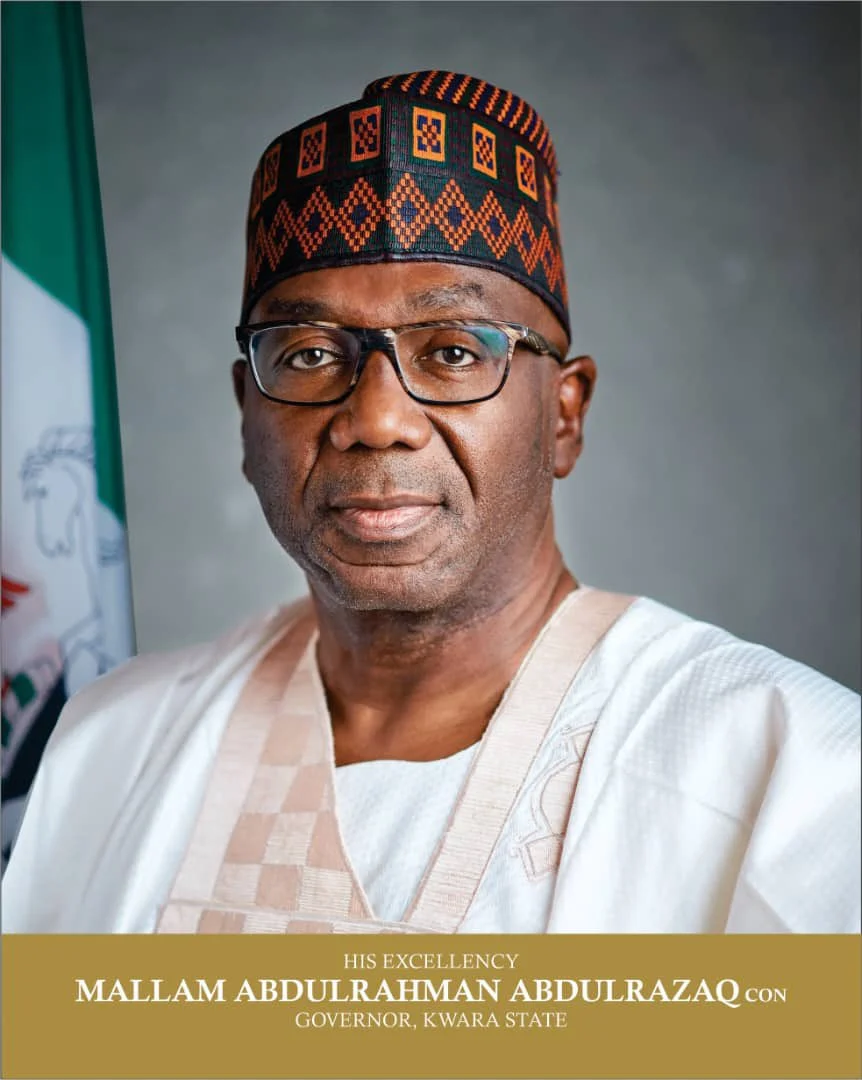
KWARA GOV ABDULRAZAK

President Muhammadu Buhari has congratulated Kwara State Governor AbdulRahman AbdulRazaq on his emergence as the new Chairman of Nigeria Governors’ Forum (NGF). Buhari, in a congratulatory message issued by his Spokesman, Malam Garba Shehu, on Friday in Abuja, urged the governor to give his best in providing leadership for the forum. He commended the governors for their maturity and stability of the NGF over the years, especially in electing new leaders. The president also acknowledged the significant role which the forum has been playing in stimulating discussions on development, promoting democracy and counseling political leaders on service to the nation. He was optimistic that the new NGF Chairman would further improve relations, tighten policy issues and provide more opportunities for growth among states and the Federal Government, considering his antecedents in business and government. The president wished AbdulRazaq the very best in the new assignment. 

Security: NSA, DG DSS task governors on conflict management

STAKEHOLDERS AT THE NGF INDUCTION

The National Security Adviser (NSA), retired Maj.- Gen. Mohammed Monguno, has tasked state governors with the regular engagement of stakeholders and proper management of conflicts to enhance the security of their respective states. The NSA made the call at the ongoing three-day 2023 induction program for re-elected and newly elected governors organised by the Nigeria Governors’ Forum (NGF) in Abuja. Munguno, represented by Mr. Joseph Dashwuep, a senior officer in the NSA’s office, also called on State Governors to adopt both the kinetic and non-kinetic models in tackling insecurity in their states. Monguno who was the lead discussant at a panel session on “Managing security in the states: Ungoverned spaces and regional security” said that security agencies would always do their best to keep Nigeria safe. He said that there was the need for state governors to adopt policies that meet the aspirations of the people and ensure proper management of conflicts. “The way you manage conflicts go a long way in determining the peace and security of your state,” Monguno said. He also advised them to regularly meet with security agencies, media, civil societies, non-governmental organizations, citizens, and traditional and religious leaders. Also speaking, the Director-General of the Department of State Service (DSS), Yusuf Bichi who was a discussant, advised governors to act promptly on intelligence reports and early warning alert. ”You are expected to act promptly once you receive intelligence or early warning reports. “Do not neglect these reports. Sometimes governors will receive intelligence report and hand it over to a special adviser or aide,” he said. The Inspector-General of Police, Usman Baba, who was also a discussant, advised governors to work with existing security architecture to secure their state. Baba said that establishing a new security outfit would cost more than improving of the existing ones He also advised governors to tackle the issue of unemployment and poverty as well as adopt advanced technology in fighting crime. Contributing, Gov. Charles Soludo of Anambra, said that state governors should be empowered to tackle security challenges at the local level because the federal security agencies were not localised. “The central point here to make is that security or insecurity is largely a local issue. Every locality has its own peculiarities. “I think for those of us who are governors and the governors-elect, a major concern that we need to address is that the national security architecture places much emphasis on kinetic architecture which is almost exclusively on the shoulders of the Federal Government. “Whereas the governors are called chief security officers (without troops); we must have to learn how to cope for survival in a dysfunctional system,” he said. Soludo expressed happiness that the President-elect, Sen. Bola Tinubu had expressed his commitment to state police saying that is really the way to go in a federal structure. “The vigilante services of various states are backed by law. The one of Anambra is doing well but we are operating on a tight constraint as it were,” he said. Also, Gov. Hope Uzodinma of Imo, said instead of establishing new security outfit at the state, governors should key into efforts by federal government. He said that federal security agencies were functioning, but in adequate fund remain a big challenge that states can step into to fund their operations. “If we can tackle the funding gap that exists among these security agencies and fund them early enough, the idea of having a general without a troop will disappear because you know as we always say, who plays the piper dictates the tune,” he said. Uzodinma called for partnership and cooperation between the state and federal governments “I am also aware that given the economy and revenue sources available to the states, it may not be very easy now for some states to fund the cost of setting up an independent security architecture that will be effective and efficient in their various states. “Rather, an inter-dependent relationship between the federal establishment and provincial authorities will also work,” he added. On managing the process of governance, Gov. Babajide Sanwo-Olu of Lagos State advised incoming governors not to abandon any project because they were not the initiators. Sanwo-Olu said the completion of a project was more important to the people than who started it. “If a project is 86 per cent completed and abandoned, no body will take the credit. What the people are concerned about is to enjoy the facilities,” he said. Gov. Seyin Makinde of Oyo State also advised governors not to abandon projects. Former Governor of Cross River, Donald Duke, urged governors to deliver on their by promises saying “politics is over. You emerged one way or the other, it is time to work. “I will congratulate you for winning election but the bigger congratulations will come at the end of your tenure,” he said.